


Persian saffron does not literally have a lack of brands; the deeper problem identified by Iranian researchers was the absence of a strong, trusted identity that consistently connects origin, quality and packaging in export markets. Their 2015–16 expert study ranked processing and branding ahead of export and production constraints as influences on the foreign-currency value retained from saffron. That finding remains useful, but it should not be turned into the claim that a logo alone can solve the value-chain problem.
What the Iranian saffron branding study found
The research was conducted by Fatemeh Rastegaripour and Nariman Mohammadi and published in 2018 in the Journal of Saffron Research. Its AGRIS bibliographic record and abstract describe a Delphi study for the 2015–16 crop year. Experts considered 36 subcriteria grouped under production, exports and processing.
Processing ranked first, exports second and production third. Within those groups, the experts identified three leading concerns:
- the lack of a national brand was the most important processing criterion;
- saffron fraud and abuse by opportunistic actors was the leading export criterion; and
- farmers working individually, with too few suitable cooperatives, was the leading production criterion.
A Delphi study organizes expert judgment and seeks areas of consensus. It does not measure the causal effect of each problem on export revenue in the way a controlled experiment or transaction-level econometric study would. The rankings show what knowledgeable participants considered most important at that time.
The historical scale figures need a date
The original English article says saffron supported more than 400,000 people, gives Iranian production as about 230 tonnes and says Iran accounted for 70% of the product’s global export value. It also describes saffron as 2.6% of Iranian agricultural export value and 1% of non-oil export value in “recent years.”
Those figures belong to the article’s historical background. It does not name the statistical year or define every denominator, so they should not be presented as current market shares. For a check on the scale close to publication, the WITS presentation of UN Comtrade data records Iranian saffron exports in 2019 at about $297.2 million and 282,996 kg. Customs data measures recorded trade, not farm output or the number of livelihoods.
“Brand” can mean four different things
Discussion of Persian saffron often uses brand as if it were one object. In practice, several layers can coexist:
- A company brand identifies a particular seller and its promise to buyers.
- A product or range brand distinguishes a grade, package or intended use within that company.
- A geographical indication or appellation links a product’s qualities or reputation to a defined place and specification.
- A national or category identity is the wider reputation buyers associate with Iranian saffron.
These tools are related but not interchangeable. A company can register a trademark without proving that every lot is good. A geographical indication protects a place-linked name under stated conditions; it is not owned by one packer in the same way as a private mark. A national reputation is built collectively and can be damaged by one poorly documented shipment.
Iran already has origin-related intellectual-property tools. WIPO’s 2018 appellations bulletin records Iran’s Ghayenat saffron as an appellation of origin under the Lisbon system. That does not erase the study’s branding concern. It shows why “no brand” should be read as no sufficiently strong, coordinated market identity, rather than no registered name of any kind.
Packaging creates value only when it does a job
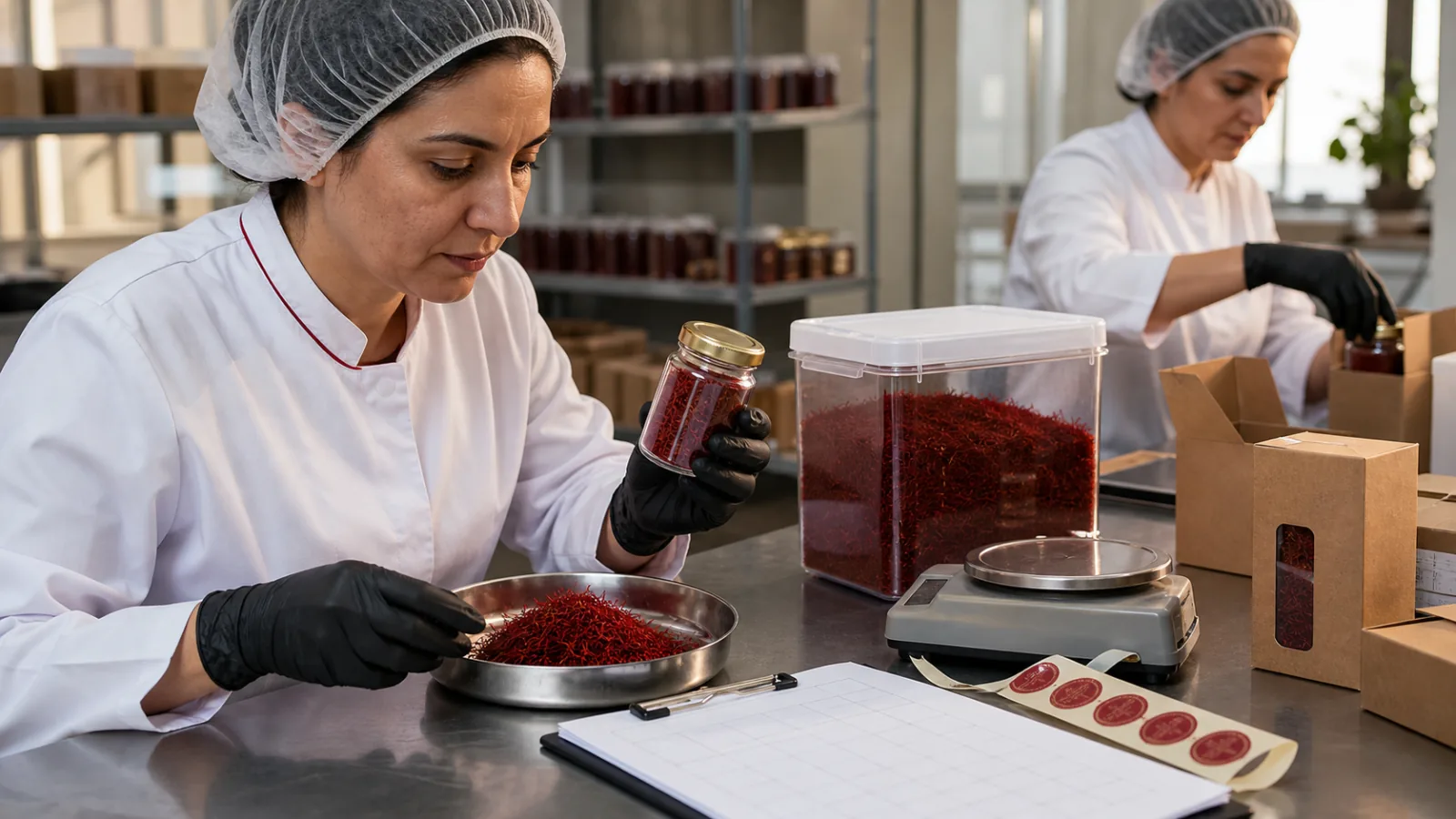
Packaging can protect saffron from moisture, contamination, crushing, light and unwanted odours. It can also carry the information a buyer needs: net weight, lot code, pack date, origin, storage conditions, responsible business and any justified test or certification claim.
Decoration alone is not value addition. An ornate box around an anonymous or weakly tested lot may increase cost while making the product harder to compare. Export packaging also has to suit the customer. A household may want a sealed one-gram pack; a food manufacturer may need a traceable bulk container that fits its receiving and sampling process.
The researchers highlighted compliance with market standards, customer preferences and package design. The practical order is protection and truth first, regulatory fit second, ease of use third, then visual expression. A beautiful package cannot repair a false origin or an inconsistent batch.
Fraud is a brand problem before it reaches the label
The study’s experts ranked fraud as the biggest export criterion. Adulteration, substituted material, artificial colour, incorrect grade and misleading origin all reduce trust. A brand that buys undocumented saffron and checks only the finished package is taking the risk too late.
Authenticity controls should begin with the supplier and lot. Records need to follow the saffron through cleaning, drying, storage, testing, blending and packing. Sampling should be representative, the test method should be named, and results should be tied to the same lot that reaches the buyer. Our consumer guide to recognizing fake saffron explains why appearance is useful but cannot prove every quality or authenticity claim.
FAO’s current work with Iran addresses this same weak point. Its saffron authenticity and post-harvest project combines advanced chemical fingerprinting with guidance for preserving quality and training across the Khorasan provinces. The programme began years after the study, so it should be seen as relevant current action, not evidence that every earlier recommendation was implemented.
Why bulk exports are not automatically the enemy
The old article criticizes saffron going to the UAE or Spain and returning to global markets after packaging. Those countries were significant destinations, but a customs destination does not show who packed a shipment, which brand it carried later or whether its origin was disclosed correctly.
Bulk trade can be legitimate. Industrial users and professional packers need larger lots. The lost opportunity arises when the seller provides an undifferentiated commodity while someone else performs the testing, customer service, market access and brand work that earns a larger margin. The answer is not to force every kilogram into tiny retail boxes. It is to choose the right format while retaining evidence, bargaining power and a fair share of the value created.
Cooperatives can help, but structure is not a guarantee
Small farms face obvious disadvantages when they buy inputs, arrange seasonal labour, test small lots or negotiate with a large exporter one by one. A well-run cooperative can pool those tasks, create viable batch sizes and improve access to storage, laboratories and buyers.
It can also fail if grades are mixed, records are weak, costs are hidden or management is not accountable to members. The study’s concern was the shortage of suitable cooperative arrangements, not a claim that any cooperative label makes the chain efficient. Clear acceptance rules, separate lot identities, audited costs and timely payment matter more than the organizational name.
Mechanization should solve a defined constraint
The researchers recommended appropriate mechanized cultivation and lower processing costs. That word “appropriate” matters. A machine should be evaluated against the task, field scale, flower condition, labour availability, hygiene and effect on the finished saffron.
Mechanizing planting, soil preparation or cleaning may improve consistency. Delicate flower collection and stigma separation can create different trade-offs. An expensive machine that damages material, sits idle or requires unavailable parts may raise costs instead of reducing them. Trials need to record throughput, losses, quality and full operating cost before broad adoption.
What a stronger Persian saffron brand would prove
A credible market identity is a system, not a slogan. It should let a buyer verify:
- where the saffron was grown and who handled it;
- which lot is inside the package and when it was harvested or packed;
- the physical form, grade basis and named test methods;
- how authenticity, cleanliness and storage were controlled;
- who accepts a complaint and how a nonconforming lot is handled; and
- whether origin, certification and quality claims mean exactly what the label says.
The 2018 study was right to put processing, export conduct and producer organization in the same frame. Persian saffron and lack of brand is not simply a packaging story. Value stays with producers and exporters when a recognizable name is backed by repeatable quality, traceability, honest origin and service that gives buyers a reason to return.

![Exporting Saffron to Turkey + Price Guide [Complete 0 to 100]](https://img.rowhanisaffron.com/20260827003933/saffron-export-turkey-quality-inspection.webp)



