


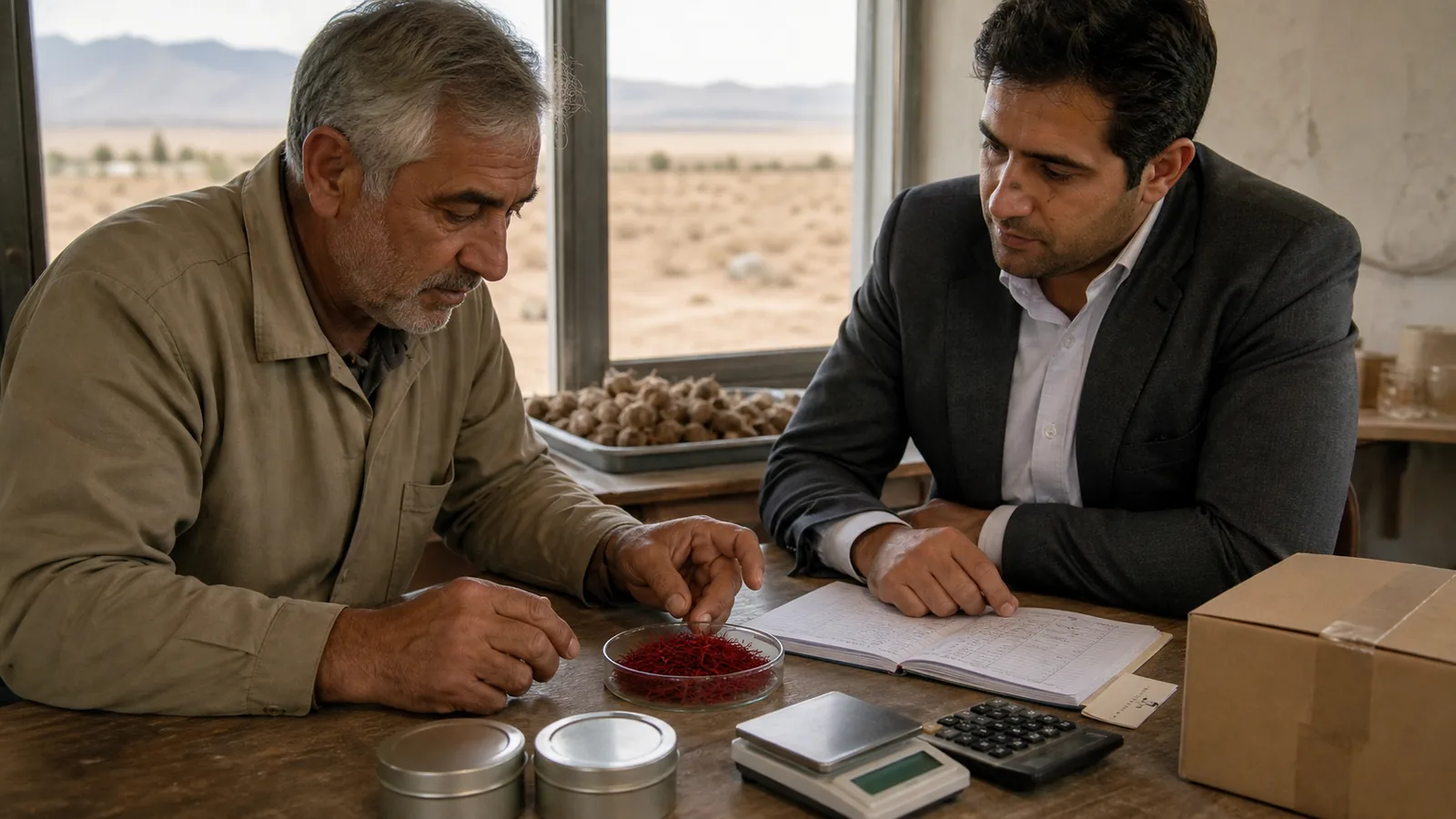
The willingness of foreign buyers to purchase Iranian saffron under other brands is not automatically a rejection of Iran’s name. Bulk supply and private label are normal parts of international food trade. The problem begins when the commercial arrangement hides or misstates origin, leaves the Iranian supplier unable to identify the final market, or returns so little value that the farmer cannot sustain the next crop.
This article began with a 2015 ISNA report quoting Mohsen Ehtesham, then identified as vice-president of Iran’s National Saffron Council. He connected the sale of Iranian saffron in the name of other countries with bulk exports, weak working capital, high production costs, loan timing and drought. Those concerns need to be separated carefully: a foreign brand, a country of packing and the agricultural origin of saffron are three different facts.
What the 2015 interview reported
Ehtesham said Iranian saffron was not sufficiently recognised in European and other overseas markets, so buyers preferred to purchase it under the name of other countries. In his account, saffron left Iran in bulk and more of the downstream benefit went to businesses elsewhere.
He attributed some of that pattern to a lack of working capital. Farmers and Iranian businesses needed cash before they could hold, pack and market the crop, which made an immediate bulk sale more likely. He also said high production costs had reduced the farmer’s return.
The interview compared agricultural credit in Iran with support said to be offered in Afghanistan. According to the report, Afghan production units could receive loans without making instalments before harvest, while an Iranian borrower had to begin repayment immediately. No loan programme, rate or contract is identified in the surviving article, so that comparison cannot be treated as a current description of either country’s finance system.
Finally, the report described production as increasingly unsettled, referring to drought, water scarcity and loss of flowers. It expected little from that season. This was a dated outlook, not a forecast for today, but water and crop risk remain important to the economics behind any export offer.
What “in the name of others” can actually mean
A foreign company can legally own the brand on a jar that contains Iranian saffron. It may have selected the lot, imported it, packed it for local retailers and taken responsibility for the final label. None of those activities changes where the crocus was grown.
There are several different situations that are too often described with the same phrase:
- an importer packs genuine Iranian saffron under its private label and states origin accurately;
- an Iranian packer produces a buyer’s private-label jars before export;
- a distributor sells an Iranian-owned brand in another country;
- a trader re-exports a traceable Iranian lot after storage or repacking;
- a seller makes a false or misleading claim about where the saffron was grown.
The first four can be legitimate commercial models. The last is an integrity problem. Exact origin and food-labelling rules differ by destination, so the importer must verify the final artwork and declaration for that market. Repacking, blending or owning the trademark should never be used as shorthand for a different agricultural origin.
Our guide to Iranian saffron under foreign brands explains those brand and packing structures in detail. The concern here is earlier in the chain: why limited finance can push a grower or processor into a sale that gives up visibility and negotiating power.
Why working capital changes the type of sale
Saffron income is seasonal, while costs arrive before and during the harvest. Growers pay for field work, irrigation, flower picking and rapid separation of the stigmas. Processors then need cash to buy material, dry or condition it correctly, sort it, test it, hold inventory and prepare an order.
If money is due immediately, waiting for a better-specified buyer may not be possible. A farmer can accept the first workable farm-gate offer. A processor can sell a large unbranded lot instead of financing months of inventory and a retail-pack launch. The buyer who has storage, market access and cheaper capital then takes on the later work and may keep the final customer relationship.
That outcome is not proof that bulk trade is exploitative. Bulk buyers provide liquidity and can carry genuine price, quality and sales risk. The question is whether the Iranian seller chose the channel because it offered the best risk-adjusted return or because cash pressure removed every other choice.
A 2014 UNIDO diagnostic of Iran’s saffron value chain described fragmented relationships, weak market organisation and difficulty connecting small suppliers with leading firms. Its analysis supports a broader point: producing more saffron does not by itself create durable access to the businesses that control distribution and customer demand.
Finance should follow the crop cycle
A useful finance arrangement recognises when the crop can generate cash. That does not mean every instalment should always wait until harvest or that lending is risk-free. It means repayment dates, grace periods and collateral need to match the actual use of funds and the expected sale.
Different needs call for different structures. A grower may need seasonal input and harvest finance. A processor may need short-term purchasing and inventory finance. An exporter may need funds against a confirmed order, receivable or insured shipment. A packaging project needs a budget for artwork, materials, regulatory work and stock that may sell gradually rather than all at once.
Buyer advances can help, but they change bargaining power. The contract should state whether the money secures a particular quantity, lot, price formula or delivery window. It should also explain what happens if weather reduces output or the agreed lot fails a test. An advance that leaves every risk with the supplier is not necessarily better than a transparent loan.
Cooperatives and producer groups can pool saleable volume or services, yet they still need governance, records and a real buyer. A new organisation is not a financing solution by itself. Members should know who owns the inventory, who can agree a price, how quality differences are valued and when payment reaches each grower.
Farmer profitability cannot be inferred from the retail price
Saffron may sell for a high price per kilogram, but very little dried stigma comes from a large number of hand-picked flowers. Farm return depends on yield and saleable quality as well as the costs of corms, labour, water, land, finance and post-harvest handling.
A foreign retail price sits at the far end of another cost structure. It can include testing, packaging, freight, duties, importer and distributor margins, store costs, marketing, unsold inventory and tax. Subtracting the farm-gate price from the shelf price and calling the difference “profit” ignores those steps.
A better review follows one kilogram or one defined lot through the chain. Record what the farmer received, what was lost during cleaning and grading, what processing and tests cost, how long the stock was financed, what the exporter earned and what the destination business added. Only then can the participants see where avoidable loss or excessive bargaining power may exist.
Water scarcity is a production and finance risk
Saffron is often described as suitable for dry regions, but that does not mean yield is independent of water. The 2015 interview’s references to drought, flower loss and worsening water scarcity should therefore not be dismissed as mere rhetoric.
A three-year field study in the arid climate of Qaen compared basin, furrow, drip and sprinkler irrigation and measured effects on saffron stigma yield, quality and water-use efficiency. The peer-reviewed irrigation study found that management method mattered. Its result does not supply a universal schedule for every Iranian field; soil, salinity, rainfall, field age and local water quality still have to be considered.
For a finance decision, the important point is uncertainty. A repayment plan based on one optimistic yield can fail after water stress or flower loss. Lenders, buyers and producers need realistic yield ranges, documented field conditions and a clear rule for what happens when the harvested amount is below the contracted quantity.
How to keep Iranian origin visible without forcing one model
Not every exporter needs to build a consumer brand in every country. That route requires trademark work, labels, local distribution, promotion and enough stock to support repeat sales. A well-run bulk or private-label contract can still preserve Iranian origin and give the supplier a fair return.
The protection begins with the lot. Keep records linking the received saffron to the grower or documented region, processing steps, sample, laboratory result, package and shipment. The purchase agreement should state the declared origin, permitted claims, responsibility for final artwork and whether the buyer may blend the lot with another origin.
If a protected geographical name is used, the product must genuinely qualify. WIPO’s Lisbon register records Ghayenat saffron as appellation of origin 1118; that registration is not permission to apply the name to saffron from elsewhere in Iran. Regional identity is valuable only when it is accurate and supported.
An exporter can also negotiate how origin appears on a private-label pack, website or product file. A statement such as “saffron of Iranian origin” can coexist with a foreign trademark when the destination rules and facts allow it. The agreement should prevent the buyer from inventing a farm, harvest date, certification or place.
A practical contract review before a bulk sale
Before accepting a sale made under another company’s name, the supplier should settle:
- the lot, grade, form, net weight and objective acceptance criteria;
- the price basis, payment date, currency and finance cost;
- the agricultural origin and evidence that will travel with the lot;
- who owns the brand and approves the final label and claims;
- whether repacking, blending or re-export is expected;
- which party pays for tests, packaging, freight, clearance and a rejected lot;
- what information the exporter will receive about complaints and repeat demand.
The file should connect the contract, sample, invoice, packing list, origin evidence, test report and final package. A generic certificate or a photograph of attractive saffron does not provide lot-level traceability.
What a better outcome looks like
Success is not simply replacing every foreign brand with an Iranian one. It is giving growers and processors enough options to choose the right channel, keeping origin truthful, and retaining a reasonable share of value for the work and risk carried in Iran.
Useful measures include the farmer’s net return, time from harvest to payment, financing cost, share of lots sold with traceable origin, repeat-buyer rate, claims and rejections, destination concentration and value retained after packing and export costs. Those figures show more than a retail price or total export weight.
The old interview joined branding, credit and drought because they meet at the moment of sale. When water or yield is uncertain and repayment begins too early, the seller has less ability to wait, specify and negotiate. Better finance cannot make rain fall, and branding cannot correct a weak lot. Together with sound production, traceability and a fair contract, however, they can help Iranian saffron reach a foreign shelf without losing the truth of where it came from.
The working-capital, profitability, Afghan-loan, drought, flower-loss and seasonal-outlook statements are retained as claims from the site’s 2015 ISNA report. UNIDO, WIPO and irrigation research were reviewed on 29 August 2026; no historical loan programme or crop forecast is represented as current.

![Exporting Saffron to Turkey + Price Guide [Complete 0 to 100]](https://img.rowhanisaffron.com/20260827003933/saffron-export-turkey-quality-inspection.webp)



