


The 2019 warning behind “The threat of exiting immigration is waiting for saffron” was about saffron corms leaving Iran and production expanding elsewhere. It did not predict a saffron shortage. In fact, the speaker feared the opposite: Khorasan might produce more saffron than domestic and export demand could absorb, pushing prices lower unless markets developed.
What Ali Hosseini warned about in 2019
Ali Hosseini, identified as a member of Iran’s National Saffron Council, combined two concerns. The first was a possible supply-and-demand imbalance as cultivation expanded in Khorasan Razavi and South Khorasan. The second was the movement of planting corms to neighbouring countries, which he saw as a threat to Iran’s competitive position.
The title’s “exiting immigration” is damaged translation. It refers to outward movement or migration of the crop through its corms, not to people leaving and not to saffron disappearing from the world.
Was the article predicting a saffron shortage?
No. The article cited an estimate of roughly 350 tonnes of annual world consumption and up to 60 tonnes within Iran, while describing about 400 tonnes of potential output from the two Khorasan provinces. Those estimates pointed to surplus risk and weak prices, not a global shortage.
A saffron shortage can still occur in a particular grade, origin, delivery month or market. Weather, a weak crop, logistics and inventory can tighten availability temporarily. But this 2019 report supplied no stock survey, current order book or later harvest result that proved a shortage. Its visible concern was how to sell a large expected crop.
How the 400-tonne forecast was calculated
Hosseini said the Ministry of Agriculture recorded about 100,000 hectares of saffron in Khorasan Razavi and South Khorasan. He applied an expected yield of four kilograms per hectare. The arithmetic is:
100,000 hectares × 4 kilograms per hectare = 400,000 kilograms, or 400 tonnes.
That gives exactly 400 tonnes, not “more than 400 tonnes” as the old English stated. Output would exceed it only if the area or average yield exceeded those assumptions. Planted area is not the same as productive harvested area, and yields vary with field age, corm density, water, soil, weather, disease and management. The calculation was a planning scenario rather than a measured crop total.
Why the speaker expected price pressure
The report said saffron prices had fallen and traders were waiting for the new harvest and new export requests. It placed the main harvest in November and described the outlook as hard to predict until orders appeared. Hosseini said historical exports had been about 200–230 tonnes a year but argued that the sector should prepare to market as much as 400 tonnes.
Domestic consumption of 60 tonnes, annual exports of 200–230 tonnes and potential production of 400 tonnes were all his estimates. They do not share a documented year or method, so subtracting them cannot produce a reliable inventory figure. Carry-over stock, informal trade, processing loss and different crop periods would also matter.
What the five-month export figures mean
The original translation says “68 tons and 640 thousand kilograms,” which is internally impossible. Read as a conventional mixed unit, the reported quantity was 68 tonnes and 640 kilograms. It paired that with an export value of $92.623 million, 54 destination countries, and year-on-year increases of 26.48% by weight and 16.22% by value during the first five months of the stated year.
Those are historical customs figures reproduced by the article; the source table is not embedded. For a full-year cross-check, the WITS presentation of UN Comtrade data records Iran’s 2019 saffron exports at 282,996 kg and about $297.2 million. The different periods should not be compared as if they were competing totals.
Why corms matter more than seed
Cultivated saffron, Crocus sativus, is a sterile triploid. It does not reproduce through ordinary viable seed; growers multiply it vegetatively by dividing and planting replacement corms. A 2019 genome-wide study of saffron’s origin describes the crop as a male-sterile triploid lineage propagated vegetatively since its origin.
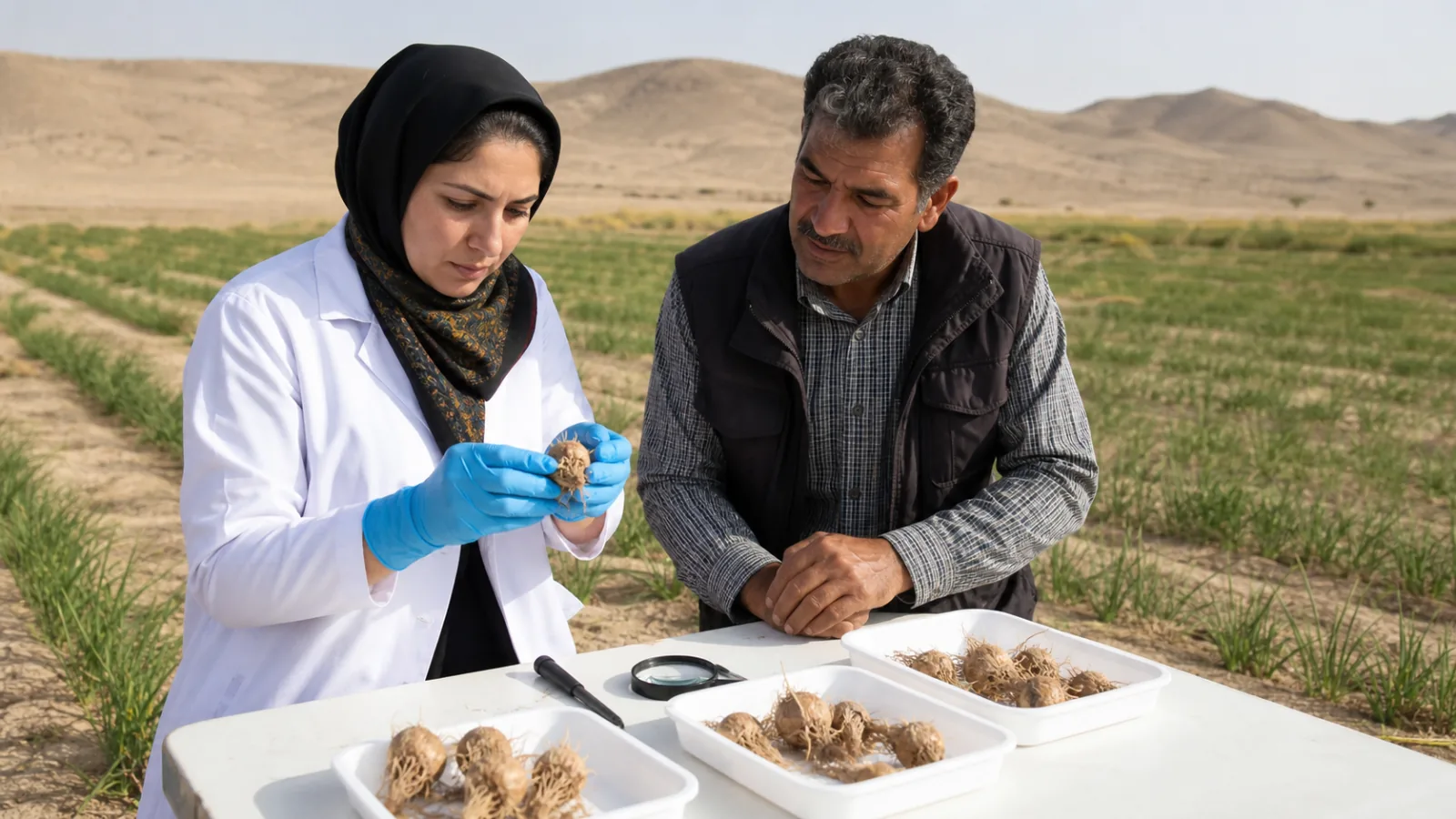
That makes healthy corm stocks commercially important. Establishing a mature field takes time, and a grower cannot replace a lost planting in the same way as sowing an annual cereal. Hosseini’s comparison with wheat was directionally useful on that point.
Corm movement is not botanical extinction
The old article says smuggling corms could cause saffron’s “extinction.” Corms leaving Iran do not make the species extinct. The credible risks are different: unauthorized removal of valuable planting material, erosion of a competitive advantage, depletion of healthy local stock, loss of traceability and movement of pests or pathogens.
Plants for planting receive special phytosanitary attention because they can carry organisms into a new production system. The International Plant Protection Convention’s adopted standards include ISPM 36 on integrated measures for plants for planting in international trade. The exact lawful requirements depend on the exporting and importing authorities.
Our detailed review of saffron corm movement to Afghanistan explains why legality, plant health and evidence must be kept separate from a general fear of foreign cultivation.
Neighbouring producers are competitors, not proof of wrongdoing
Hosseini named Armenia, Tajikistan and Afghanistan as countries capable of growing saffron. A country developing its own crop is not by itself evidence that Iranian corms were smuggled there. Such a claim would require a documented shipment, genetic or traceability evidence, and the applicable law.
He also gave a broad story in which Iran overtook Spain through greater quantity, quality and a more competitive price, then Spain transferred corms to Morocco and struggled to rebuild its fields. The article provides no production series, business records or corm-transfer documentation for that chain. It should be read as the speaker’s market narrative, not established history.
Why doubling yield is not an easy promise
The speaker argued that Iran should stop relying on expansion of cultivated area and raise output per hectare instead. He suggested the four-kilogram figure could be doubled through farm measures. Improving existing fields can be more sustainable than unplanned expansion, but no single intervention reliably doubles every farm.
A credible yield programme has to begin with representative measurements. Field age, healthy corm size and density, irrigation timing, drainage, nutrition, weeds, rodents, disease, flower collection and drying all affect the result. An eight-kilogram target may be realistic for one field and unrealistic for another. Higher stigma yield also has little value if quality falls or the market cannot absorb it.
What planning for target markets requires
“Marketing” cannot mean producing first and searching for a buyer after harvest. Before expanding output, farms, processors and exporters need to know which physical forms, pack sizes, test specifications, origin records and delivery terms target customers will accept. Forecasts should distinguish retail packs from wholesale lots and identify whether the buyer needs a recurring programme or a single shipment.
Production planning also needs inventory. Carry-over saffron by crop year, grade and storage condition affects the market just as much as the coming flower estimate. A shortage headline based only on this year’s field output can be wrong when warehouses are full; a surplus headline can be wrong when saleable grades are scarce.
The useful conclusion from the warning
The 2019 article raised a legitimate strategic issue: Iran’s production strength does not guarantee a stable price or permanent market leadership. Healthy corm supply, lawful plant movement, productivity, verified quality and customer development all matter.
Its language was too absolute. Foreign cultivation does not mean Iranian saffron will become extinct, a 400-tonne multiplication is not a harvest result, and the report was not evidence of a saffron shortage. The durable lesson is to measure productive area and inventory honestly, protect plant health, improve fields where evidence supports it, and build demand before extra supply reaches the market.

![Exporting Saffron to Turkey + Price Guide [Complete 0 to 100]](https://img.rowhanisaffron.com/20260827003933/saffron-export-turkey-quality-inspection.webp)



