


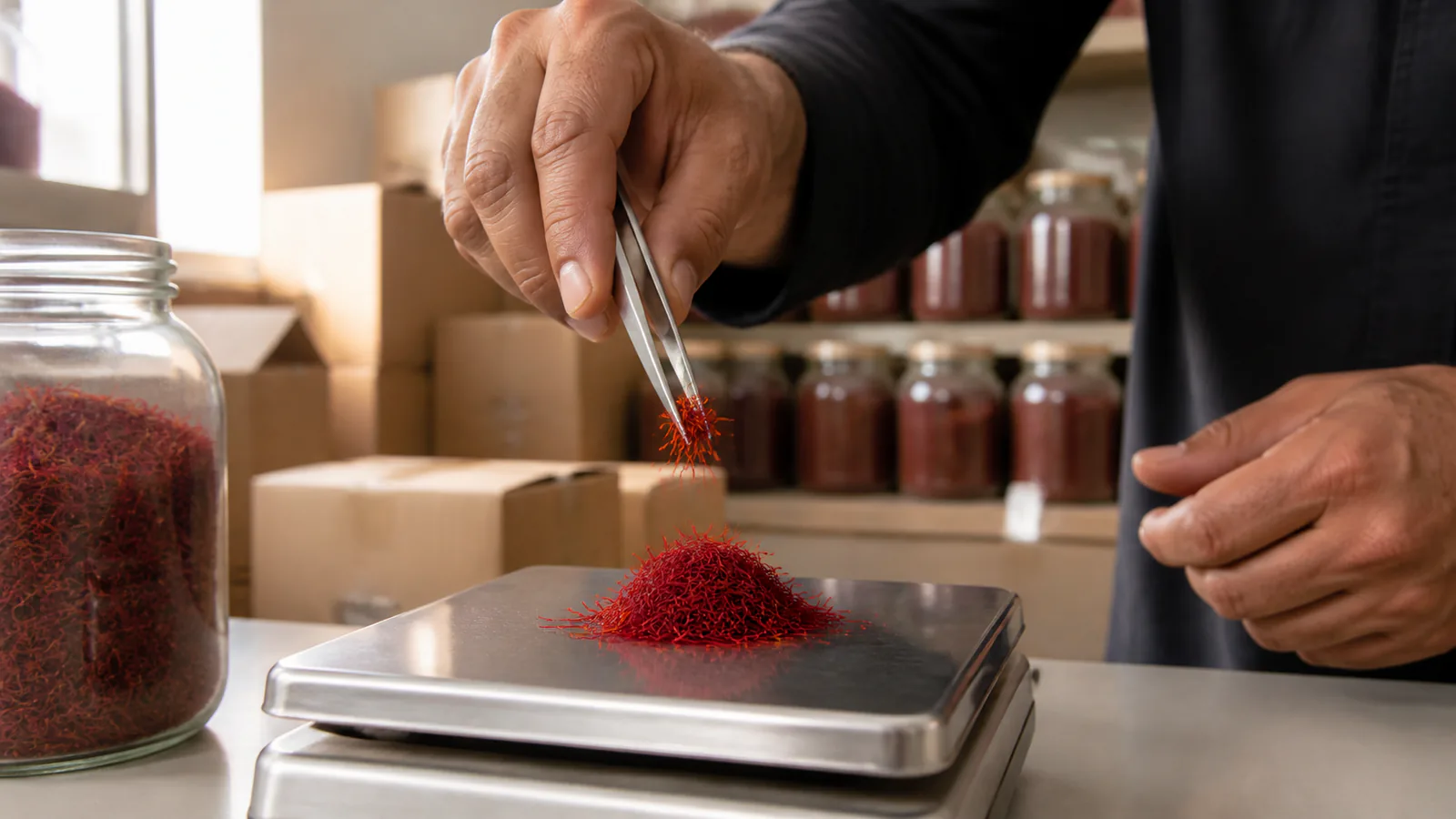
The reported Iranian saffron price per kilo ranged from 6 million to 10 million tomans during the early COVID-19 market disruption. That is the period described here, not a quotation for saffron today. In the same set of contemporary reports, an industry representative said weaker export and domestic demand had reduced the price by roughly 1 million tomans per kilogram over two months.
Those figures make more sense when read as a snapshot of an unusually quiet market. Border disruption, store closures and uncertainty interrupted the normal path from Iranian farms to overseas buyers. Growers and exporters were left with more saffron in storage while buyers delayed or cancelled purchases.
What the 6–10 million toman price meant
Ali Hosseini, identified in the original reports as a member of Iran’s National Saffron Council or National Saffron Association, placed the lowest price near 6 million tomans and the highest near 10 million tomans per kilogram. The spread was important: saffron does not have one uniform wholesale price. Grade, colour strength, cut, cleanliness, packaging, order size and the terms of a sale can all change the price.
Hosseini also reported a decline of about 1 million tomans per kilogram compared with the previous two months. That statement described movement in the Iranian bulk market at the time. It should not be converted into a current retail price or compared directly with a small consumer pack without accounting for inflation, exchange rates, quality and packaging.
Readers looking for present-day buying information should use a dated quotation and compare the same grade and quantity. Our saffron price page is the better starting point for current offers; this article preserves the historical market record.
Why demand fell so sharply
Iranian saffron depends heavily on export demand. The reports said overseas saffron shipments had effectively stopped for two months, while demand inside Iran had also declined. Some product intended for export remained in warehouses, putting additional pressure on sellers who needed cash flow.
The saffron account sits within a much larger trade shock. UN Trade and Development estimated that global merchandise trade would fall 5.6% in 2020 and described the pandemic as a major disruption to international commerce. That broader evidence supports the direction of the report, although it does not independently verify the exact Iranian price or the claim of a complete two-month export halt. Those details remain attributed to Hosseini’s contemporary assessment.
UNCTAD’s 2020 trade assessment provides the international context.
Ramadan demand did not provide its usual lift
In a normal year, Hosseini said, buyers in neighbouring markets often increased orders between 20 days and one month before Ramadan. In the conditions described by the report, inactive borders and widespread restrictions made that seasonal pattern unreliable. He therefore did not expect a significant Ramadan-driven price movement.
This point helps explain why the market could remain weak even though saffron is closely associated with festive food and hospitality. Seasonal demand matters only when buyers can place orders, transport is available and distributors are confident they can sell the stock.
More production was expected while stock accumulated
The second report added a difficult supply-side detail. Recent rain and a larger or more productive cultivated area were expected to support a bigger crop. At the same time, saffron from the previous selling period was already being held in storage. More incoming supply alongside weak demand could prolong downward price pressure.
Storage does not automatically ruin saffron, but conditions matter. Light, moisture, heat and air exposure can reduce aroma, colour and commercial quality. Producers holding stock therefore faced more than a delayed payment: poor storage or an extended wait could also reduce the value of the product.
Why the shock mattered beyond one season
Iran’s importance to the sector magnified the disruption. The UN Food and Agriculture Organization describes Iran as the world’s leading saffron producer and estimated its share at 85–90% in a 2025 value-chain update. Saffron also supports many smallholder livelihoods in Khorasan Razavi and South Khorasan.
FAO’s saffron value-chain update also stresses authenticity, quality assurance and stronger value-chain governance. These are long-term concerns, but they illuminate the 2020 problem: when a trade channel stalls, growers, processors and exporters all need reliable storage, transparent quality controls and diversified routes to market.
What government support meant in the original report
Hosseini called for government support for producers and exporters who had suffered losses. The report did not set out a specific policy. In practical terms, possible support could have involved export facilitation, financing, market access or help with properly managed storage. It would be inaccurate to treat that appeal as proof that any particular programme was adopted.
The report also expected business to recover after the immediate crisis. That was a forecast made in an uncertain moment, not a guaranteed timetable. A historical article should preserve the uncertainty rather than silently replacing it with hindsight.
How to interpret this saffron price per kilo today
The 6–10 million toman range and the reported 1-million-toman decline answer a specific question: what did one Iranian industry representative say about bulk saffron prices during the early COVID-19 disruption? They do not establish today’s global saffron price.
For a useful comparison, check the date, currency, unit, saffron grade, wholesale or retail status, packaging and delivery terms. Without those details, two prices that look very different may not refer to the same product at all.
This episode shows how quickly saffron prices can respond when export access, seasonal purchasing and domestic demand weaken together. It also explains why a quoted saffron price per kilo needs context: the number is only meaningful when the market, date and product quality are clear.

![Exporting Saffron to Turkey + Price Guide [Complete 0 to 100]](https://img.rowhanisaffron.com/20260827003933/saffron-export-turkey-quality-inspection.webp)



