


The area under saffron cultivation in Kermanshah reaches 470 hectares was announced as a 2020 expansion target, rising from a reported 305 hectares at the end of the previous year.
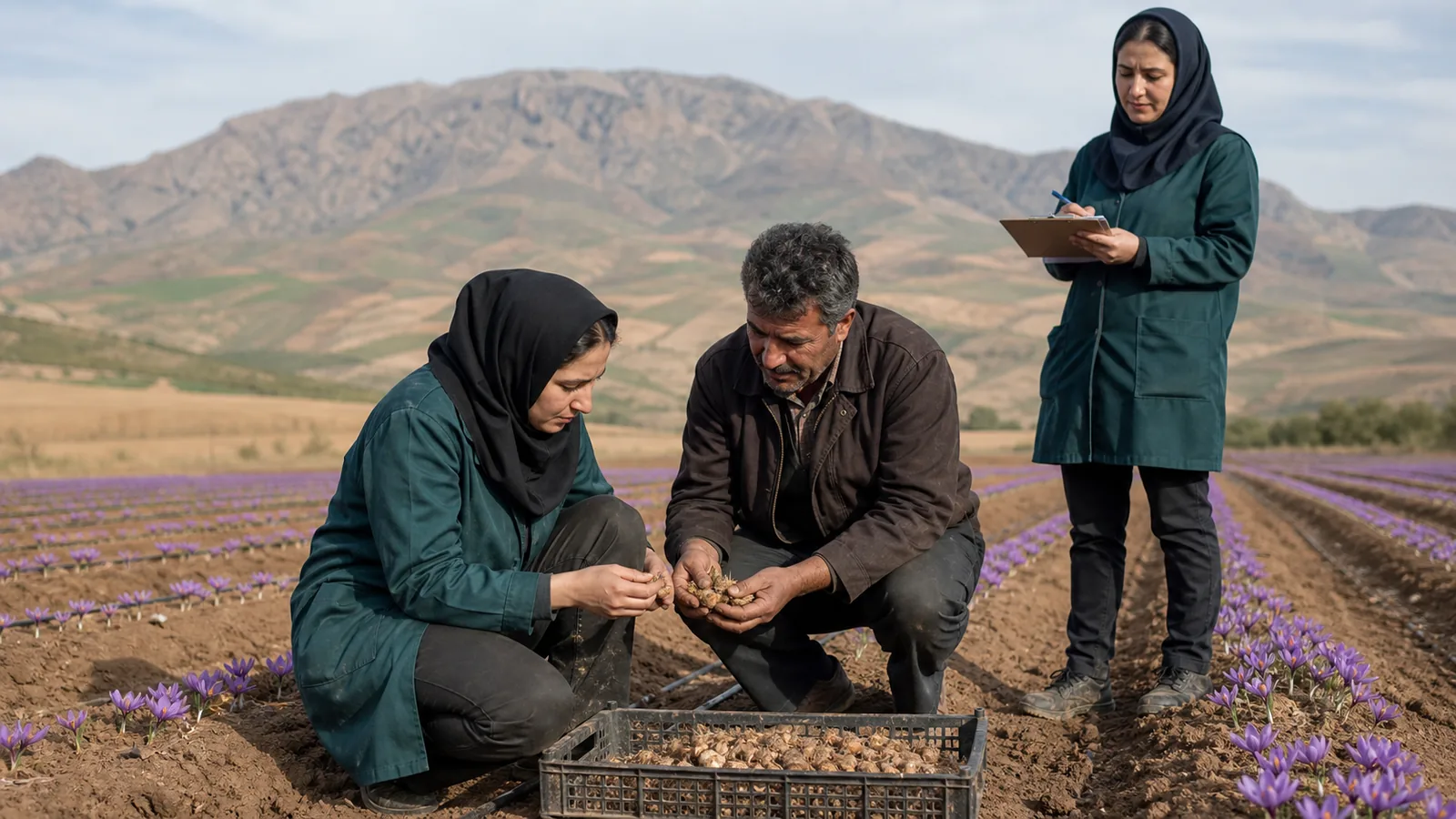
Dr Seyed Afshin Safavi, deputy for plant-production improvement at Kermanshah’s Agricultural Jihad organization, described the target alongside the province’s planting window, supply of healthy saffron corms and support available to growers. The figures belong to that announcement and are not a current acreage count.
From 305 to about 470 hectares
Safavi said 305 hectares of land in Kermanshah Province had been planted with saffron by the end of the preceding year. The area was expected to reach about 470 hectares during the year covered by the report.
The difference between those figures is approximately 165 hectares. Because 470 hectares was presented as an expectation, the announcement does not by itself confirm that all of the additional area was planted.
Where saffron cultivation was considered suitable
According to Safavi, saffron could be cultivated across the province except in its tropical areas. His statement framed the crop as suitable for a broad range of Kermanshah’s cooler locations rather than every site without qualification.
He said planting was under way and farmers had until the second half of September to establish the crop. That timing is retained as guidance reported for the local programme in 2020, not as a universal planting date for every climate or season.
Irrigated land and support for expansion
Safavi identified irrigated agricultural land as the condition for joining the programme and said there was no administrative restriction on developing saffron cultivation in the province. In context, this meant eligible applicants could seek support; it did not remove the need to assess soil, water, field history and local climate.
Applicants were also offered saffron planting material at half price. The original translation called these “onions,” but saffron is established from corms, the underground structures from which the plant grows.
How Kermanshah sourced saffron corms
The programme placed particular emphasis on clean, high-quality planting material. Safavi said provincial experts had visited saffron farms in South Khorasan, North Khorasan and Razavi Khorasan before bringing selected corms to Kermanshah.
He described the chosen material as free from corm pests. This was part of the province’s quality plan: expansion was not only about adding hectares, but also about starting new fields with healthier stock.
Quality claims for Kermanshah saffron
Safavi said laboratory evaluations placed saffron produced in Kermanshah among the higher-quality types and that it could compete with Khorasan saffron. The article did not publish the laboratory results, test method or measured values, so the statement remains attributed to him rather than presented as an independently verified comparison.
That distinction preserves the original claim without making it broader than the evidence supplied in the report.
The reported harvest season
Saffron harvesting in Kermanshah was said to begin in the first ten days of November and continue for about a month. A month-long provincial window is plausible as fields differ in altitude and temperature, but individual farms may flower earlier or later.
For growers, the practical meaning is that a province-wide harvest is a sequence rather than a single date. Flowers must still be collected promptly when they open, and the stigmas separated and dried without unnecessary delay.
What the 470-hectare figure represents
- 305 hectares: the saffron area reported at the end of the preceding year.
- About 470 hectares: the area expected during the year of the announcement.
- About 165 hectares: the implied planned increase between those two figures.
- Second half of September: the reported end of the local planting opportunity.
- First ten days of November: the reported start of a harvest period lasting roughly one month.
A dated record of Kermanshah’s saffron plan
The report captures how Kermanshah officials intended to expand saffron cultivation: more eligible irrigated land, subsidized corms, attention to pest-free planting material and a defined seasonal calendar.
Its central number should be read carefully. The province had reported 305 hectares; 470 hectares was the target expected next, not proof of the final area later achieved.

![Exporting Saffron to Turkey + Price Guide [Complete 0 to 100]](https://img.rowhanisaffron.com/20260827003933/saffron-export-turkey-quality-inspection.webp)



