


An early Khorasan plan argued that supplying saffron through the stock market could improve price transparency, quality assurance and confidence for growers and buyers.
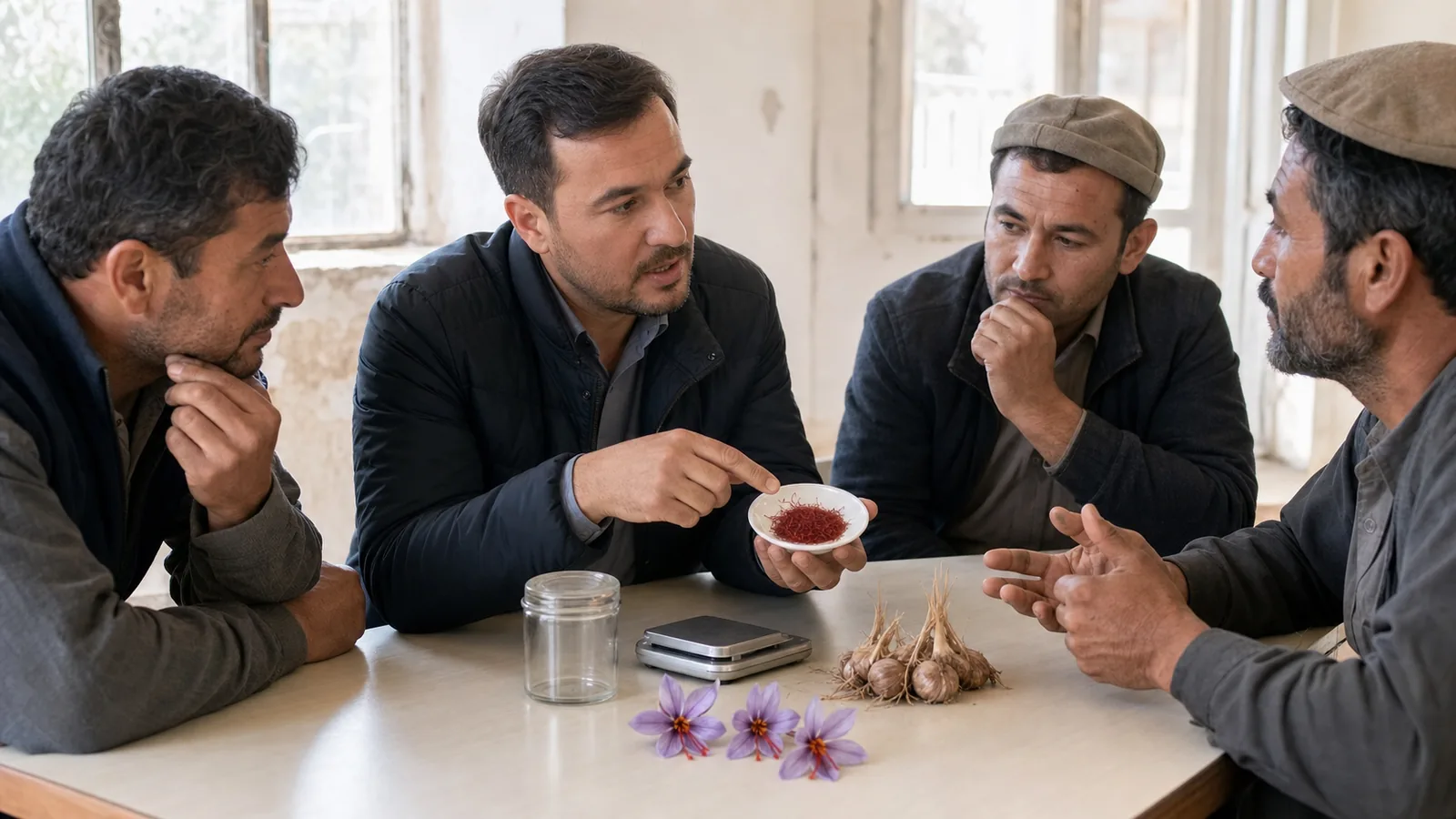
More precisely, the proposal concerned Iran’s commodity exchange rather than shares in an ordinary equity market. Mohammad Reza Ghodsi, then horticulture director at the Khorasan Razavi Agricultural Jihad Organization, presented exchange trading as one part of a wider effort involving standards, farmer education and village-level production support.
What the saffron exchange was expected to solve
Ghodsi identified four expected advantages: clearer prices, quality-based supply, greater assurance for buyers and producers, and less market power for unnecessary intermediaries. The exchange had announced that it was ready to accept saffron under special conditions, but producer participation remained low.
The title says the stock market “solves” red-gold problems. That was the official’s ambition, not a demonstrated result. A trading venue can make offers and completed transactions more visible, while accepted warehouses and specifications can define the product behind a sale. It cannot by itself improve a poorly handled crop, give every farmer working capital or create export demand.
Why 5, 10 and 15 kg consignments were considered small
In the preceding year, limited quantities had been offered in consignments of 5, 10 and 15 kg. Ghodsi regarded that participation as too small compared with the amount of saffron produced in Khorasan Razavi.
The challenge was not simply the physical size of a lot. Farmers and local sellers had to understand how acceptance, grading, storage, brokerage, sale and settlement worked. If the process appeared unfamiliar or more difficult than an immediate farm-gate sale, low uptake was predictable.
A proposed financial concession or incentive for exchange supply did not proceed because funding was unavailable. The archived article does not define the concession, its value or who would have qualified, so those details cannot be reconstructed.
Meetings with farmers and the quality requirement
To build familiarity, officials planned meetings with farmers in different cities. Exchange brokers were to explain the trading process and answer producers’ questions.
Ghodsi also stressed that saffron offered through the market had to meet the required quality standard, and said arrangements were being made for that purpose. This condition protects the meaning of a standardised lot: buyers need confidence that the grade and quantity named in a contract correspond to the product available for delivery.
Quality cannot be added at the final transaction. It begins with sound corms and field management, then depends on prompt flower collection, clean stigma separation, controlled drying and suitable storage. Exchange acceptance is a checkpoint in that chain, not a substitute for it.
The four-year UNIDO saffron project
The market plan sat beside a joint saffron project involving the provincial Agricultural Jihad Organization, Bank Keshavarzi—also translated as Agricultural Bank—and the United Nations Industrial Development Organization (UNIDO).
Ghodsi described it as a four-year, $2 million programme for sustainable agriculture, saffron education and reducing pressure for villagers to leave rural areas. In the year covered by the report, 17 experts were working across 13 cities. Farmers received instruction in planting, crop maintenance and harvesting.
The experts also gathered climatic, geographical and demographic information for the agricultural organisation. That data collection mattered because a useful training programme has to reflect differences between districts rather than assume one field method fits all of Khorasan.
Later official documentation records the value-chain programme at $1.9 million, close to the rounded $2 million stated in the interview. UNIDO’s Iran country programme for 2017–21 names Bank of Agriculture as the partner and lists three intended outcomes: improved saffron production, better processing and packaging technology, and a larger direct share for Iranian small and medium-sized businesses in the global market.
Training was about more than exchange trading
The UNIDO work addressed the production and value chain, not only the commodity exchange. An official UNIDO procurement notice for saffron-industry training set objectives of increasing export volume and value, raising stakeholder income, improving yield per hectare, enhancing processing and packaging, and increasing the direct global-market share of Iranian businesses.
The old report says the Agricultural Jihad Organization had cooperated with UNIDO since 1992 and expected the saffron project to expand in later years. It does not identify the earlier programmes behind that date, so the statement is retained as Ghodsi’s institutional history rather than independently extended.
What would make exchange supply useful to growers?
The plan needed several parts to work together:
- clear product specifications and credible quality checks;
- accepted storage and a practical route from village to market;
- plain-language training on costs, brokerage, sale and settlement;
- enough buyers and sellers for meaningful price discovery; and
- farm and post-harvest practices capable of producing the required grade.
Under those conditions, commodity-exchange supply could help with some red-gold problems. It could not settle every question of farmer finance, export branding or rural development on its own. The enduring value of Ghodsi’s proposal is that it connected the market mechanism to quality infrastructure and hands-on support for producers rather than treating a listing as the entire solution.

![Exporting Saffron to Turkey + Price Guide [Complete 0 to 100]](https://img.rowhanisaffron.com/20260827003933/saffron-export-turkey-quality-inspection.webp)



