


Standardizing onion and flower saffron for Iranian saffron means creating a consistent system from planting corm to dried stigma. “Onion” is a mistranslation: saffron is planted from a corm, not an onion bulb. A corm standard, a flower-handling protocol, a dried-spice specification and a reliable statistics system solve different problems and should not be collapsed into one grade.
The Ferdowsi University panel behind the headline
The original report quoted Professor Alireza Koocheki of the Faculty of Agriculture at Ferdowsi University of Mashhad. He spoke at a panel whose translated title was “With Iranian Saffron in World Arenas.” His central complaint was not that Iran lacked saffron expertise; it was that the sector lacked a shared order, statistical system and basis for decisions.
Koocheki referred to the Fifth International Symposium on Saffron Biology and Technology in Morocco. He reported 74 participants from 15 countries, with Iran’s 25 participants forming the largest national delegation. The International Society for Horticultural Science records that symposium in Agadir, Morocco, on 10–13 November 2015.
A future symposium plan that did not occur as stated
The speaker said the next symposium would be held in Iran in 2018 and proposed stronger participation from medical and pharmacy faculties because health was part of the theme. That was a forward-looking statement at the time.
The eventual Sixth International Symposium on Saffron Biology and Technology formed part of the 2018 International Horticultural Congress in Istanbul, Turkey, on 12–16 August. The old statement should therefore remain a proposal, not be rewritten as an event that took place in Iran.
Health research also needs precise product identity. A study using a measured extract cannot justify a claim about every culinary thread, tea or supplement. Standardization helps researchers describe what they tested; it does not turn an experimental result into a treatment promise.
Iranian scale is not botanical exclusivity
Koocheki said the farms seen in Iran had no equivalent elsewhere and concluded that saffron was “definitely an Iranian product.” His point reflected Iran’s production scale, landscape and accumulated farming knowledge. It should not be read as a botanical claim that saffron grows nowhere else.
Saffron is cultivated in several countries. A 2019 genome-wide study of the crop’s origin traced cultivated Crocus sativus to an autotriploid lineage derived from wild Crocus cartwrightianus near Attica, Greece. Iran’s agricultural heritage and present production leadership remain substantial; heritage, genetic origin and exclusive ownership are different questions.
Why the old production numbers did not agree
The panel noted that different totals for Iran’s saffron area and output were circulating, including at the international symposium. Koocheki cited a Ministry of Agricultural Jihad announcement of 350 tonnes produced in the previous year, but the report did not identify the crop year, source table or whether that number was preliminary.
He described Iran as a “desert of statistics” and argued that the absence of order, a system and shared records held the sector back. The criticism matters because two figures can both sound official while measuring different things: planted versus productive hectares, flowers versus dried stigmas, forecast versus final harvest, or calendar year versus crop year.
Our maintained saffron production statistics guide keeps those definitions and dates visible rather than forcing unlike numbers into one trend.
Layer one: a standard for saffron corms
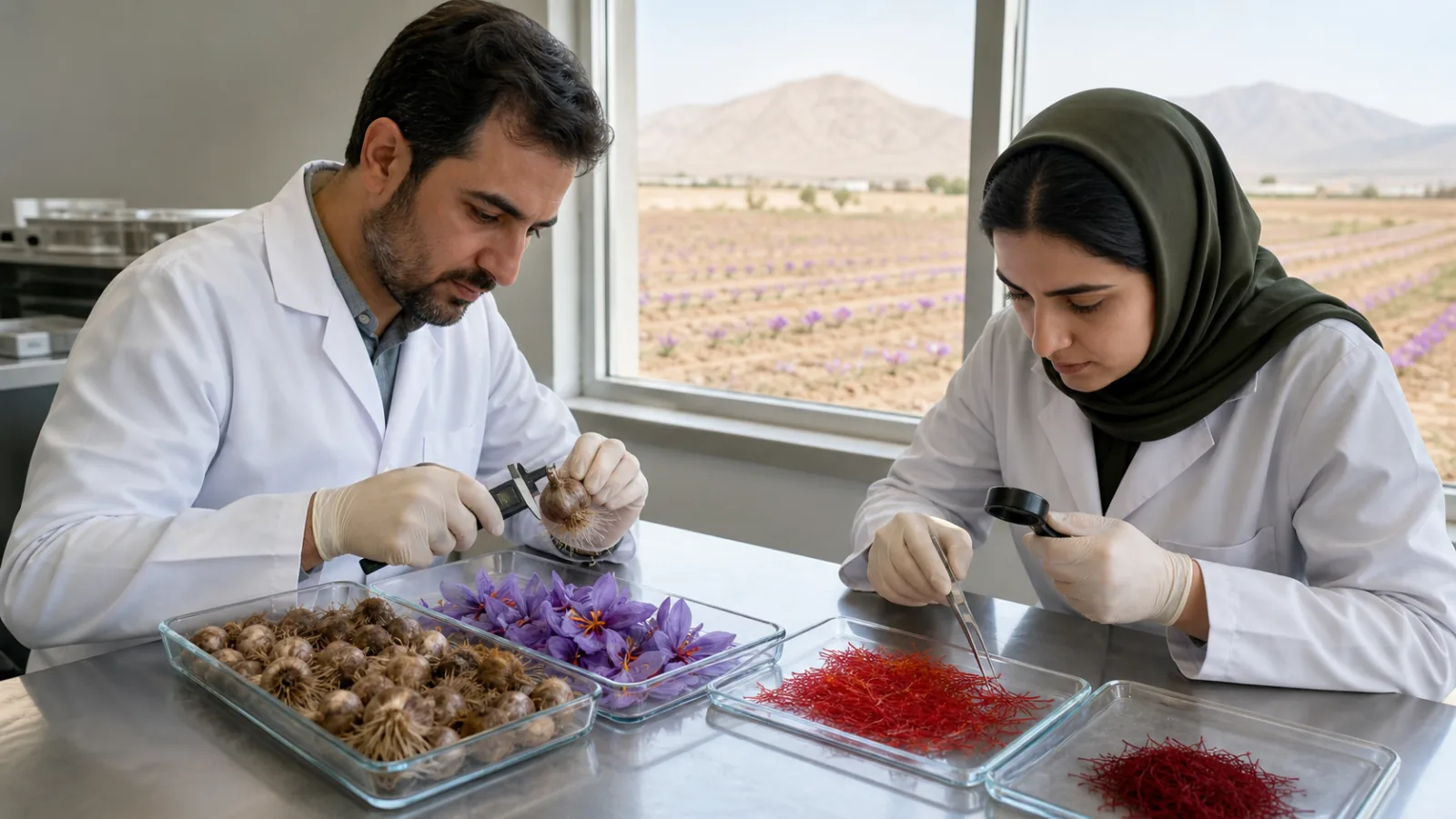
A saffron corm lot should be described in terms useful for planting and plant health. Records may include botanical identity, source field, harvest date, lot number, size distribution, visible injury, rot symptoms, treatment history and storage conditions. Where corms move between regions or countries, applicable phytosanitary requirements also matter.
Size can influence establishment and flowering potential, but a single weight threshold cannot describe every climate, planting density and production goal. A standard should define how corms are sampled, measured and categorized. It should not promise a yield from appearance alone.
The word onion creates avoidable confusion here. An onion is a true layered bulb; the saffron planting organ is a solid stem structure covered by a fibrous tunic. Calling it a corm makes research, inspection and trade records easier to compare.
Layer two: field and crop statistics
A national total becomes more reliable when every contributor uses the same denominator. A workable field record should separate:
- planted area from area actually harvested;
- new fields from mature and declining fields;
- fresh flower weight from fresh stigma and dried saffron weight;
- physical grade and cut from a generic “saffron” total;
- forecast, revised estimate and final measured harvest; and
- crop year, calendar year and export-reporting period.
Sampling rules are as important as the form. A voluntary report from high-performing farms can overstate regional yield, while counting every planted parcel as productive can understate it. Published totals should name the reporting body, collection method, coverage and revision date.
Layer three: flower harvest and stigma separation
Flowers are a highly perishable intermediate, not the final commodity. A handling protocol should address picking stage, clean collection containers, time and conditions in transport, separation hygiene, protection from crushing and the delay before drying.
ISO 21983:2019 provides guidelines for harvesting, transportation, stigma separation, drying and storage before packing. It does not make every farm use one identical tool. It creates a common process language for the stages where contamination, loss and inconsistent drying can arise.
Layer four: dried saffron specification and testing
Once dried, saffron needs a specification for the product actually sold. ISO 3632-1:2025 specifies requirements for dried saffron from Crocus sativus pistils in filament, cut-filament and powder forms. ISO 3632-2:2010 supplies the associated test methods.
A commercial agreement may add origin, crop year, moisture limits, microbiological or residue requirements, packaging, net weight and sampling provisions appropriate to the market. The key is to state which standard, edition and contract limits apply. “Premium Iranian saffron” is not a measurable specification by itself.
Our overview of Iranian saffron standards explains how product form, laboratory results and buyer specifications fit together.
Layer five: traceability without losing the lot
Standards work only when a physical lot stays connected to its records. Field or supplier identity, harvest period, drying batch, storage container, sampling event, laboratory report and final pack should use a lot code that survives repacking and aggregation.
Traceability does not require exposing private farm data to every retail buyer. It requires the responsible business to retrieve the evidence behind a claim and isolate affected stock if a result fails. Combining lots without recording the inputs makes later investigation much harder.
Who must agree for the system to work
Koocheki criticized a situation in which every participant acted as their own boss and shared decisions were difficult. A credible system needs defined roles. Growers and cooperatives record fields and lots. Universities test methods and study regional variation. Laboratories demonstrate competence. Standards bodies maintain specifications. Agriculture and plant-health authorities govern planting material, while food and trade authorities cover the final commodity within their mandates.
No institution should quietly redefine another’s measure. A production forecast is not a customs export total, a quality category is not a botanical variety, and a symposium estimate is not a national census.
Standardization should protect useful diversity
Iranian saffron farms differ in water source, climate, field age, labour practice and local knowledge. A standard should make evidence comparable without erasing every difference. It can define how moisture is measured while allowing appropriate drying equipment to vary. It can define a corm-size category without forcing one planting density in every region.
That is the practical answer to the panel’s call for order. Start with the correct object—corm, flower, dried stigma or statistic—then define its identity, measurement, sampling and record. When those layers connect, Iranian saffron can be described consistently from field to buyer without reducing a complex farming system to one unreliable number.

![Exporting Saffron to Turkey + Price Guide [Complete 0 to 100]](https://img.rowhanisaffron.com/20260827003933/saffron-export-turkey-quality-inspection.webp)



