


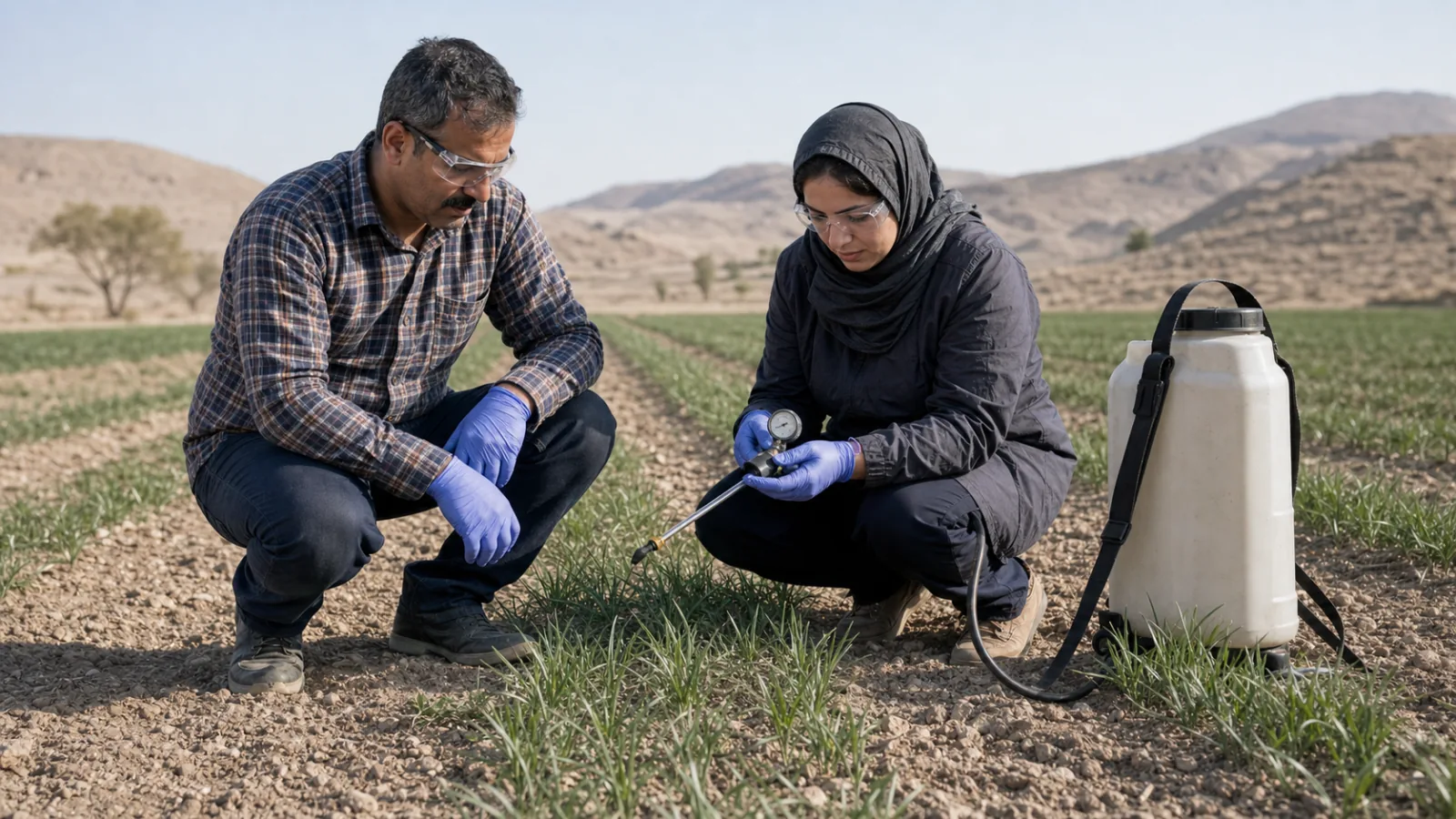
“Spreading the red gold of the city of Darmian” is a 2019 report about foliar feeding in Darmian’s saffron fields, not about scattering saffron or expanding the crop. Its English title appears to confuse spreading with spraying. The underlying idea is straightforward: nutrients were to be applied to active saffron leaves, under local agricultural guidance, after the flower harvest.
What Darmian’s agriculture office announced
Ziaeian Ahmadi, identified in the translated report as the director of Agricultural Jihad in Darmian, said farmers were being advised on micronutrient foliar sprays. The stated purpose was to improve crop nutrition and provide elements associated with plant growth and later yield.
He said local service centres had distributed a fertilizer rendered in English as “Akadin,” and that nutrition instructions would be provided by the city’s agricultural experts. The translation also records 20 kilograms of fertilizer, a credit of 57 million rials and a spraying period from 15 February into the following month.
Those figures are part of the dated announcement, but the surviving English does not say whether the 20 kilograms referred to the whole programme, one service centre or an amount allocated in another way. The product name and formulation are also uncertain. They should not be converted into a present-day dose.
Why saffron leaves matter after flowering
Saffron flowers appear before or alongside its narrow leaves. Once flowering is over, those leaves remain active for months. They make and move carbohydrates that help replacement corms develop underground. Those corms carry the next cycle of growth, so the vegetative period is not an empty interval between harvests.
This explains the timing in the Darmian report. A foliar treatment needs a healthy leaf surface capable of receiving it. Spraying flowers would be too late for the harvested stigmas and could create unnecessary contamination concerns. Spraying after leaves have senesced would provide little useful target.
What saffron research says about foliar nutrition
Research supports the possibility that foliar nutrients can influence saffron growth, but it does not support one universal product or concentration. A 2015 greenhouse study on corm size and foliar fertilizer found that both the starting corm weight and fertilizer level affected growth and yield components. Its best result belonged to that experiment’s particular multi-nutrient product, concentration and conditions.
A later field experiment on humic acid and micronutrients tested iron, zinc, copper and manganese separately over two growing seasons. Responses differed by nutrient and by the humic-acid treatment; no single micronutrient was best for every measured trait.
These findings make two points useful to growers. Leaves can absorb applied nutrients, and the response depends on what the crop lacks, what is applied, when it is applied and how the field is managed. A positive trial does not justify copying its percentage into every Darmian field.
A soil or tissue diagnosis should come first
The phrase “complete micronutrient fertilizer” can sound as though every field needs the same mixture. That is unlikely. Soil pH, organic matter, salinity, texture, irrigation water and past fertilizer use can change nutrient availability. Leaf symptoms can also have several causes; yellowing may reflect nutrition, water stress, root or corm damage, disease, cold or the crop’s natural ageing.
A sensible programme begins with field history and a representative soil test. Where local advisers use plant analysis, the sampling stage and laboratory method should be consistent. The aim is to identify a plausible limitation before adding material, not to use a spray as insurance against every problem.
Our broader saffron cultivation tips place nutrition beside drainage, corm health, irrigation and post-harvest handling. Fertilizer cannot compensate for a waterlogged bed, diseased planting material or badly timed irrigation.
How to plan a safe foliar application
Farmers should use a product legally supplied for the crop and follow its current label and the advice of a qualified local agronomist. Before treating a field, confirm the product identity, nutrient analysis, recommended dilution, water volume, compatibility and re-entry precautions. A translated brand name from a 2019 news item is not enough.
Application conditions matter. Leaves should be actively growing, and the equipment should deliver a uniform mist without runoff. Strong sun, drying wind, frost, rain soon after application or a stressed crop can make results unreliable and may increase leaf injury. Mixing fertilizers or pesticides without a documented compatibility basis can create precipitates, nozzle blockage or crop damage.
A small comparison strip is useful when a recommendation is new to the farm. Leave an untreated reference, record the product, lot, rate, water volume, date and weather, and observe both leaf response and the following crop. That turns a seasonal expense into evidence the farmer can use.
What service centres can contribute
The most useful part of the Darmian announcement was not the distribution of a bag by itself. It was the link between material, instructions and local agricultural experts. A service centre can help farmers verify the product, calibrate sprayers, recognize an unsuitable day and keep neighbouring fields from receiving contradictory advice.
Distribution records also matter. They should show which formulation was supplied, how much each farmer received and what area it was intended to treat. Without those details, neither the 57-million-rial allocation nor the 20-kilogram figure tells readers whether the programme was sufficient or effective.
How success should be measured
A greener leaf is not the final objective. A useful review should compare treated and untreated areas and record corm size distribution, flower number, dry stigma yield and any quality measurements relevant to the buyer. Costs, labour and crop injury should be counted as well.
Year-to-year weather can easily obscure the result, especially when the entire field receives the same treatment. That is why replicated trials provide stronger evidence than a before-and-after impression. Farm records do not need to become a research paper, but a fair comparison is more valuable than memory.
The practical lesson from Darmian
The 2019 programme recognized a real feature of saffron production: the leaves that remain after flowering help build the corms behind the next crop, and foliar nutrition may be useful during that period. It also placed local experts between the product and the farmer, which is the right direction.
The details should remain historical. No grower should infer today’s product, rate or budget from a damaged translation. For Darmian’s “red gold,” good nutrition means diagnosing the field, choosing a defined input, applying it to healthy leaves under suitable conditions and checking whether the crop—not merely the sales claim—responded.

![Exporting Saffron to Turkey + Price Guide [Complete 0 to 100]](https://img.rowhanisaffron.com/20260827003933/saffron-export-turkey-quality-inspection.webp)



