


“Spain 2.5 times profit from Iranian saffron” was an Iranian industry headline about value leaving the producing region when saffron was exported in bulk and later branded abroad. The archived article argues that European intermediaries and companies earned more than farmers, but it does not show the prices, costs or calculation needed to verify a 2.5-times profit.
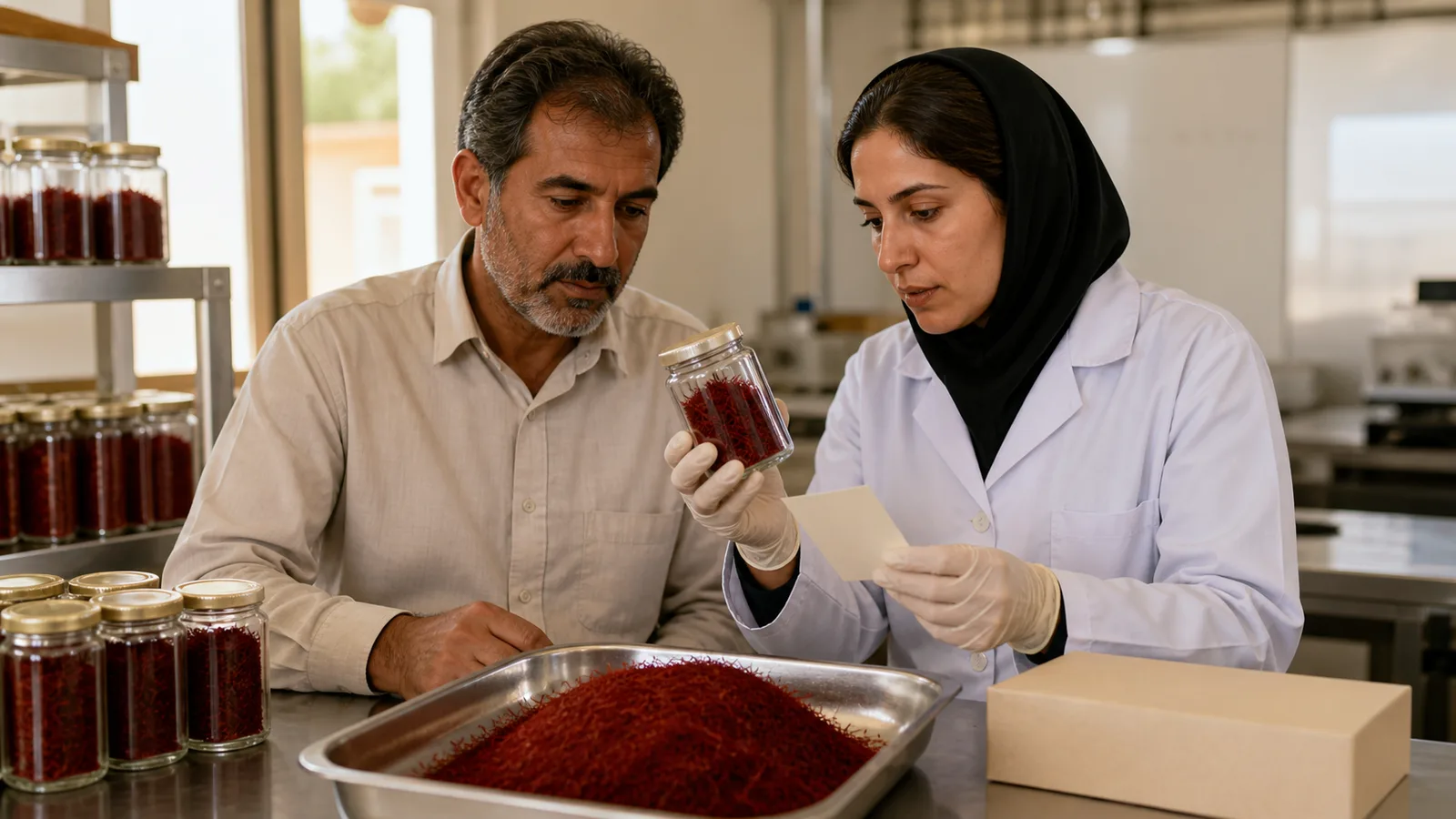
The underlying question is more useful than the unsupported ratio: which parts of saffron’s final value can growers and processors retain through careful drying, testing, traceable packaging, direct market access and a recognisable Iranian origin?
Production origin and commercial brand are different
Saffron grown and dried in Iran may later be tested, repacked, branded or re-exported by a business in Spain or another country. Those later activities can be legitimate and add real cost and value. They do not change where the crop was cultivated.
Reza Jabbari, quoted in the original report, said Spanish branding had made Spain more visible to buyers while the Iranian name became less prominent. His criticism was directed at a supply chain in which farmers performed the labour-intensive production but the consumer-facing identity belonged elsewhere.
Profit cannot be inferred from the difference between a farm-gate price and a retail shelf price. Processing loss, testing, rejected lots, packaging, finance, transport, importer costs, retailer margin and tax all sit between them. A credible “2.5 times” claim would need comparable transaction data and net costs, which the source does not provide.
The Kashmar production story
The destination’s English translation repeatedly says “Kashmir,” but the Iranian city concerned is Kashmar in Khorasan Razavi. Sayed Abolghasem Mousavi, then head of the local Agricultural Jihad office, reported 7,200 hectares under saffron: 4,700 hectares in the central district and 2,500 in Kuhsorkh.
He described Kashmar as third in Khorasan Razavi by saffron area and production for that reporting period. Frost damage was severe: about 90% in the central district and 40% in Kuhsorkh, according to his account. He also said 18 years of drought and excessive summer heat had reduced yield performance by roughly 30%.
At an average yield of 2.5 kilograms per hectare, the report projected 18,000 kilograms across 7,200 hectares. The old translation calls this “saffron flowers,” but the arithmetic refers to the weight of saleable saffron, not flowers. All the acreage, damage and yield figures are dated local statements, not current Kashmar statistics.
Processing and packaging capacity in Kashmar
The source contains two apparently opposing claims: one seller said inadequate cleaning, processing and packaging caused losses, while the agricultural official said Kashmar had no packaging problem because six companies had received licences and three others were active.
Both can be true at different points in a supply chain. A county may have facilities while some growers still lack affordable access, suitable collection, consistent grading or enough capacity during the short harvest. Counting licences does not show how much saffron was actually processed, what standards were used or how quickly farmers were paid.
Mousavi said 95% of the city’s saffron was exported to markets including the United Arab Emirates, other Persian Gulf destinations, Russia and Europe. That is a historical local estimate, not a current customs breakdown. The article also records efforts to help exporters sell under a Kashmar identity.
The ministerial Iranian-brand programme
A related report added a national-government perspective. Ali Rabiee, then Minister of Cooperatives, Labour and Social Welfare, discussed saffron during a visit to Torbat Heydariyeh and Zaveh. He said work had begun in Khorasan Razavi and South Khorasan to package and export saffron under Iranian brands rather than relying mainly on bulk routes through Spain.
Rabiee said international packaging experts had been consulted about pack type and that specialists were working on standardisation and quality. He placed saffron inside Khorasan employment-development programmes and criticised traditional traders for failing to connect with new markets.
Those remarks describe a programme and intention, not proof of how many packs reached shelves or how many jobs resulted. “International expert” is also not a quality standard by itself. The useful test is whether the finished system improved traceability, compliance, buyer access and the share of value retained locally.
What export-ready Iranian packaging has to do
A decorative box is the visible end of a much longer process. An export-ready consumer product needs:
- a traceable lot and truthful cultivation origin;
- controlled drying, moisture and storage;
- defined filament style and tested quality;
- a food-grade container that protects aroma and colour;
- accurate net weight, durability and storage information;
- a responsible producer, packer or importer identified for the destination market;
- language and claims that comply where the food is sold.
For example, European Union food-information rules require mandatory particulars for prepacked food and require origin or provenance where omission could mislead the consumer. The European Commission’s official guidance also makes clear that the responsible food-business operator and storage information belong on the label.
The international Codex standard CXS 351-2022 supplies a common baseline for dried saffron styles, quality classes, contaminants, hygiene, packaging and labelling. Contracts may require additional ISO testing or buyer specifications.
Packaging does not stop counterfeit saffron by itself
Behrouz Bonyadi, then Kashmar’s representative in parliament, argued that small processed packs could prevent counterfeit goods. Tamper-evident, traceable packaging can make substitution harder after packing, but it cannot prove that the material placed inside was authentic.
Authentication begins with lot control and testing. In 2025, FAO and Mashhad University of Medical Sciences started work on advanced saffron fingerprinting and field-ready post-harvest guidance. The aim is to connect laboratory integrity with the handling that preserves colour, flavour and aroma.
A trusted Iranian or Kashmar brand should therefore promise only what it can document. Origin, grade and purity must be evidence, not decoration.
Corm restrictions and genetic-reserve claims
The older Kashmar report also raised the movement of saffron corms to Afghanistan. Mousavi argued that saffron should remain a regional genetic reserve and said instructions had been issued to prevent corms moving abroad or even to other Iranian cities.
That was an official’s policy position in a dated report. It is not evidence of the current law, and the article does not provide the instruction itself. Planting material should move only under applicable agricultural, customs and plant-health rules; local commercial protection should not be confused with a scientific conclusion that saffron cannot be grown responsibly elsewhere.
How more value can remain with producers
The strongest response to the old branding complaint is not to deny that packers and distributors add value. It is to make sure Iranian producers can perform or negotiate those functions on clear terms.
That means rapid flower handling, consistent drying, shared testing capacity, audited lots, packs designed for actual destination rules, direct relationships with importers and transparent payment to growers. It also means measuring whether a branding programme changes realised farm income, not merely counting new logos.
Spain’s exact profit from Iranian saffron cannot be established from this article. What can be established is where value is created. When origin, quality and handling remain traceable from Kashmar or another producing area to the buyer, an Iranian brand has something real to stand behind.

![Exporting Saffron to Turkey + Price Guide [Complete 0 to 100]](https://img.rowhanisaffron.com/20260827003933/saffron-export-turkey-quality-inspection.webp)



