


Saffron corm smuggling was the issue behind this article’s mistranslated old title. Gholamreza Miri, then vice-president of Iran’s National Saffron Council, alleged that planting corms had been moving out of Iran to China and Afghanistan for years. He warned that uncontrolled movement, weak domestic support and export barriers could erode Iran’s position.
The claim was disputed by officials at the time and the archived report provides no shipment records. It should therefore be read as an attributed industry warning, not proof that every saffron corm planted abroad came from illicit Iranian trade.
Corms are planting material, not the saffron spice
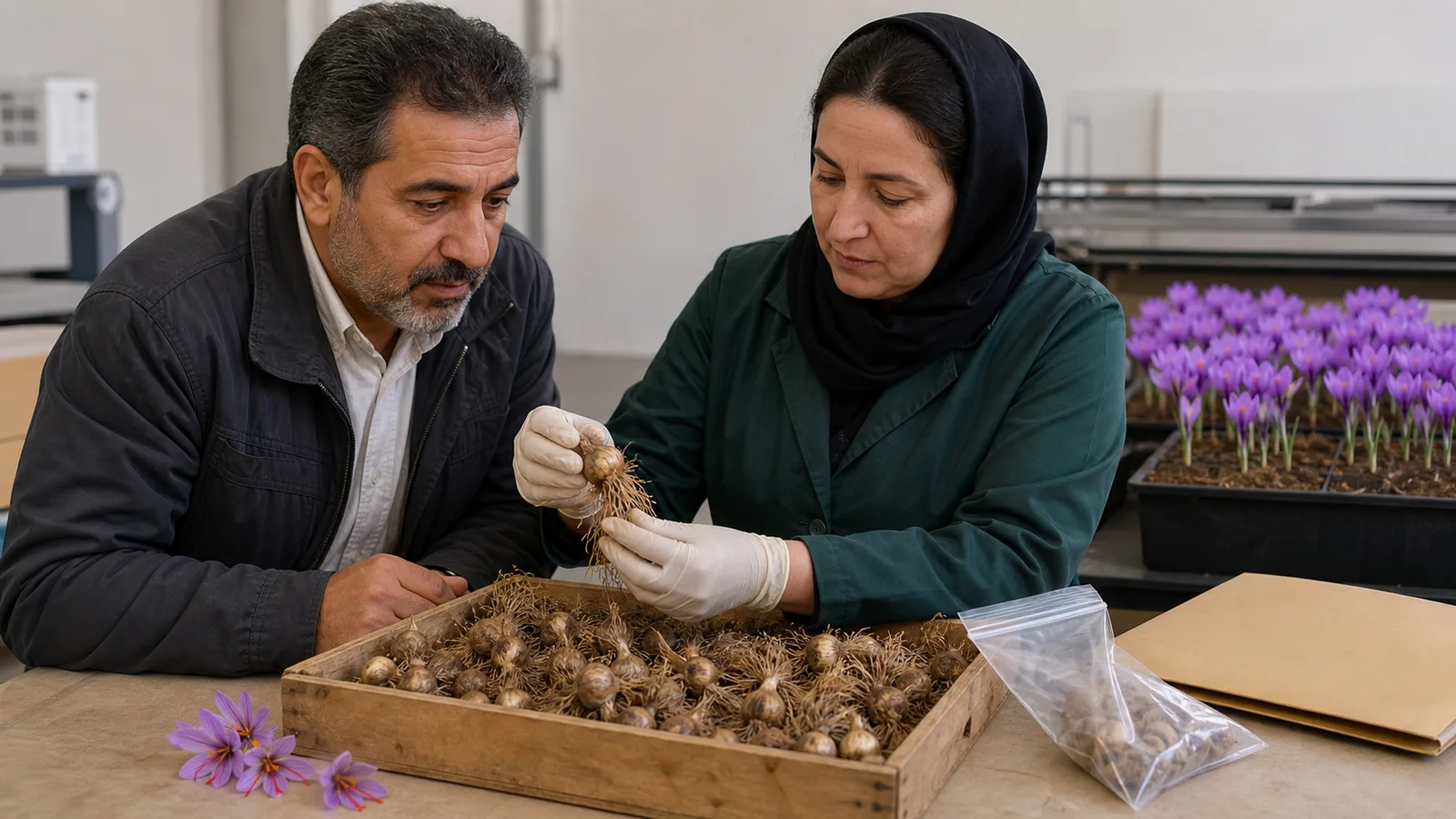
Crocus sativus is propagated through corms, the underground structures commonly called saffron “bulbs.” Dried saffron consists of the flower’s stigmas. Moving a box of corms is consequently different from exporting a box of spice: it transfers planting material that can establish future production.
That movement has several implications. A corm can carry soil or plant pests, its health affects the receiving crop, and the stock may have commercial value to breeders and growers. The International Plant Protection Convention provides the framework for phytosanitary certification, under which national plant-protection organisations attest to the phytosanitary status of regulated consignments.
A movement is not “smuggling” merely because corms cross a border. Whether it is lawful depends on the export, import, customs and plant-health rules applying to that consignment. Undeclared movement outside those controls is a different matter from documented trade with required permits and certificates.
What the original warning said
Miri said Iran then produced 92% of the world’s saffron and argued that corms should not leave the country. He proposed three responses:
- prevent unauthorised outward movement of saffron corms;
- support domestic production so Iranian farms remain competitive;
- support legitimate saffron exports and protect access to buyers.
His prediction that continued corm movement would make Iran “definitely” lose its production and exports was rhetorical. New producers can increase competition, but land, climate, farm knowledge, labour, processing, testing, brand reputation and trade access also determine market share.
Afghanistan now has a genuine saffron sector of its own. FAO describes Herat-Bastan saffron as an Afghan priority product, and another FAO account documents local entrepreneurs and growers. That does not resolve individual allegations about past corm movements; it does mean Afghanistan’s production should not be described simply as disguised Iranian output.
The historical export and price picture
A related interview with Miri reported saffron exports up about 37% during the first eight months of that year. Approximately 78 tonnes had reportedly left Iran by the end of November, compared with the same period a year earlier.
He nevertheless called the domestic market stagnant. The translated account said Negin saffron had fallen by about 30%, with a range of 4.4–5.6 million tomans per kilogram, while other saffron types had moved down by roughly 1–2%. Its reference to “rubles” at the top of the range is a translation error; the surrounding Persian market quotation is in tomans.
Production estimates varied from 310 to 360 tonnes. Miri criticised customs for not publishing November and December figures promptly, making it difficult to align export growth, market activity and the final crop.
All these numbers are dated historical reports. They are not current prices, output or shipment totals, and the article does not provide enough grade, contract or customs detail to reconstruct them as a modern market series.
Old export markets and the re-export problem
A second source named Spain as the largest importer and re-exporter of Iranian saffron, followed by China, the United Arab Emirates, Italy, Saudi Arabia and India as important markets. That ranking belongs to its reporting period and must not be treated as today’s destination order without current customs data.
The commercial concern was clear: bulk saffron could leave Iran and later be packed, branded or exported again from another country, so the final consumer might recognise the packer more readily than the grower’s origin. Re-export is not inherently improper. The problem arises when origin is misstated, traceability is lost or the original producer receives little of the value added later.
FAO’s 2025 overview puts Iran at roughly 85–90% of current global production. It remains the leading producer, while the lower share compared with old 92% or 95% claims also shows why global percentages should retain a date.
Export barriers were broader than corm movement
The source articles identified drought, new competitors, price volatility, delayed statistics and speculative buying. Their broken translation obscures some sentences, but the durable point is that no single cause explains export performance.
Speculators may increase volatility when they withhold stock or buy ahead of a perceived shortage. They are not the only reason prices rise. Harvest size, exchange rates, payment restrictions, buyer demand, grade, inventory, packaging costs and shipping terms can all change a seller’s outcome.
The reports also called for better processing and less unnecessary manual contact. Mechanisation is not automatically cleaner, and hand work is not automatically unsafe. Hygienic premises, trained workers, food-contact materials, time and temperature control, lot separation and verifiable cleaning are what reduce contamination risk.
The proposed comprehensive saffron programme
Agricultural official Ramin Esmi described a comprehensive saffron programme with an estimated budget near 3,000 billion rials that had been sent to the Cabinet for approval. The plan reportedly gathered input from agriculture, health, industry, mining, trade and private-sector participants across production, processing and export.
One proposal was a saffron commodity exchange intended to make purchasing more transparent and reduce unstable dealing. The source also said approximately 95% of Iranian production came from Khorasan Razavi and South Khorasan, and associated the sector with annual production value of $300–$400 million.
Those were historical programme claims and estimates, not evidence that the budget was approved, that every measure was implemented or that an exchange would hold prices stable. A trading venue can standardise grades, contracts and settlement, but it cannot remove harvest, currency or demand risk.
What a stronger export system would protect
A durable response to the concerns in these reports has several parts:
- Healthy planting stock: documented corm origin, pest inspection and lawful movement.
- Competitive farms: suitable water, healthy corm renewal, training and realistic finance.
- Traceable saffron: lot records from field through drying, testing and packing.
- Current market data: prompt customs and crop statistics with clear units and periods.
- Defined contracts: grade, test method, weight, currency, delivery and payment terms.
- Truthful origin: cultivation, processing and packing locations stated without implying they are the same.
That framework is more useful than trying to preserve market share by secrecy alone. Iran’s advantage depends on the quality and trust attached to its saffron as much as on where the first corm originated.
The old warning about saffron corm smuggling therefore belongs inside a wider export story. Planting material should move lawfully and safely; farmers need a functioning domestic value chain; and dried saffron needs transparent quality, origin and trade records. Protecting all three is how a producer keeps value when new regions enter the market.

![Exporting Saffron to Turkey + Price Guide [Complete 0 to 100]](https://img.rowhanisaffron.com/20260827003933/saffron-export-turkey-quality-inspection.webp)



