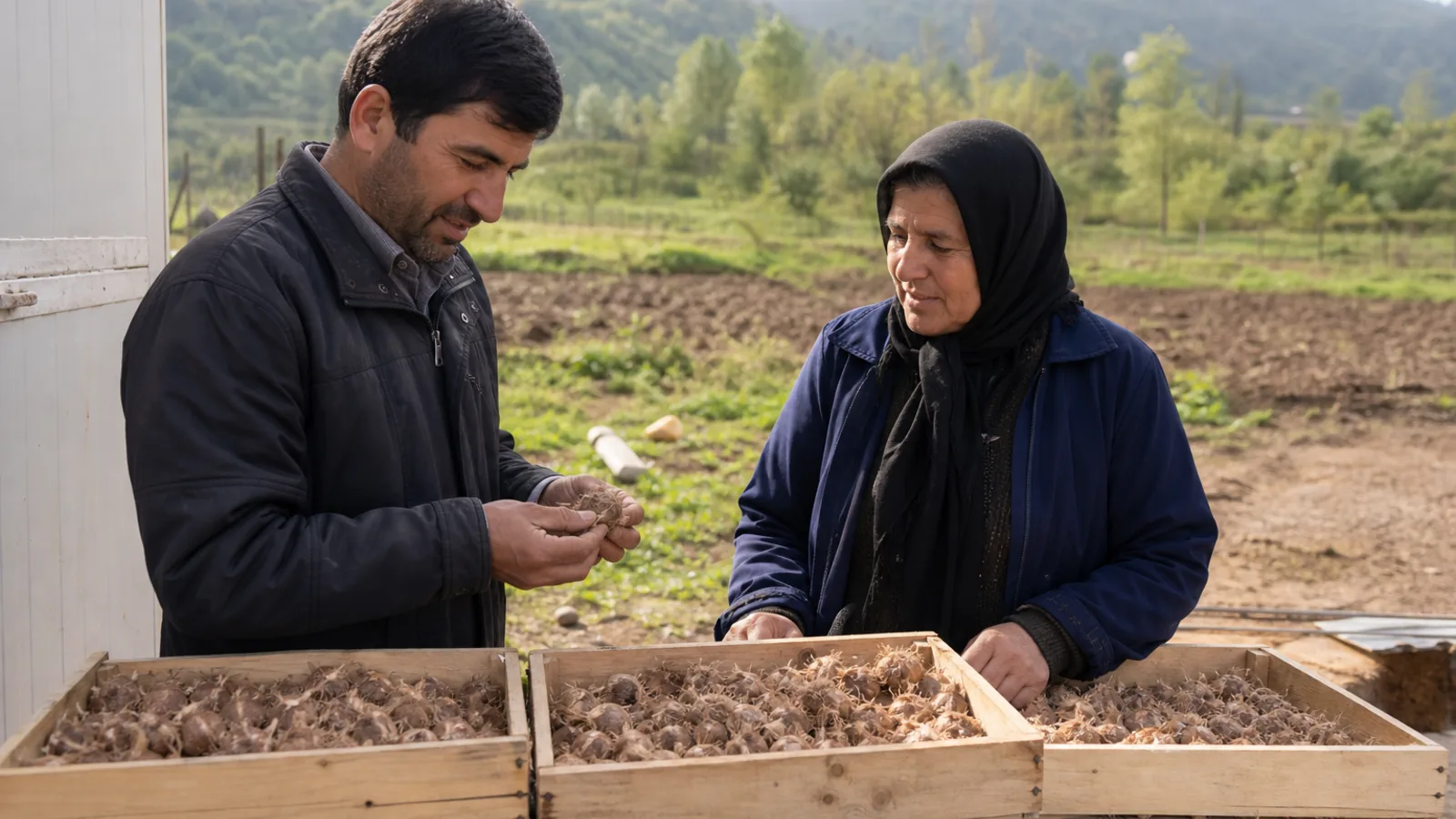
Seed saffron distribution in Amlash was the subject of a local agricultural meeting reported on this page in 2015. The phrase needs one immediate clarification: cultivated saffron is not normally raised from botanical seed. Crocus sativus is a sterile triploid, so growers establish and renew a field with corms. In this article, “seed saffron” retains the wording of the report and the page’s indexed topic, but it means planting corms.
The meeting described 1.5 tonnes of planting material, small plots in Kejid and Malakut, 30 growers, and an average dry-saffron yield of two kilograms per hectare. Those are useful details from a particular programme and period, not current statistics or a universal planting formula. Read carefully, the report is less a recipe than a starting point for deciding whether a corm-distribution scheme is likely to produce healthy, traceable fields.
What the Amlash distribution report said
According to the Gilan edition of the Iranian Students News Agency (ISNA), the Amlash Agriculture Jihad director, Masoud Amir Bandeh, told the meeting that the county had 30 saffron growers. He announced the distribution of 1.5 tonnes of what the translated report called seed saffron, intended to develop cultivation around Kejid and Malakut.
The planting material was described as being distributed among growers working plots of 200 to 300 square metres. The official also said that, at the time of the report, the 30 growers cultivated a combined 1.5 hectares in Amlash. Saffron was presented as a perennial crop able to withstand difficult conditions, including water scarcity, and the county’s average yield was given as two kilograms per hectare.
All of these figures are historical and attributed. The surviving report does not give a distribution list, corm-size specification, planting density, crop year, measured plot results or a later programme evaluation. It would therefore be misleading to use the 1.5-tonne total to calculate how many corms were issued or how much new land was planted. Corm weight varies substantially, and planting density changes the area that a given weight can cover.
Why “seed saffron” actually means corms
The distinction is practical, not merely botanical. A buyer looking for saffron seed may be offered corms under a familiar trade phrase, but the planting unit should still be identified accurately on records and labels. A recent scientific review of saffron production describes the crop as a sterile triploid propagated exclusively by corms, while a broader review of saffron biology likewise explains that commercial propagation is vegetative rather than by viable seed. That is why the health and identity of each corm lot matter so much: planting material also carries the history of the field from which it came.
Corms are swollen underground storage organs. A mother corm supports growth and produces replacement corms, which make it possible for the planting to continue across seasons. Their size, physiological condition, disease status, storage history and planting environment can all influence establishment and flowering. A tonne is therefore only a transport or procurement measure. It says nothing by itself about the number of viable units or their fitness for a particular field.
For cultivation, specify “saffron corms” in technical documents even when local commerce uses “seed saffron.” A lot record should connect the supplier, source field, lifting date, size or weight band, inspection result, storage conditions and delivery date. That small change in language and record-keeping makes later problems much easier to trace.
Assessing planting material before distribution
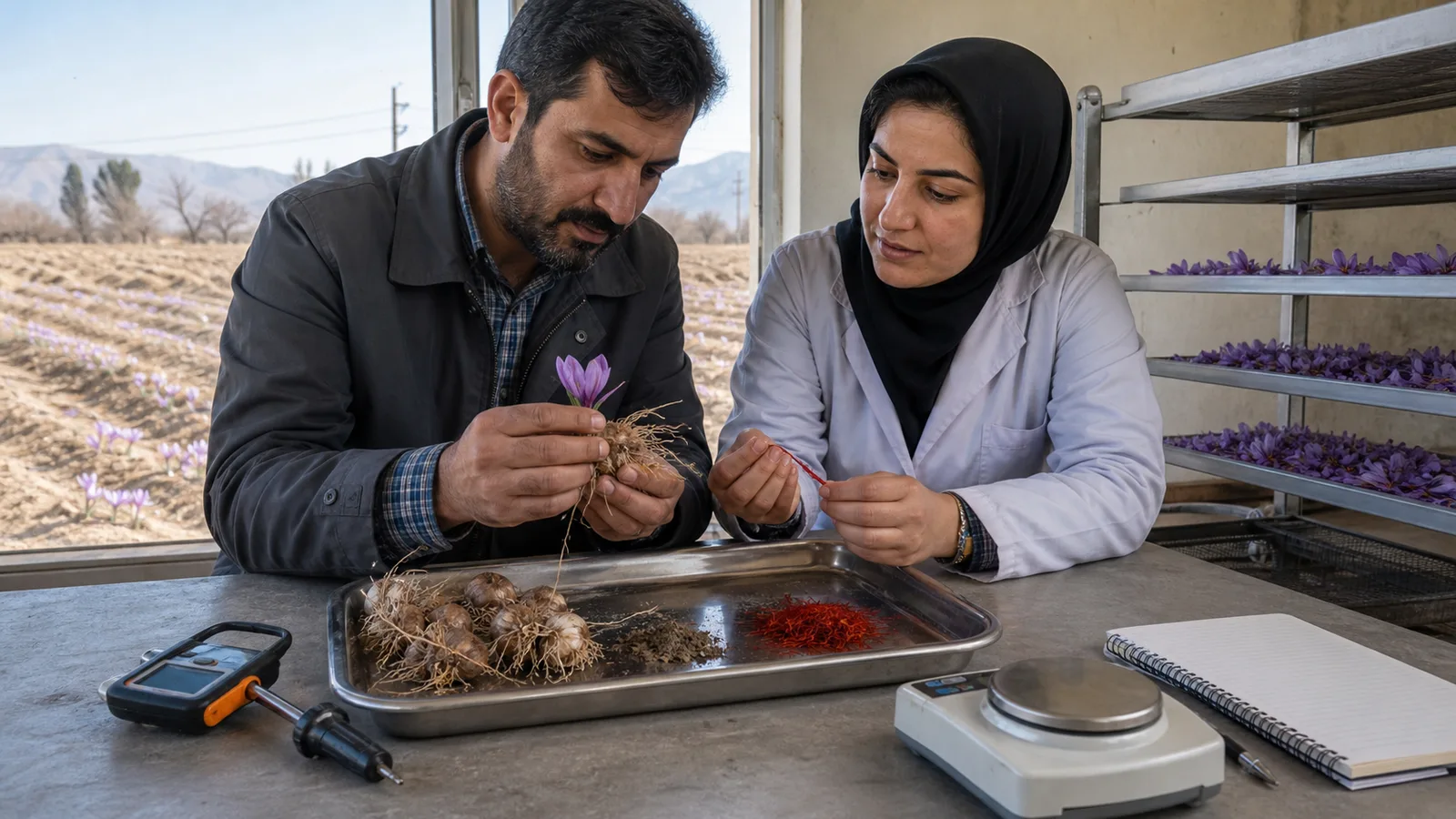
A distribution programme can look successful on the day sacks leave a warehouse and fail months later if the contents were mixed, damaged or poorly stored. Sampling should happen before allocation. Open enough containers to see whether the lot is reasonably uniform, then record what is accepted, rejected or separated.
Sound corms should feel firm and show no obvious rot, deep wounds or extensive mould. Loose outer tunics may hide the surface, but aggressive peeling can damage the corm and removes protection. A clean appearance is not a guarantee of freedom from pathogens, and a fungicide treatment should not be improvised without a local diagnosis, legal label and agronomic recommendation.
Size also needs a declared method. Research often finds that larger mother corms have more stored reserves and can flower more readily, but the result is affected by cultivar material, climate, field age, planting depth and spacing. Studies of corm weight and planting depth are useful evidence, not a universal grade for Amlash. Mixing small and large corms without recording the bands makes it difficult to compare plots fairly.
The completed guide to selecting and handling saffron bulbs and corms covers visible defects, timing, storage and density in more detail. Its central point applies here: buy a documented lot for a defined planting plan, not a weight of anonymous material.
Can saffron suit the conditions in Amlash?
Saffron is often described as a low-water crop. That description can be useful when comparing it with more water-intensive alternatives, but it should not be shortened to “needs no water.” Moisture timing still affects root growth, flowering and daughter-corm development. Excess moisture and poor drainage can be just as damaging as shortage, particularly in a humid setting.
Amlash lies in Gilan, a province better known for tea and citrus than for the dry landscapes associated with much of Iran’s saffron production. That does not make saffron impossible. It does make site selection more important. A trial plot should be judged on drainage, soil structure, slope, standing-water risk, previous crops, irrigation control, access during flowering and the ability to dry harvested stigmas promptly.
FAO’s account of Iran’s qanat-based saffron system shows how local knowledge, water management and rural livelihoods are connected in a long-established production landscape. It should not be copied as a planting prescription for wetter Gilan. The lesson is to match saffron’s seasonal cycle to the actual water, soil and labour conditions of the place rather than relying on the crop’s reputation for resilience.
The 200-to-300-square-metre plots mentioned in the Amlash report are a sensible scale for observation if they are treated as trials. Each plot can be mapped, measured and compared without committing a large area before local performance is understood. Growers should keep the corm lot and planting method consistent within a comparison, then change only a limited number of variables.
A practical plan for a small recipient plot
Before planting, the grower and programme organiser should agree on what will be measured. A simple field record is more valuable than a complicated form that nobody completes.
- measure the planted area rather than estimating it from field boundaries;
- record the corm lot, weight band, number issued and number actually planted;
- note soil condition, drainage work, planting date, depth and spacing;
- keep irrigation, rainfall and unusual weather observations by date;
- record emergence, gaps, visible disease, rodents, weeds and any treatment used;
- count flowers and weigh properly dried saffron from that exact plot;
- retain labour hours and post-harvest losses so the result can be judged economically.
Planting depth and spacing should follow a locally tested plan. A 2024 field study of corm size and planting depth found that the two interacted, and more recent semi-arid research also examined shading, depth and corm weight together. Neither experiment establishes one optimum for every soil and climate. In heavy or wet ground, copying a depth from a dry-region trial without checking drainage can create the wrong conditions around the corm.
The same caution applies to plant density. Closely packed corms can increase the number of potential flowers per unit area at first, but they also use more planting material and may increase competition and crowding as daughter corms multiply. Wider spacing changes both cost and management. Report the actual number planted per square metre; kilograms per plot alone cannot describe density.
How to interpret the reported two-kilogram yield
The old report’s average of two kilograms per hectare should remain attached to Amlash and the period in which it was stated. It is not a promise for a recipient of the distribution programme. We do not know whether the figure referred to newly established fields, mature fields, a survey or an estimate.
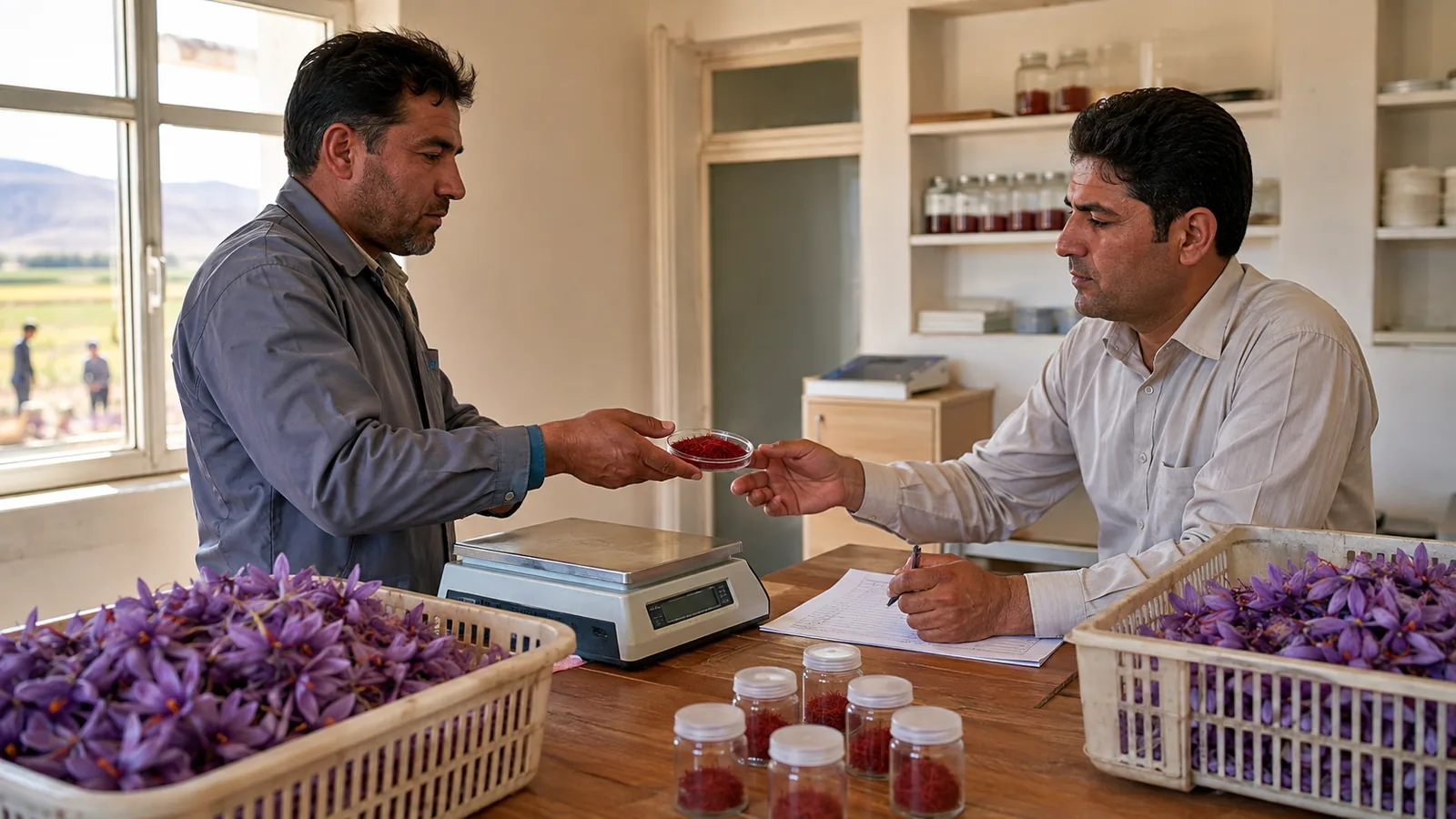
Yield comparisons need the same denominator. Dry saffron weight should come from the measured planted area, with the harvest year and field age stated. A first-season result is not directly comparable with an established planting. Drying method also matters because residual moisture changes weight, while poor handling can reduce the amount of saleable product even when flower numbers are good.
Programme evaluation should look beyond kilograms. Corm survival, disease incidence, flowering, daughter-corm development, labour demand, drying capacity, product quality and the grower’s net return all affect whether the crop deserves a larger area. If a small plot establishes badly, the useful result may be a diagnosis that prevents an expensive expansion.
Distribution has to continue after delivery
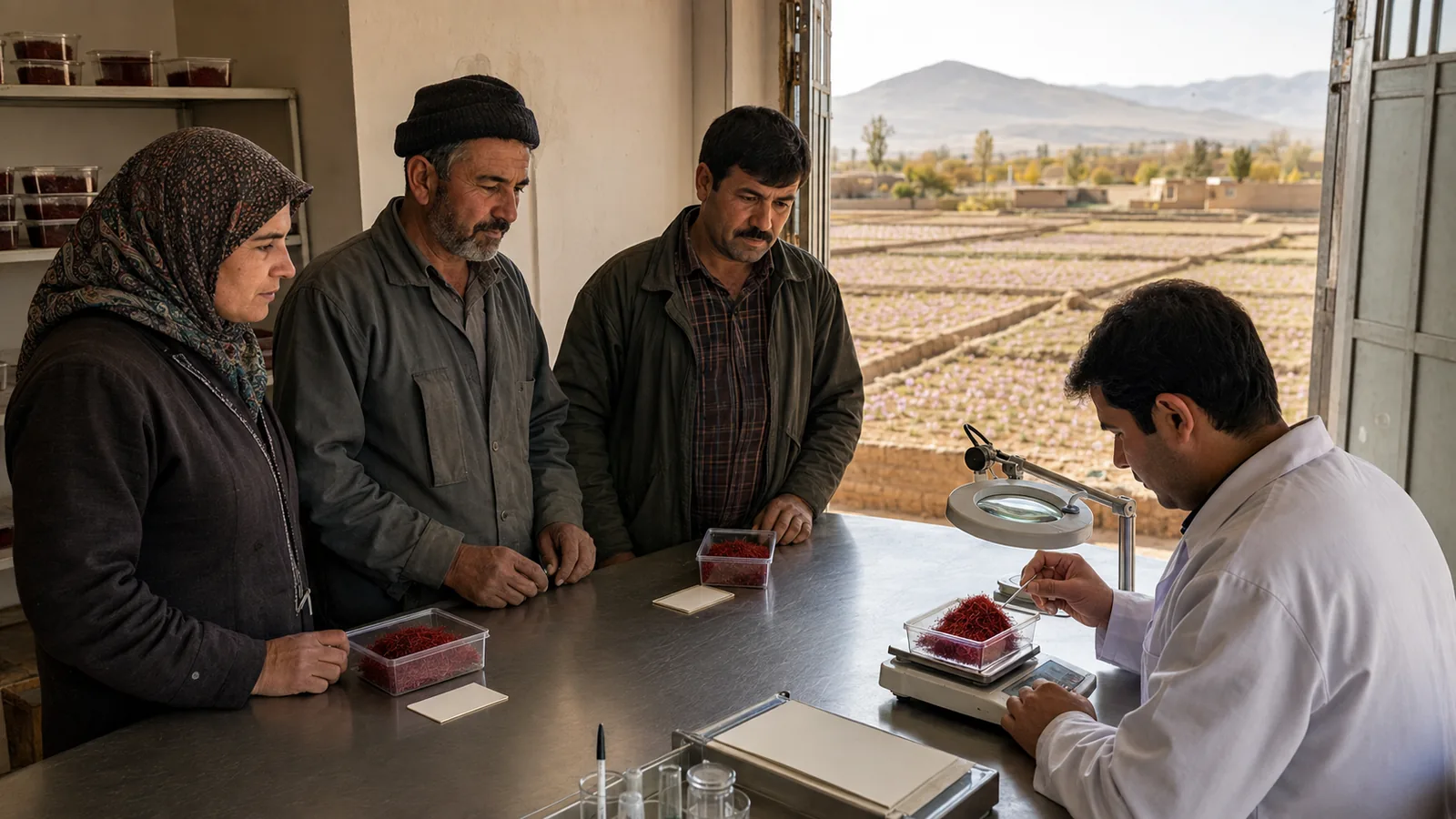
A credible seed saffron distribution programme begins with recipient and site selection, then continues through at least one complete crop cycle. The organiser needs a traceable allocation register and a way to inspect planting, emergence, flowering and post-harvest handling. Growers need one contact for reporting a suspect lot or a field problem before it spreads.
Results should be separated by location and planting lot. Kejid and Malakut may not have identical elevation, exposure, soil or water behaviour, and a combined average can conceal a weak site. Photographs, plot measurements and laboratory or plant-health findings should be tied to dates and lot numbers rather than used as general programme publicity.
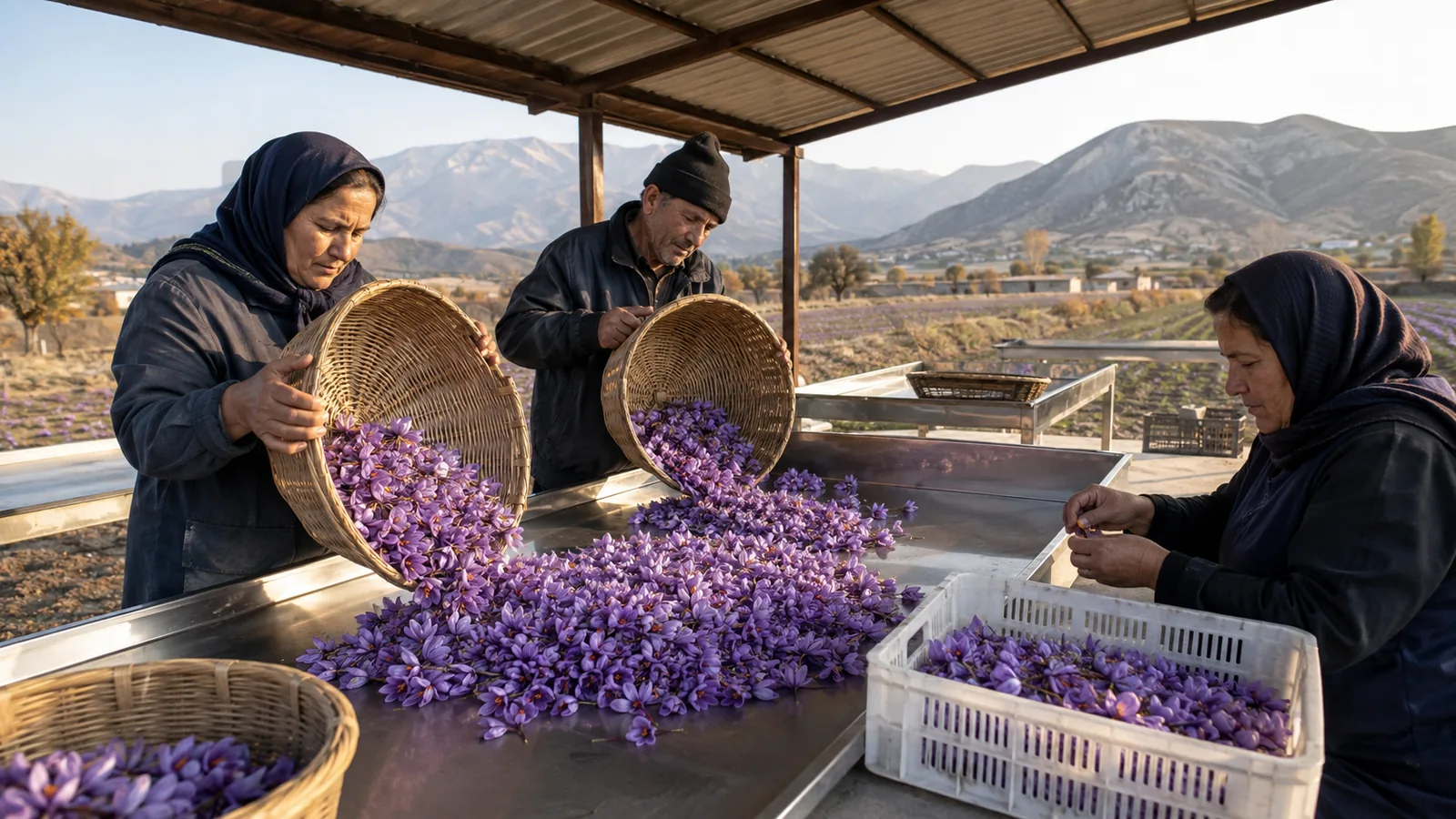
Expansion is justified only when the trial answers the practical questions: Did the corms establish? Could the field drain? Was flowering and harvest manageable? Could the stigmas be separated and dried promptly? Did the saleable result cover the real cost? A distribution total cannot answer any of them.
The tea and citrus discussion was a separate subject
The same Amlash meeting also covered biological control in tea and citrus gardens. The report said a beneficial Cryptolaemus beetle had been distributed or used in September to control mealybugs across 400 hectares. It described Amlash as having 5,200 hectares of tea gardens and 2,936 hectares of citrus orchards.
Cryptolaemus beetles are recognised predators of mealybugs; the University of California’s integrated-pest-management guidance describes Cryptolaemus montrouzieri in that role. This does not make the reported release a treatment for saffron, and a release rate from another crop or country should not be transferred to Amlash without local identification and advice. The 400-hectare, September, tea and citrus figures remain historical details from the meeting.
The final surviving sentence expressed concern about allegedly arbitrary land-use-change permits issued by some village administrations or offices. The source ends before explaining particular cases, legal findings or a proposed response. That concern can be retained, but the missing details cannot responsibly be reconstructed.
What the Amlash account can teach a modern programme
The report captured a genuine development idea: give growers planting material, begin on manageable plots and test whether saffron can add value in a new area. Its weakness was not the idea but the absence of the information needed to judge the outcome.
A stronger programme would call the material corms, define the lot, screen its health, match the field to local conditions, record how it was planted and follow the plot through drying and sale. It would keep the two-kilogram yield as a dated local reference rather than a forecast. With those safeguards, seed saffron distribution in Amlash becomes a measurable agricultural trial instead of a one-day tonnage announcement.
The 1.5-tonne distribution, Kejid and Malakut locations, 200–300-square-metre plots, 30 growers, 1.5 cultivated hectares, two-kilogram-per-hectare yield, September biological-control work, 400 hectares, 5,200 hectares of tea, 2,936 hectares of citrus, and land-use-permit concern are retained as claims from the meeting reported here in 2015. They are not represented as current statistics. Scientific and extension sources were reviewed on 29 August 2026.

![Exporting Saffron to Turkey + Price Guide [Complete 0 to 100]](https://img.rowhanisaffron.com/20260827003933/saffron-export-turkey-quality-inspection.webp)