


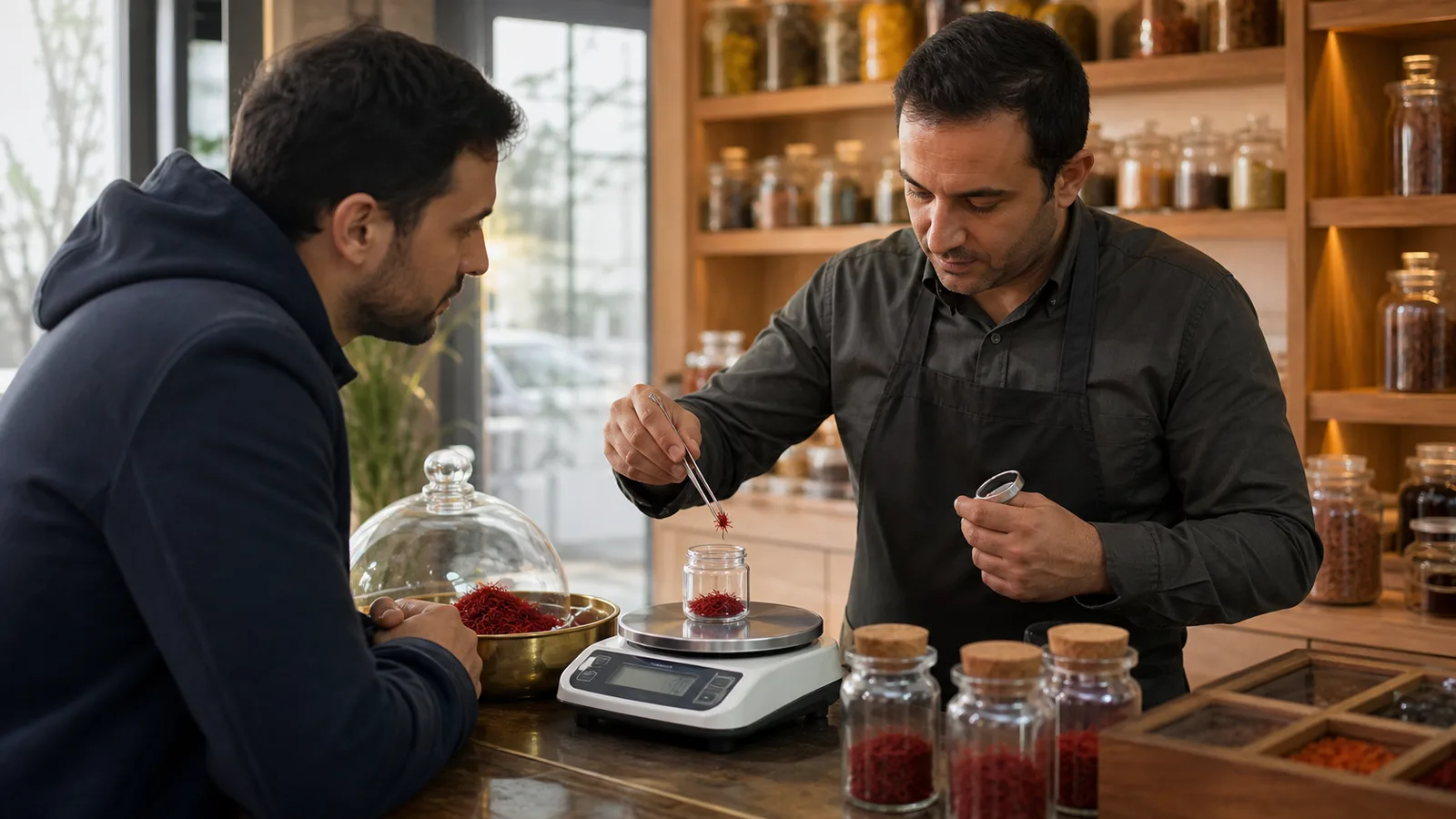
Sale of one kilogram of Iranian saffron in Turkey at 70000 lira refers to a specific report published in March 2019. A herbalist in Marmaris was offering imported Iranian saffron at 70,000 Turkish lira per kilogram, then approximately US$12,500. It was a retail asking price quoted by one shop, not the standard Turkish saffron price for every city, grade or transaction.
The date and context matter. Currency values, production costs and retail markets have changed sharply since 2019. Anyone asking how much saffron is in Turkey today needs a current, dated quote with the grade, pack size, origin and seller clearly identified.
What the 70,000-lira report actually said
The original Turkish news item described Iranian saffron brought to order by herbalists in Marmaris. It said a kilogram sold for 70,000 TL and that foreign residents, particularly women living locally, were more frequent buyers than the local population. This was a piece of local-market reporting rather than a representative price survey.
A contemporaneous English report repeated the 70,000-lira figure and converted it to about $12,500. It also compared the Turkish retail number with much lower prices quoted inside Iran. That gap cannot be read as pure profit. A retail price may include very small package sizes, importing, taxes, transport, payment risk, shop overhead, slow turnover and the seller’s margin.
Most customers do not buy a full kilogram. When a costly spice is sold by the gram, the implied kilogram price can be much higher than a bulk contract. Multiplying a one-gram shelf price by 1,000 does not prove that a merchant could sell an entire kilogram at the same rate.
How to compare a saffron price in Turkey
A usable comparison should state:
- the date and whether the currency is Turkish lira;
- retail, wholesale, import or farm-gate level;
- the actual pack weight and price per gram;
- Iranian, Turkish or another declared origin;
- threads or powder and the commercial grade;
- tax, shipping and customs treatment;
- laboratory or certification documents; and
- whether the number is an asking price or a completed sale.
Without those details, “saffron price in Turkey” can mix unlike products. A decorative tourist-market vial, an imported bulk lot and locally grown Safranbolu saffron answer different buyer needs.
Why genuine saffron costs so much
Saffron is often called “red gold” because so much labour is concentrated into a small, valuable product. It consists of the dried red stigmas of Crocus sativus. Each flower supplies only three delicate stigma branches, and the flowers open during a short harvest period. They are usually picked by hand before workers separate and dry the stigmas.
The 2019 report used a figure of more than 170,000 flowers for one kilogram. Scientific reviews give ranges rather than one universal number: approximately 110,000 to 165,000 flowers in one review and around 150,000 in another. Flower size, stigma yield, moisture and processing help explain the variation.
Labour continues after picking. Rapid separation, controlled drying, storage and protection from moisture and light affect colour, bitterness and aroma. Testing and traceability also matter because high value makes saffron a target for substitution and adulteration.
Iranian saffron in Turkey
In Turkish, saffron is called safran. Turkey has its own saffron tradition, especially around Safranbolu in Karabük Province, while the market also contains imported saffron. An academic history traces documented cultivation in the Safranbolu area to Ottoman records from the sixteenth century and describes a modern revival from the 1990s.
Iranian saffron occupies a different scale. FAO reports that Iran produces about 85–90% of the world’s saffron, making it the biggest saffron producer by a wide margin. Current work in Iran focuses on authenticity, post-harvest practice, quality control and traceability across that large value chain.
“Biggest saffron exporter” is a separate statistic from biggest producer. Export rankings depend on the year, trade code, reported origin and whether a country re-exports saffron grown elsewhere. A large producer can also sell through intermediaries, while a smaller producer or trading hub may appear prominently in export data.
Is saffron from Turkey the same as Iranian saffron?
Both are normally the dried stigmas of the same cultivated species, Crocus sativus. They are not automatically identical in sensory profile or commercial value. Terroir, corm stock, harvest timing, stigma separation, drying, storage and grading can affect the finished spice.
Origin should be demonstrated through records and testing rather than inferred from a shop’s location. A product sold in Turkey may be Turkish-grown, Iranian, Afghan or from another source. Likewise, a Turkish label or reseller does not by itself prove Turkish cultivation.
When buying Iranian saffron, look for intact red threads, a credible lot identity, accurate net weight, origin information and packaging that protects the contents. Powder is convenient but harder to inspect visually.
A long history of Iranian saffron trade
The previous page said saffron cultivation in Iran went back more than 3,000 years and described Iranian traders introducing it to Greeks, Romans, Chinese and Semitic peoples, including Arabs, before cultivation spread through Persian communities to North Africa, Andalusia and Sicily between roughly the first and fourth centuries CE.
Those statements combine several broad historical traditions. Ancient texts and later trade routes do show saffron moving among West Asia, the Mediterranean and beyond, but a simple one-direction timeline is difficult to prove. The page therefore preserves the claimed connections without presenting a precise 3,000-year sequence as settled fact.
Historical Iranian culture has associated saffron and gold with status, hospitality and celebration. Accounts describe their use at weddings and in honouring elders and guests. These traditions help explain saffron’s symbolic value, while modern export value depends on measurable quality and buyer confidence.
Traditional medicine is not modern treatment evidence
The 2019 news story attributed many therapeutic claims to saffron, including a claim about cancer. Traditional use is part of saffron history, but it does not establish that culinary saffron treats disease.
Laboratory studies have examined crocin, crocetin, safranal and saffron extracts in cancer-related models. Most such findings are preclinical, and they do not show that eating saffron replaces oncology care. A shop price should never be justified with a cure claim.
Competition in the global saffron market
The original article listed Afghanistan, Greece, Morocco, Turkey and India as increasingly active producers and traders. Spain and Italy also remain important in European saffron history and trade. Their roles differ: some markets focus on cultivation, some on processing and packaging, and some combine domestic crop with imported material.
For Iran, scale is an advantage only if buyers can trust each lot. Consistent drying, residue and contamination controls, authenticity testing, traceable origin and reliable delivery turn production volume into durable market value. Our guide to Iranian saffron exports explains those commercial distinctions.
Can the 70,000-lira price be used today?
No. It is a dated benchmark for one March 2019 retail report. It remains useful because it shows how a tiny, labour-intensive import could be valued in a Turkish tourist market, and because the exact figure continues to attract search interest.
For a current purchase, compare live quotes on the same day and normalise them to the same weight and quality. Ask the seller for origin, grade and lot documentation. Keep the 70,000-lira number in its historical frame instead of treating it as today’s price or a forecast.
Sources
- Original March 2019 Turkish report of Iranian saffron at 70,000 lira/kg.
- Contemporaneous English report and approximate 2019 dollar conversion.
- Review of saffron quality, labour and flower-count ranges.
- FAO: Iran’s production share and current saffron value-chain work.
- Academic history of Safranbolu saffron from Ottoman archives.

![Exporting Saffron to Turkey + Price Guide [Complete 0 to 100]](https://img.rowhanisaffron.com/20260827003933/saffron-export-turkey-quality-inspection.webp)



