


Electronic nose Saffron safer saw the market was an awkwardly translated 2019 headline for a real quality-control idea: using a sensor array to read saffron’s volatile aroma pattern. An electronic nose can help screen and compare samples quickly, but it does not literally smell, prove origin on its own or replace validated laboratory tests.
The university announcement behind the story
The original report covered remarks by Faramarz Hossein Babaei, a faculty member at Khajeh Nasir Toosi University of Technology, during a ceremony honouring university researchers. The translation moved between the relationship of universities and industry, the risks faced by new companies and several earlier research projects before ending with news of an “electronic” saffron product expected to reach the market.
Read in the context of the title, that final product was a saffron electronic nose. The source does not provide a model name, launch date, validation file, price or commercial manufacturer. It is therefore more accurate to preserve it as an announced applied-research project than to claim that a particular certified instrument went on sale.
Babaei compared industry to a black box: resources and ideas enter, then a saleable product has to emerge. He argued that universities should not operate separately from industry and that knowledge must be transferred between people if production is to continue.
He placed that argument in a long history of scholarship, mentioning the University of Bologna alongside the scientific era of Omar Khayyam and Abu Rayhan al-Biruni, then the Sorbonne in France. His comparison was broad rather than a precise timeline: al-Biruni died in 1048, Khayyam lived from 1048 to 1131, Bologna’s conventional founding date is 1088, and the historic Sorbonne dates to the thirteenth century. The underlying point was that organized learning and the exchange of knowledge have long influenced practical progress.
What an electronic nose actually measures
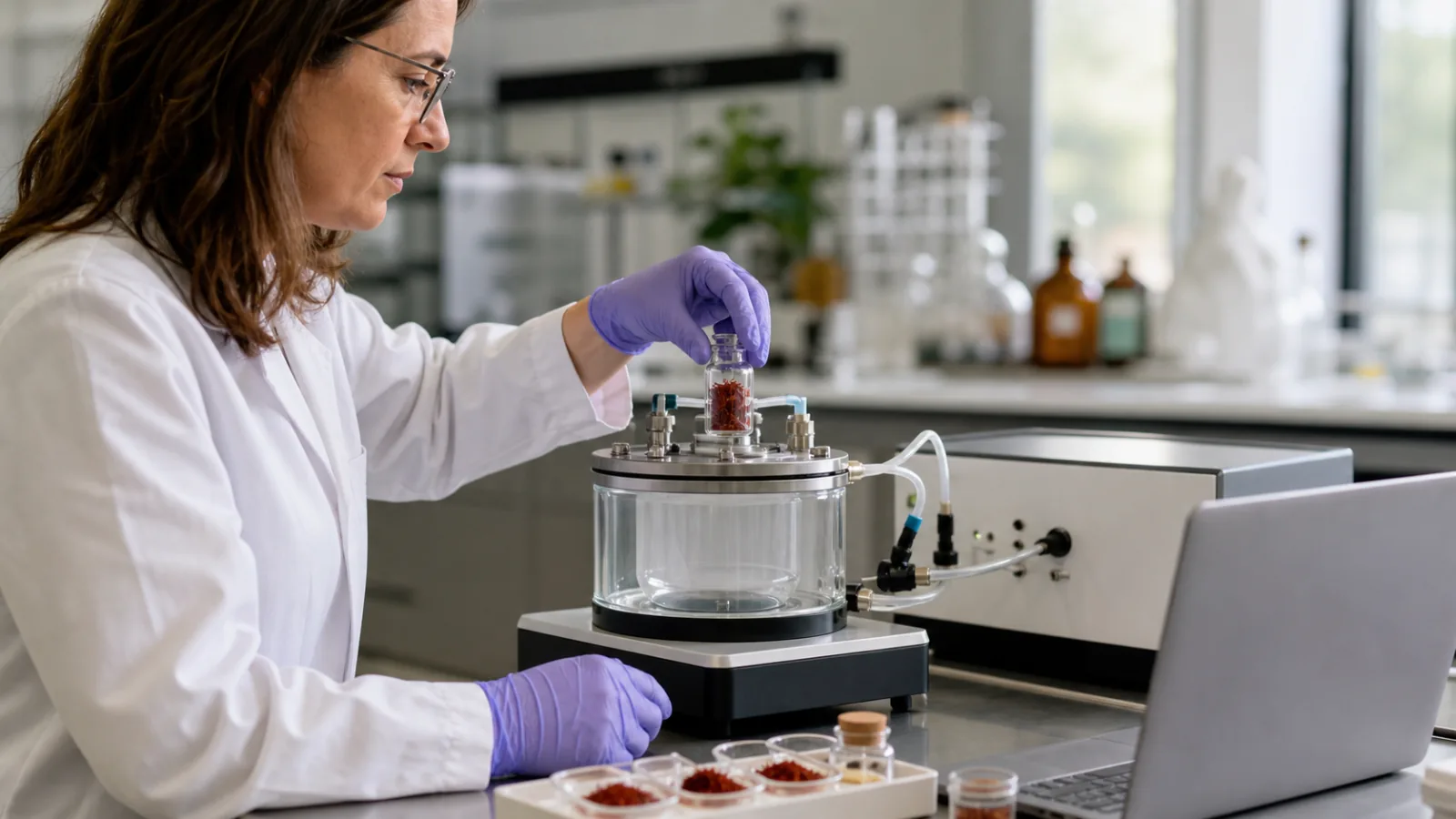
An electronic nose is normally a group of gas sensors connected to data acquisition and pattern-recognition software. A small saffron sample is held under controlled conditions. Volatile compounds collect in the air above it—the headspace—and produce a combined response across the sensor array.
The output is not a simple reading of “good” or “bad.” Software compares the response pattern with samples used to train or calibrate the system. Temperature, humidity, sample mass, container, equilibration time, sensor drift and the reference set can all affect the answer.
A 2016 study on a portable electronic nose for saffron tested eleven samples and used multivariate models to classify their aroma patterns. A later study examined whether electronic-nose data could help characterize origin, processing and age. Those results support further development; they do not show that every device can identify every saffron lot under commercial conditions.
Why aroma matters in saffron
Dried saffron’s aroma develops from volatile compounds, with safranal playing an important role. Drying and storage influence that profile. Excess heat, moisture, long storage or poor packaging can change what a sensor—and a person—detects.
That makes aroma screening useful in several places. A processor might compare incoming lots, monitor whether a drying process is repeatable or flag a sample whose pattern differs sharply from its established reference. It may also help researchers study how age and handling affect volatile fingerprints.
The current ISO 3632-1:2025 saffron specification covers dried saffron in filament, cut-filament and powder forms. The ISO framework and an electronic nose are not interchangeable: one defines product requirements, while the other is a possible screening technology whose performance has to be demonstrated for a specific use.
Screening for adulteration: promising, not absolute
Research has tested electronic noses against saffron mixed with materials such as safflower, yellow styles or coloured corn stigma. Some controlled experiments reported useful separation, particularly when adulteration changed the volatile pattern enough for a trained model to recognize it.
That should not become a blanket promise that a device makes saffron “safe” or authentic. A fraud that changes colour but not the measured headspace may be missed. A genuine sample from a new harvest, origin or drying method may fall outside the training set. Sensor drift can also make a once-accurate model less reliable.
Published work on commercial saffron has found that authenticity is stronger when complementary methods are combined. Microscopy can inspect filament structure, spectroscopy measures selected quality characteristics, and DNA or chemical methods answer other questions. No single test covers identity, purity, grade, contaminants and geographical origin at once.
What “safer saffron” should mean
Aroma screening can support quality control, but food safety includes hazards an electronic nose may not detect: pesticide residues, microbial contamination, foreign matter, undeclared dyes or unsuitable packaging. Those risks need an appropriate sampling plan and validated physical, chemical or microbiological methods.
The instrument should therefore be treated as a triage tool when that is what its validation supports. It can identify samples that warrant investigation, help monitor process consistency and potentially reduce the number of routine samples sent for slower analysis. A lot should not be released solely because a dashboard gives it a favourable label.
For buyers, the practical safeguards remain clear specifications, traceable lot codes, representative sampling and laboratory reports appropriate to the claim. Our guide to Iranian saffron standards explains how those pieces fit together.
From university prototype to a useful product
Babaei’s wider remarks were about applied research. The report referred to his students’ energy and intelligence, university laboratories, employment stability and the country’s need for industrial work. It also listed earlier achievements in thermodynamics, permanent-magnet manufacturing, industrial systems, the Mashaal plan and a Third Millennium Development Center established in the Iranian year 1397. The short source supplies no technical records for those claims, so they remain attributed rather than independently certified here.
His comments about Apple, Facebook and startup failure were intended to normalize experimentation. The translation said roughly one in seven registered companies in North America survives and suggested a similar pattern in Iran. Because neither period nor dataset was identified, that ratio should not be used as a current startup statistic. The useful lesson is narrower: failed trials can provide evidence, but a food-testing product needs much more than an inventive prototype.
Before commercial use, an electronic nose needs a defined purpose, standardized sample preparation, representative reference lots, blinded validation and documented error rates. Operators need training, sensors need maintenance, and the model must be checked when harvests or operating conditions change. Claims on a sales page should match that evidence exactly.
A sensible place for electronic noses in saffron trade
The strongest case for an electronic nose is speed. A processor handling many lots could use a validated unit to spot unusual aroma profiles early, then send flagged samples for the right confirmatory analysis. Over time, consistent records may also reveal changes in drying, storage or supplier performance.
That is more credible than saying a machine has solved saffron fraud. The 2019 university announcement pointed toward a useful bridge between sensor research and industry. Whether any device deserves a place in a real quality system depends on the samples it was trained on, the question it answers and how reliably it performs outside the laboratory.

![Exporting Saffron to Turkey + Price Guide [Complete 0 to 100]](https://img.rowhanisaffron.com/20260827003933/saffron-export-turkey-quality-inspection.webp)



