


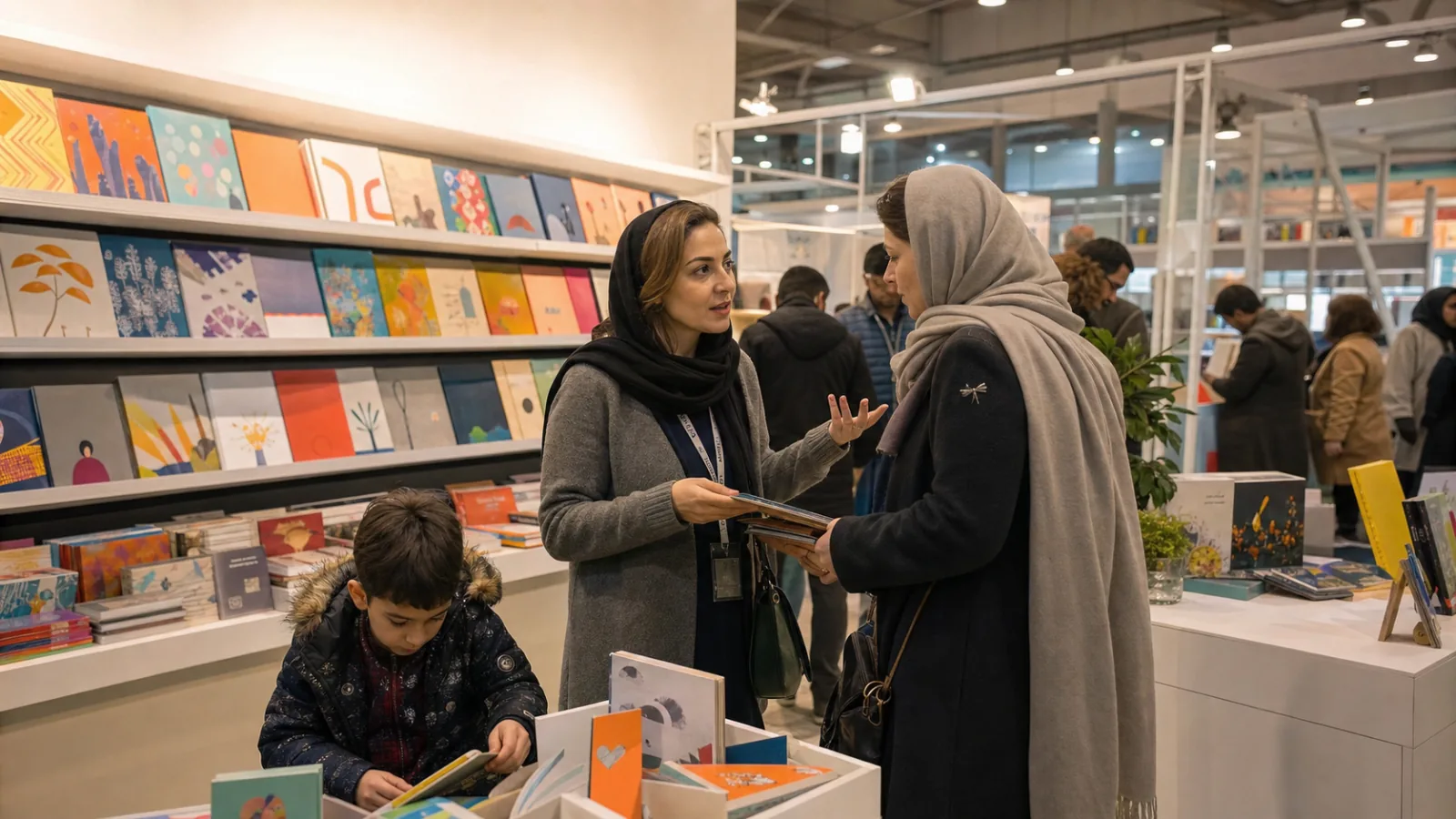
“Saffron Publishing Company at Book Fair” is about an Iranian children’s publisher named Zafaran or Saffron—not the spice. In a historical interview from the 30th Tehran International Book Fair, publishing director Nooshin Nilforooshan said the company had brought 280 book titles, including 25 first editions.
The distinction matters on this website. Nothing in the report concerns saffron farming, food or trade, and it would mislead readers to force those topics into it. This page preserves the event record and explains the translated catalogue and fair figures as accurately as the surviving source permits.
What Saffron Publishing brought to the fair
Nilforooshan gave two catalogue totals: 280 books at the stand, but only 263 recorded in the Book House listing used for that publication year. She explained that books published after 12 March had entered the following year’s records, which created the 17-title difference.
That is a classification issue rather than a contradiction. A fair stand can contain newly delivered books that have not yet entered the same reporting window as the rest of the catalogue. The figure also should not be read as 280 brand-new releases; only 25 were described as first editions.
The English translation names new items as “Numbers Kit,” “Animal Train” and “School Bus.” It also lists several puzzle or activity titles, but renders them as “Jokes of Zebel,” “Happoo of Athletes” and “Pianos.” Those forms are too damaged to use as dependable English book titles. They remain part of the historical record, not recommendations for a modern catalogue search.
Children’s books that continued to sell
Nilforooshan said the Felix books and the Jolly Postman titles were still among the publisher’s popular sellers. Later catalogue records corroborate Zafaran as the Persian publisher of books in both series, although editions, translators and availability change over time.
Her explanation of their appeal was straightforward: a book tends to find an audience when something distinctive happens in it and the concept does not feel routine. This was not presented as a formula based only on bright covers or familiar characters. The event, idea and reading experience had to give families a reason to choose the book.
That comment also explains why a children’s publisher may keep established titles beside new releases at a fair. Parents and librarians often arrive with a known series in mind, while new work benefits from being discovered alongside books that readers already trust.
How the publisher described its selection process
Before publishing a book, Nilforooshan said the company examined the reasons for bringing it to market, considered its audience and looked at both reader taste and the book market. The surviving translation is brief, but the sequence is useful:
- identify the intended child or family audience;
- ask what makes the story, activity or format distinctive;
- judge whether the work suits that audience rather than copying a trend;
- consider how it fits the publisher’s list and the market;
- prepare the edition so its translation, design and production support the reading experience.
A market check does not mean chasing sales alone. In children’s publishing, format, illustration, paper, safety, language level and the role of adults in choosing books all affect whether a strong manuscript reaches its reader.
The difficult conditions in the children’s publishers’ tent
Much of the interview concerned the fair itself. Nilforooshan said amenities were limited and ventilation was poor in the tent used for children’s publishers. Rain entered the structure, damaging publishers’ stands or stock. She singled out the first Friday of the exhibition: bad weather caused losses on what would normally have been one of the strongest sales days.
Her criticism was not only about publisher convenience. Visitors had travelled through Tehran traffic and heat to attend, and she argued that the fair should respect that effort. A family-friendly book event needs clear access, safe walkways, comfortable air, weather protection and enough room for children to browse without crowding.
The same principle applies to protecting the books. Tents need raised storage, dry flooring and a plan for rainwater. Valuable stock should not sit directly on the ground, and electrical fittings must remain isolated from water. These are basic event-design requirements, not luxuries.
Why the thirtieth book fair report remains useful
The article captures both sides of a publishing fair. At the stand, Saffron Publishing arrived with a sizeable backlist, 25 first editions, recognised series and an editorial belief in non-routine ideas. Around the stand, poor ventilation and rain threatened books, sales and the visitor experience.
It also shows why catalogue numbers need context. The 280 displayed titles, 263 registered titles and 25 first editions measure different things. Treating them as interchangeable would exaggerate either the publisher’s new output or the size of the official annual record.
Nothing here establishes the publisher’s current catalogue, management or fair schedule. Readers seeking a particular Felix, Jolly Postman or activity title should verify the current Persian title, edition, translator, ISBN and availability with a bookseller or the publisher.
A clear reading of “Saffron Publishing Company at Book Fair”
Nooshin Nilforooshan’s interview described Zafaran Publishing’s participation in the 30th Tehran International Book Fair: 280 titles on display, 25 first editions, established children’s favourites and difficult conditions in the children’s tent. It was a publishing-industry story whose repeated word “Saffron” referred to the company’s name.
Keeping that distinction explicit makes the page useful to the readers who find it through the publisher or fair, while preventing an accidental claim that a saffron company exhibited agricultural products at a book event.

![Exporting Saffron to Turkey + Price Guide [Complete 0 to 100]](https://img.rowhanisaffron.com/20260827003933/saffron-export-turkey-quality-inspection.webp)



