


Saffron packaging in Spain is often praised for presentation and market fit, but the quality of a pack depends on what it protects, communicates and proves—not the country printed on it. A 2019 speaker at the National Razavi Souvenir Festival argued that Iranian saffron was widely recognized as an Iranian souvenir while Spanish businesses were better at presenting it. The useful comparison is not Spain versus Iran as a slogan; it is a checklist of functions that any credible saffron package should perform.
The claim made at the Razavi Souvenir Festival
The event was held at Ferdowsi University of Mashhad and focused on souvenirs associated with Razavi culture and the region’s visitor economy. A speaker whose name survives in the English translation as Mohammad Kare, described as a faculty member at Iran University of Science and Technology, said packaging is a multidisciplinary field. It has to be designed for the audience rather than treated as a final decorative step.
He reported that 40 works had been submitted to the festival and welcomed the ideas from Iranian artists. He also connected the university–industry relationship with festivals, start-ups and the university growth centre, which he said could help interested students reach financial partners.
The article does not provide a programme, jury record or portfolio of those 40 entries. It records the speaker’s argument and the number he gave; it does not establish that every submission became a commercial package.
Why saffron works as an Iranian souvenir
Saffron is small, valuable, culturally familiar and closely associated with the Khorasan provinces. A traveller can carry a useful amount without heavy luggage, and the spice can later recall a meal or visit. In Mashhad, that makes it a natural souvenir for pilgrims and other visitors.
A souvenir pack has two jobs at once. It must protect a delicate food, and it must explain where the item came from without asking the buyer to decode a specialist export label. If either job fails, the package is weak. An attractive box cannot compensate for crushed, damp or anonymous threads.
What good saffron packaging actually protects
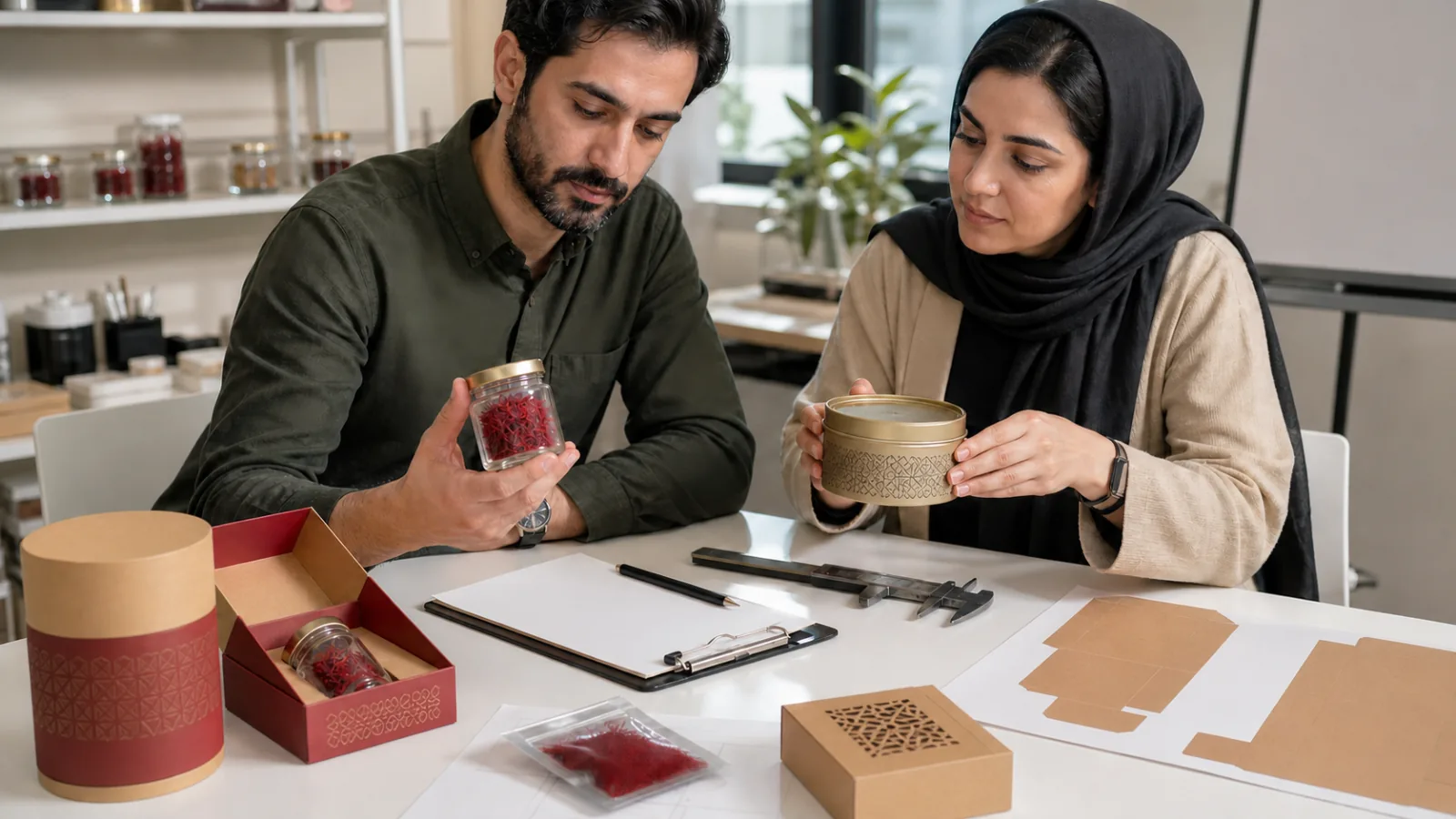
Dried saffron is vulnerable to moisture, contamination, strong surrounding odours, light and rough handling. The primary container should be food-safe, close securely and suit the amount inside. An outer carton can add physical protection and a printable surface, but it should not create a large, wasteful box around a tiny jar.
For a travel souvenir, the pack also needs to survive a suitcase. A glass jar may display the product well but requires impact protection. A sealed metal tin can block light and resist crushing, though the buyer cannot see the threads before opening. A high-barrier sachet is light and efficient but offers less presentation. The right choice depends on the customer, route and pack size.
Visible tamper evidence is valuable when it is simple and genuine. Decorative seals that can be lifted and replaced provide an impression of security without the function.
What a Spanish or EU retail label needs to do
Packaging saffron for sale in Spain is not only a graphic-design exercise. The European Commission’s summary of mandatory food information explains that Regulation (EU) No 1169/2011 governs food information for prepacked products. The exact requirements and exemptions depend on the product and presentation, but the label framework includes the food name, net quantity, date marking, storage or use conditions where needed, and the name and address of the responsible EU food business or importer.
Mandatory information must be easy for consumers in the market to understand. In Spain that normally means Spanish, although additional languages may appear. Origin information becomes particularly important when omitting it, or the overall presentation, could mislead the buyer about where the food comes from.
Pure saffron is a single-ingredient spice, so some general ingredient-list or nutrition rules may have exemptions. An exporter should confirm the current rule for the exact pack and sales channel rather than copying another brand’s label. Online listings also need mandatory food information available before purchase, subject to the regulation’s timing rules.
Iranian identity and target-market language can coexist
The festival speaker criticized Iranian manufacturers that used foreign-looking brands and labels until their goods were hard to distinguish from imports. His concern was loss of identity: a customer looking for an Iranian product might overlook it.
Identity does not require a monolingual pack. A successful export label can present an Iranian name, truthful growing origin and visual character while giving the destination market the language and information it needs. Persian can be part of the design, but it should not replace required Spanish information or force a buyer to guess how to use and store the product.
Typography, colour and ornament should support recognition. They should never make the legal name, net weight, lot code or origin difficult to find. Tiny gold writing on a patterned background may look luxurious and still be poor information design.
What 2019 trade data says about Spain
Spain was a major destination for Iranian saffron when the article appeared. The WITS presentation of UN Comtrade data records Iranian exports to Spain in 2019 at about $57.0 million and 56,932 kg.
That is evidence of a substantial trade flow. It is not evidence that all saffron sold by Spanish companies was Iranian, that every Spanish pack was better, or that every shipment was re-exported. To make those claims, we would need product-level origin statements, transaction records and a defined measure of packaging quality.
Packaging is more than a beautiful container
The original speaker was right to call packaging multidisciplinary. A commercial pack brings together several kinds of work:
- Food protection: barrier, closure, hygiene and shelf-life conditions;
- Compliance: accurate claims, mandatory information and readable presentation;
- Industrial design: size, opening, dosing, storage and transport;
- Graphic design: hierarchy, recognition, language and visual character;
- Production: materials, filling, sealing, coding and quality control; and
- Commercial fit: retailer shelf, online image, price point and customer expectation.
A design that cannot be filled consistently, coded clearly or produced at a viable cost is an exhibition concept, not yet a market package. Conversely, an inexpensive standard container can perform well if it protects the saffron and gives the buyer confident, truthful information.
How to evaluate an Iranian saffron souvenir pack
Before approving the design, test the physical pack with the actual saffron and route. Check whether threads snag in the closure, whether the seal survives handling, whether the container admits moisture or odour, and whether a small retail pack looks full rather than misleadingly oversized.
Then test the information with people who were not involved in the project. They should be able to find the following quickly:
- the word saffron and the physical form inside;
- the true net weight;
- the declared growing origin and responsible packer or importer;
- the lot and date information;
- storage guidance; and
- a contact or traceable business identity.
Our article on Persian saffron and the branding gap explains why those details matter to export value. The package is one visible part of a larger promise built from lot control, testing and repeatable service.
How festivals and start-ups can help
A design festival can bring food businesses, artists, engineers and students into the same room. It is good at generating alternatives and challenging the habit of copying familiar packages. A university growth centre can help a promising concept move toward prototyping, cost analysis and investment.
The difficult work comes after the prize. A team has to confirm food-contact materials, run transport and shelf-life tests, build a filling process, check label compliance, price the finished pack and win retailer and consumer trust. The first businesses absorb much of that uncertainty; suppliers and complementary companies often appear once demand becomes visible, which is the cycle the festival speaker described.
The fair lesson from saffron packaging in Spain
Spain offers useful examples of consumer-facing saffron presentation and has long been an important participant in the trade. It should be studied, not mythologized. There are strong and weak packages in every market.
For an Iranian souvenir, quality means more than adding Persian motifs to a box. The pack should protect the threads, survive the journey, meet the destination’s rules, state origin honestly and make the product pleasant to give and use. When it does that, Iranian identity is not a decoration applied at the end. It is supported by the product and information from the inside out.

![Exporting Saffron to Turkey + Price Guide [Complete 0 to 100]](https://img.rowhanisaffron.com/20260827003933/saffron-export-turkey-quality-inspection.webp)



