


Saffron in the Iranian Economy is more than an export statistic. The crop connects small farms, seasonal flower pickers, families who separate and dry the stigmas, laboratories, packers, traders and retailers. Khorasan remains central to that chain because it combines generations of cultivation knowledge with the dry climate and autumn irrigation pattern in which saffron is traditionally grown.
The description “red gold” captures saffron’s high value relative to its weight, but it can hide a harder question: how much of the final value stays with the grower and the producing community? Yield, labour costs, water, quality, exchange rates, packaging, certification and the route to the final customer all shape the answer.
Why Khorasan sits at the centre of Iranian saffron
Saffron farming has deep roots in the Khorasan region. Razavi Khorasan and South Khorasan are the best-known producing provinces, while North Khorasan has built an important cluster of its own. Cultivation has also spread to other Iranian provinces, but a larger planted area does not automatically produce the same yield, quality or return.
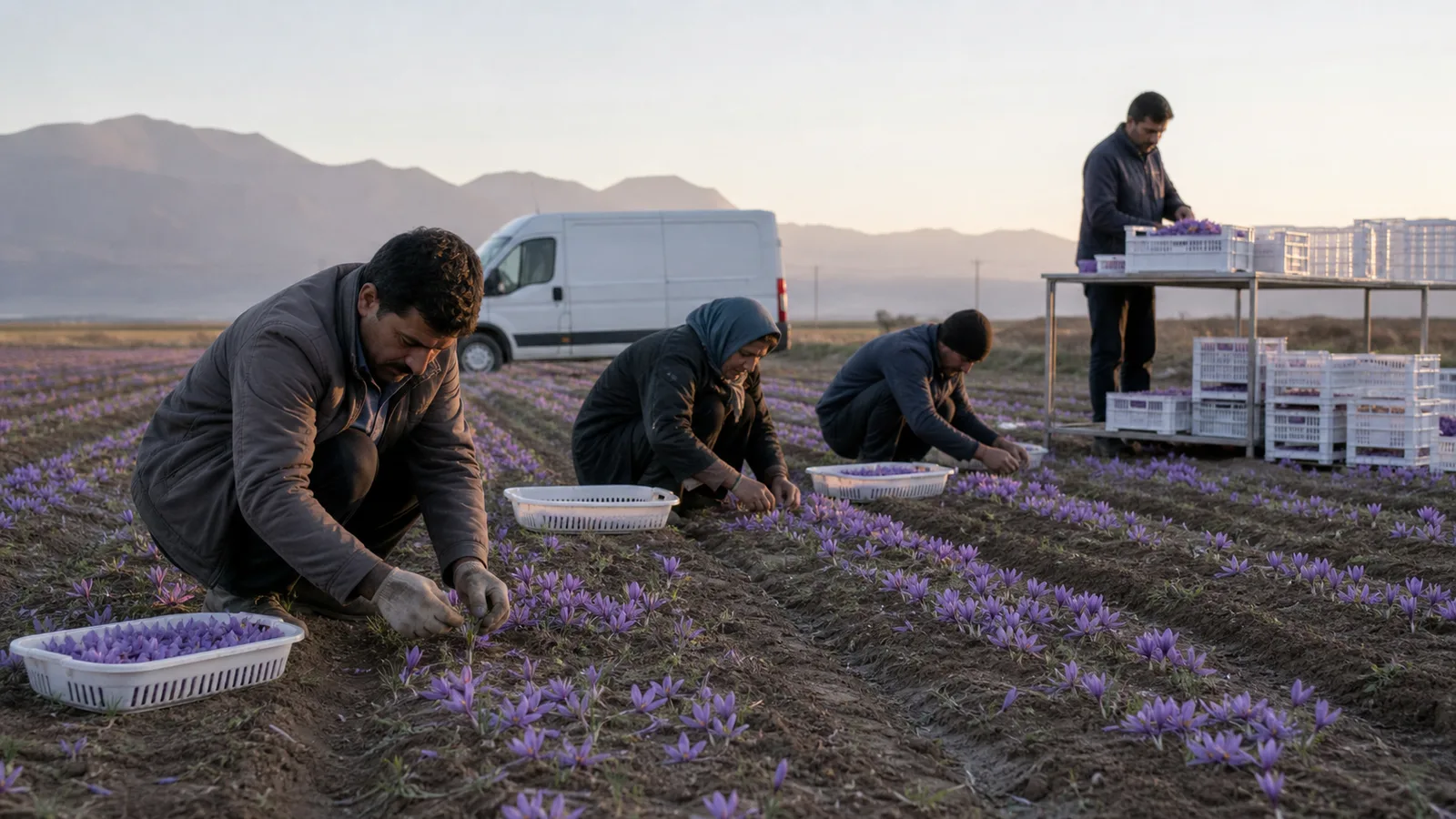
The work is compressed into a short season. Flowers are picked early, before heat and handling damage them. The red stigmas must then be separated from the petals and dried with care. A mistake during those hours can reduce aroma, colour strength and sale value after months of field work.
Farooj and North Khorasan: a dated local snapshot
Farooj is the leading saffron area within North Khorasan and offers a useful case study in how a local economy grows around one crop. An official provincial agriculture report published in 2020 recorded 4,300 hectares and a forecast harvest of 21 tonnes across North Khorasan. It put average yield at 6.2 kg per hectare and ranked the province third nationally by area and production at that time.
Those figures are a historical snapshot, not current inventory. A 2021 follow-up reported 4,350 hectares and forecast 22 tonnes. Area, yield, prices and rankings change with weather, corm condition, irrigation and the reporting year, so an undated “today” label would make the numbers misleading.
The earlier Farooj reporting also described workers arriving from Golestan and Mashhad during harvest, growers coping with labour shortages during the COVID-19 period and local attempts to mechanise flower picking. One machine was said to replace the work of 15 people. That is best read as a claim from a local pilot, not a proven benchmark for every farm or terrain.
Where saffron creates jobs
Saffron creates field work during planting, weeding and harvest, then post-harvest work in stigma separation, drying, grading and packing. The autumn peak can bring short-term income to local and migrant workers. It can also create a bottleneck: flowers cannot wait several days for a labour crew without losing quality.
Employment counts need care. A “job” may mean a full-time position, a direct farm role, a few days of seasonal work or an indirect service. Provincial reports have used large indirect-and-seasonal estimates per hectare, but those categories should not be repeated as equivalent permanent jobs. A stronger economic measure records paid days, wages, gender and age participation, workplace conditions and how much processing remains local.
The value chain after the flowers are picked
The farm gate is only the beginning. Drying controls moisture and stability. Sorting removes yellow style and foreign material. Laboratory testing can document identity, moisture and colouring strength. Packaging protects the spice and gives the buyer origin, lot and traceability information.
Each step can add value. When saffron leaves a producing area in anonymous bulk, later businesses may capture the margin from testing, branding, small retail packs and distribution. Local processing does not guarantee a good outcome by itself, but it gives farmers and cooperatives more ways to negotiate than selling fresh flowers or ungraded threads to the first available buyer.
North Khorasan reports from 2020–2021 described several processing and packing units and a seasonal rural market in Farooj. The important question is not merely how many units exist; it is whether they operate at useful capacity, meet destination-market requirements and pay for documented quality.
What export data can and cannot show
Iranian saffron reaches buyers through Spain, the United Arab Emirates, China and other markets. Partner-reported UN Comtrade data, presented by the World Bank’s WITS service, show that Spain recorded about $39.5 million and 45,437 kg of saffron imports from Iran in 2023. That confirms a substantial trade route, but it does not say that all of the product was grown in one province or sold onward under Iranian branding.
Trade figures are sensitive to reporter, year, customs code, currency and revisions. Import-partner data and Iranian export declarations may not match exactly. Re-exporting can also make the country on a retail label different from the agricultural origin. For that reason, the old claim that North Khorasan exported exactly three tonnes to Spain for 45 billion toman should not be presented as a current national total without a dated customs record.
Exchange rates, certification and market access
A weaker domestic currency can make an export price look competitive while raising the cost of packaging material, machinery, laboratory work and finance. Exporters also face changing customs procedures, payment constraints and certification requirements. Delays matter because cash tied up in stock cannot pay farmers or seasonal workers.
Quality documentation can reduce disputes, but paperwork is not a substitute for a clean product. Buyers need consistent moisture, freedom from foreign material, truthful origin and packaging that protects aroma. Our review of the historical 95% Iranian saffron claim explains why production, export and re-export shares should not be treated as the same measure.
Water advantage does not mean drought-proof farming
Saffron is often described as a lower-water alternative because much of its irrigation falls outside the peak summer demand of many crops. That can make it attractive in dry and semi-dry areas. It still needs suitable water at critical stages, healthy corms and workable soil. Drought, salinity, extreme heat, disease and poorly planned expansion can all reduce yield.
Replacing a damaged vineyard or another crop with saffron may help one farm, as happened in accounts from North Khorasan, but it is not a universal rescue plan. If too many growers expand at once without storage, processing and market demand, the result can be a price problem rather than prosperity.
What would keep more saffron value in Iran?
- Publish dated production, yield, price and export data with clear definitions.
- Improve corm health, extension support and field-level quality control.
- Protect seasonal workers with transparent pay and safe working conditions.
- Expand testing, traceability and packaging where demand justifies the cost.
- Build recognizable origin and producer brands instead of depending only on bulk volume.
- Diversify destinations and payment routes so one market disruption does not halt sales.
- Judge mechanisation by field trials, quality loss and total cost—not headline worker equivalents.
Saffron’s economic importance is real, especially across Khorasan, but it is not automatic. The crop supports livelihoods when the whole chain works: viable fields, timely labour, careful drying, trusted quality and access to buyers who pay for origin. That is the difference between exporting a valuable spice and building durable value around it.

![Exporting Saffron to Turkey + Price Guide [Complete 0 to 100]](https://img.rowhanisaffron.com/20260827003933/saffron-export-turkey-quality-inspection.webp)



