


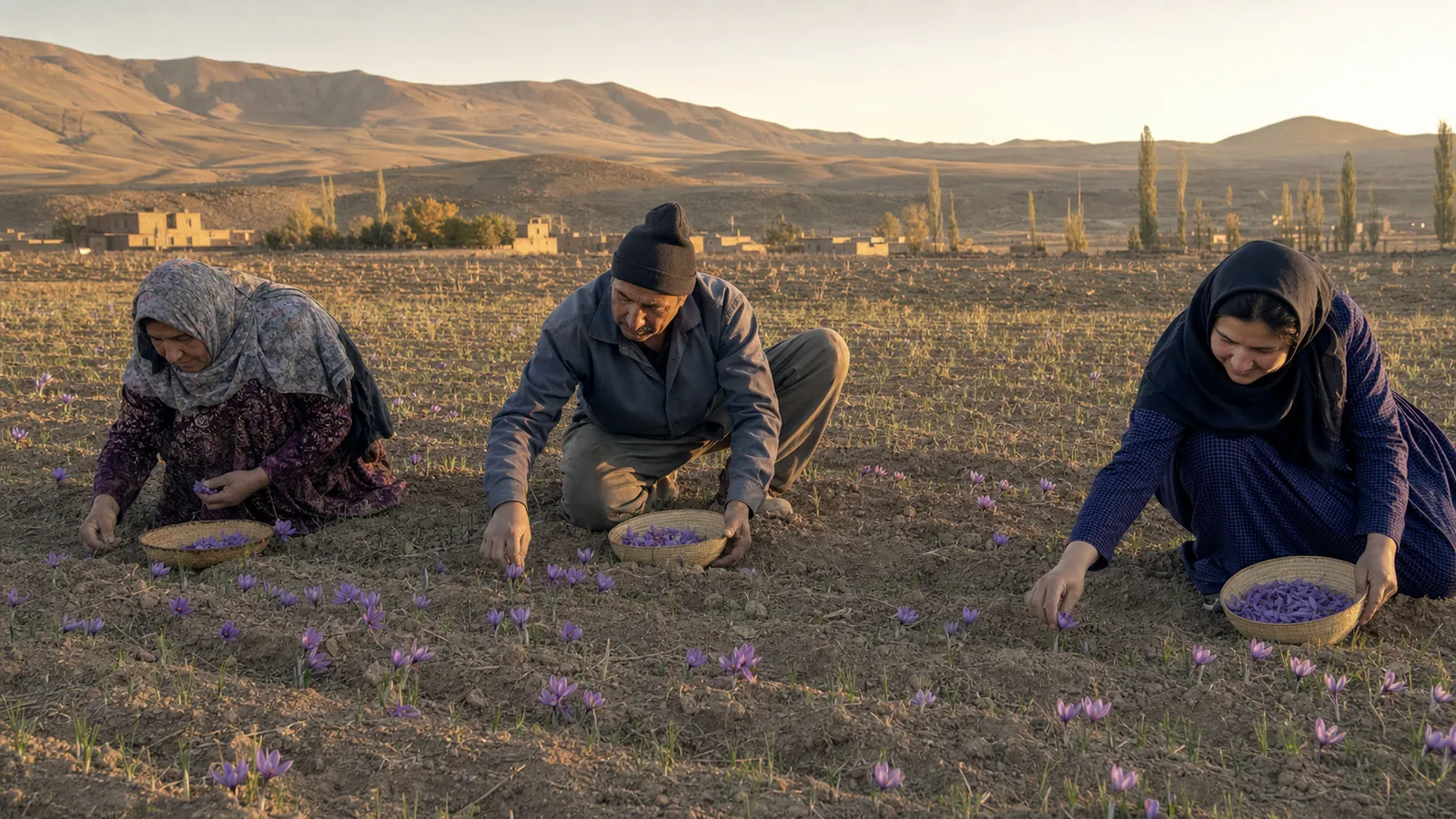
Ghaenat saffron is saffron whose protected origin is Ghayenat County in Iran. That is the clear meaning behind the old headline “Saffron Ghaenat the show will be geographic.” The name is more than promotional wording: Iran recognised it as a geographical indication, and WIPO recorded “Iran’s Ghayenat saffron” internationally as an appellation of origin in 2018.
The spelling varies in English. Ghaenat, Ghayenat, Qaenat and Qayenat can refer to the same South Khorasan area, while Ghaen or Qaen commonly names the city and county centre. A buyer should not rely on spelling alone. What matters is whether a commercial lot can be traced to eligible production in the protected area.
What the original report meant by a “geographic show”
The 2015 English article is a damaged translation about geographical recognition. It says Iranian saffron was often sold in bulk to foreign buyers and then entered other markets under European trade names, without visible reference to Iran. Its proposed answer was to register Ghaenat saffron as a geographical product, alongside a separate idea about recording its genetic resources.
Repacking saffron in another country does not change where the crop was harvested. A label can truthfully identify both origin and packing location. The problem arises when the presentation hides, confuses or falsely replaces origin, or when a regional name is used for a lot that cannot be traced to that region.
The old report also refers to a national development plan and describes Ghaen saffron as a long-established product made across local towns and villages. It does not provide the plan’s title, boundaries, production protocol or date. Those missing details can now be replaced by the legal record, rather than guessed from the translation.
How a geographical indication works
Iran’s 2005 Act on the Protection of Geographical Indications defines a GI as an indication identifying a good from a country, region or locality when a quality, reputation or other characteristic is essentially attributable to that origin. The official text in WIPO Lex also sets rules against misleading use and provides for registration and enforcement.
A GI is a collective origin right, not a private claim that one company invented saffron. Producers who meet the applicable geographical and production conditions may be entitled to use it. A business trademark still identifies the individual seller. The two can appear together because they answer different questions: where does this product come from, and who is responsible for this particular pack?
An appellation of origin is a particularly close form of geographical protection. WIPO’s Lisbon System provides an international register for appellations of origin and geographical indications already protected in their home jurisdiction. It does not make the right universal in every country; protection follows the treaty framework and the position of each participating jurisdiction.
The international record for Iran’s Ghayenat saffron
WIPO’s official bulletin lists “Iran’s Ghayenat saffron” as appellation of origin registration number 1118, registered on 19 June 2018. It defines the product as saffron and the area of production as the region of Ghayenat County.
The registration entry names Iran’s Intellectual Property Center as the competent authority. It identifies a Ghaen saffron company and the South Khorasan union of agricultural cooperatives representing barberry growers, gardeners and saffron producers among the beneficiaries. The domestic legal basis includes Iran’s GI law and a national GI registration from 2016.
This record supplies the information the 2015 translation lacked: a protected name, product, geographical area, competent authority, beneficiaries and legal basis. It is evidence of recognition. It is not, on its own, evidence that any anonymous pouch offered online contains Ghaenat saffron.
What the designation says about a saffron lot
A legitimate geographical designation links the lot to a place and to the conditions attached to use of the name. It can protect the reputation created by growers and processors over time, and it gives buyers a term that should mean more than a seller’s preferred adjective.
It does not tell the buyer everything about the product. Saffron from the same county can be offered as intact filaments, cut filaments or powder. Lots can differ in crop year, thread composition, moisture, colouring strength, aroma, cleanliness, contaminant results, packaging and storage history. A protected origin is not a substitute for a purchase specification.
Nor is it a guarantee that the most expensive lot is the best choice. A wholesaler may need durable intact threads for retail jars, a food manufacturer may work to a validated powder specification, and a restaurant supplier may prioritise aroma, colour and pack size. Origin and intended use belong in the same buying decision.
How a buyer can verify Ghaenat saffron
Verification begins before the sample arrives. Ask the seller to state the producer or eligible operator, harvest area, crop year, lot number, processing location and packing location. The wording should distinguish “grown in Ghayenat” from “packed in” another city or country.
Then follow the lot through its documents. The number on the sample, laboratory report, specification, invoice and final packaging should refer to the same commercial material. If a large lot was assembled from several growers, the processor should be able to show how the component records connect to it.
- Origin evidence: eligible grower or producer records and the field or village within the protected area.
- Lot identity: one traceable code carried through receipt, drying, storage, blending if allowed, testing and sale.
- Product form: filaments, cut filaments or powder, with the red stigma and any yellow style described accurately.
- Sampling: a representative method that connects the tested sample to the full commercial lot.
- Laboratory scope: methods and results relevant to the agreed quality, authenticity, residue and food-safety requirements.
- Commercial terms: quantity, packaging, destination, delivery term, payment method and quote validity.
A certificate image sent without a verifiable issuer, scope or lot reference is not enough. Request the original electronic report or an issuer-verification route, and check that the laboratory’s competence covers the method on the document.
Geographical origin and genetic identity are separate
The 2015 article joins geographical and genetic registration in one sentence. They should be kept apart. Ghaenat origin is a legal and traceability claim about where an eligible product comes from. Genetic-resource documentation records plant material for research, conservation and comparison.
Saffron is a sterile triploid crop propagated through corms. Genetic and morphological research can help document accessions, field performance and plant health, but it does not replace farm records. A laboratory profile cannot by itself prove the full route from a particular Ghaenat field through drying and packing.
The reverse is also true. An invoice naming Ghaenat does not prove authenticity if the lot has no credible chain of custody. Strong origin assurance combines legal entitlement, production records, controlled handling, representative sampling and a commercial audit trail.
Where the Codex saffron standard fits
Codex CXS 351-2022 gives dried saffron an international product framework. It defines covered forms and addresses quality provisions, contaminants, hygiene, packaging and labelling. The current standard is available in the FAO/WHO Codex standards register.
Codex and geographical protection complement one another. Codex helps describe what dried saffron offered in trade should meet. The appellation identifies a protected origin. Neither replaces the destination country’s food law, the buyer’s contract or lot-specific testing.
Our Iranian saffron standards guide covers product form, sampling and laboratory interpretation in more detail. For Ghaenat saffron, those quality records should remain attached to the origin record rather than travel as generic paperwork.
Bulk trade does not have to erase Iranian origin
The old article’s concern about bulk exports was not that every foreign packer was acting improperly. Bulk trade can be efficient: a destination business may pack locally, meet local language rules and serve retailers in smaller quantities. The commercial route becomes a problem when traceability ends or the label creates a false origin impression.
Exporters can protect origin while selling bulk. Use sealed, identified containers; keep weights and seals in dispatch records; state country and region accurately; contract against unauthorised substitution; and give downstream customers the evidence needed for truthful labels. If different origins are blended, the pack must not present the mixture as exclusively Ghaenat saffron.
Growers and cooperatives also need to know where value is retained. Track the quantity sold with the protected name, average payment time, rejection and downgrade rates, repeat buyers, claims, packaging location and the difference between anonymous bulk and traceable-origin contracts. A registration matters commercially only when those outcomes improve.
What “Saffron Ghaenat” should mean on a wholesale offer
The legacy Yoast phrase “Wholesale Saffron Ghaenat from Iran” captures a real buyer intent even though the original article did not answer it well. A credible wholesale offer should name the protected origin without turning it into decoration. It should then describe the exact lot a buyer can approve.
That means specifying form and grade basis, net quantity, packaging, crop year, test scope, sample terms, Incoterm, currency, payment method, lead time and document set. The supplier should state whether the offer is for one existing lot or for future production that will be matched to an approved specification.
Ghaenat’s international registration gives the regional name a legal foundation that the 2015 article hoped to see. The work after registration is more demanding: keep the origin chain intact, describe the saffron honestly, test the actual lot and make sure the label tells the same story as the field and invoice.
The bulk-trade, national-plan, genetic-record and regional-history points are preserved from the site’s March 2015 report. WIPO, Iranian GI-law and Codex sources were reviewed on 28 August 2026.

![Exporting Saffron to Turkey + Price Guide [Complete 0 to 100]](https://img.rowhanisaffron.com/20260827003933/saffron-export-turkey-quality-inspection.webp)



