


At Yazd University, agricultural students tested soilless saffron cultivation in a greenhouse as part of a research project. The original English headline called it “saffron free cultivation,” but the work described saffron grown without field soil, using controlled hydroponic or aeroponic methods.
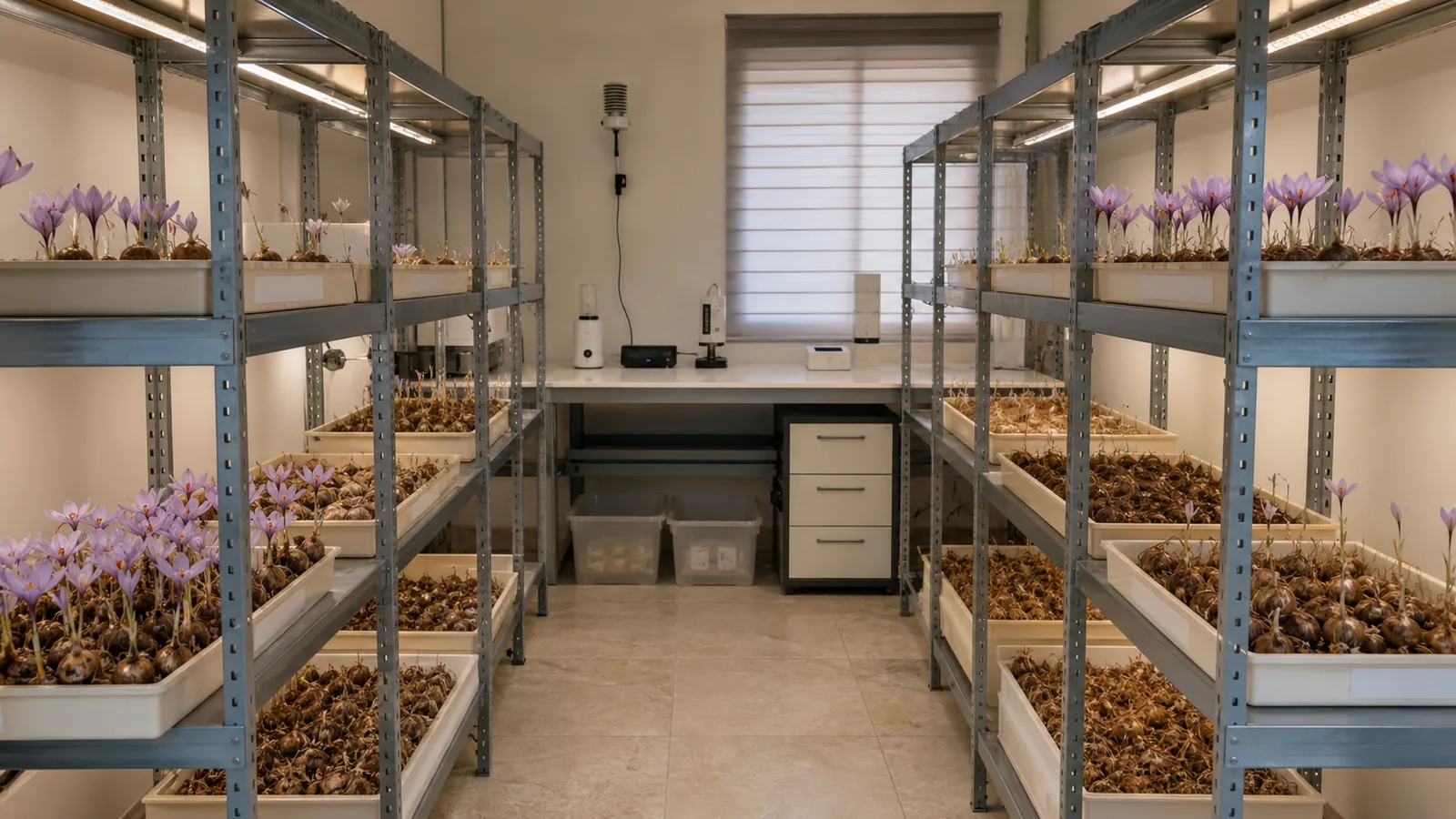
The project was presented as a master’s-thesis study with an entrepreneurship goal. It is best understood as an academic trial, not as proof that soil-free saffron is automatically more productive or profitable at commercial scale.
Who led the Yazd University project?
Somayeh Ghasemi, an associate professor and director in Yazd University’s department concerned with the rehabilitation and management of dry and desert areas, described the project. Agricultural students carried out the cultivation in the university greenhouse.
The study responded to two pressures identified in the report: rising demand for saffron and limited suitable land. It explored whether controlled systems could concentrate the flowering stage into a smaller footprint while giving students practical experience.
How the research space was arranged
The account described a 75-square-metre hall with two rows of four-level shelving. Vertical racks increased the number of corms that could be held within the room’s floor area.
Imported hydroponic substrates were said to be expensive, so the researchers tested alternative organic materials. The old article did not name those materials, their proportions or the study results. It would therefore be misleading to recommend a particular substitute on the basis of this short report.
What “soilless saffron” involves
Saffron corms store energy accumulated during their previous growth. Under managed temperature, humidity and light, they can produce fresh flowers while sitting in trays or another soil-free support. The Yazd University report said flowering could occur within one to two months in its controlled setting.
That does not mean a corm completes its whole biological cycle in a few weeks. After flowering, it must support leaf growth and develop replacement corms if the system is meant to continue. Any serious evaluation should state where this later growth happens and whether the corms remain healthy over more than one season.
Benefits claimed in the report
Ghasemi associated the system with several practical advantages:
- more corms per square metre of floor area through multi-level shelves;
- greater control over nutrition and environmental conditions;
- flowers produced in a clean, soil-free setting;
- easier access during the saffron harvest; and
- potentially lower labour needs for some handling tasks.
These are project claims rather than independently compared outcomes. More corms in a room can also increase the importance of airflow, sanitation, humidity control and rapid detection of mould. Easy picking does not account for every labour and energy input elsewhere in the system.
What would show whether the system succeeded?
A commercial assessment would need measurements that the short university announcement did not provide. Useful evidence would include corm number and weight, fresh flower yield, dried stigma yield, product quality, disease losses, energy use, labour hours and the condition of daughter corms after a full cycle.
Costs also need to include shelving, environmental control, alternative substrate preparation, storage and whatever field or greenhouse stage follows flowering. A high flower density in a photograph is encouraging, but it is not an economic result.
How this fits Yazd’s wider saffron activity
The university trial sat within broader interest in saffron across Yazd province. For regional context, the site also records an earlier projection of 1,500 kg of saffron production in Yazd. That post is a separate historical forecast, not a result of this 75-square-metre research hall.
The lasting value of the Yazd University work is its research question. It tested local alternatives to costly imported inputs and gave agricultural students a controlled setting in which to study saffron. Whether the method should expand depends on complete technical and financial data, not the promise of soil-free cultivation alone.

![Exporting Saffron to Turkey + Price Guide [Complete 0 to 100]](https://img.rowhanisaffron.com/20260827003933/saffron-export-turkey-quality-inspection.webp)



