


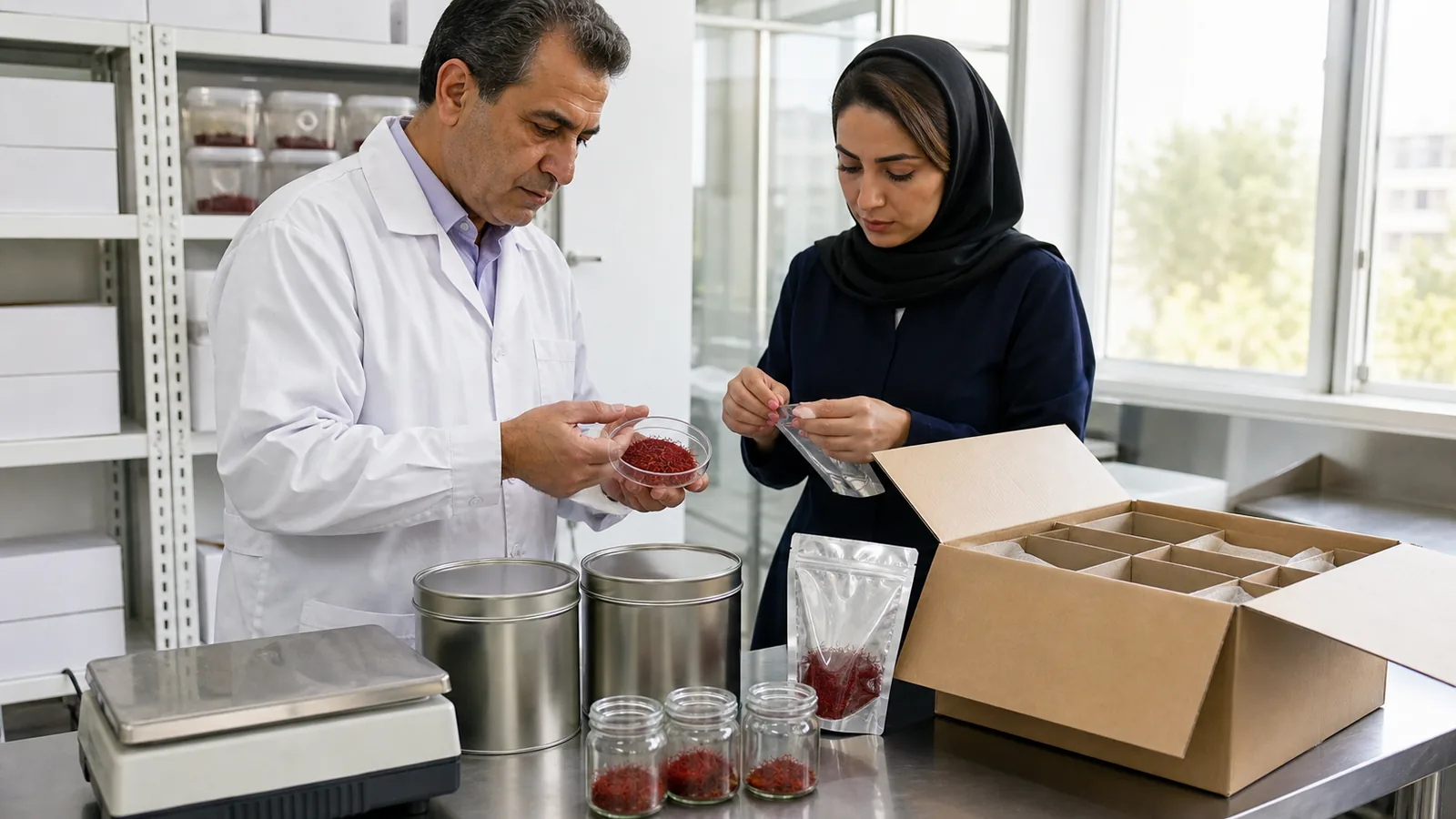
The headline “Saffron exports have increased 42%” records a claim made about Iran’s saffron trade in Iranian year 1393, which ran across parts of 2014 and 2015. The surviving article does not say whether 42 percent refers to export weight, customs value, a partial-year period or a final annual total. It should be preserved as a historical report, not repeated as a verified modern statistic.
That missing denominator matters. Saffron exports can rise in kilograms while falling in dollar value, or rise in value because the unit value changed even when less product left the country. A useful growth statement has to name the measure, dates, source and comparison period.
What the original 2015 article reported
The post described Iranian year 1393 as a successful period for selling saffron abroad and said exports had increased 42 percent over the previous year. It connected demand with saffron’s use in food and other industries, and said Iran’s production remained high despite cultivation in India, Kashmir and Afghanistan.
Spain and the United Arab Emirates were identified as leading destinations for Iranian saffron. The article’s concern was that much of the product left in bulk, was bought by foreign intermediaries and later reached retail markets in packaging that did not make Iranian origin prominent.
One damaged sentence gives the year’s export value as “approximately 100 to 201 million dollars.” That is not a usable number. It might reflect a mistranslated range, two different periods or a corrupted figure, but the source does not provide enough information to choose between them.
The article closes by saying Iranian saffron was sold across European and Asian countries but relatively little was exported in new Iranian consumer packaging. These points form a coherent historical argument: export volume was growing, yet Iran risked giving away the downstream relationship with the customer.
Why the 42 percent cannot be read on its own
“Exports” can describe several datasets. A customs authority may report declared exports from Iran. A destination country may report imports from Iran. An industry association may count member shipments. A news report may compare the first eight or eleven months with the same months a year earlier.
Those series will not always match. Export declarations are normally recorded on an FOB basis, while import declarations can include cost, insurance and freight. Timing, exchange rates, late declarations, returned shipments and different partner coding add more differences. Partner-reported trade can capture a flow that the origin report omits, but it may also contain re-exports or attribution errors.
The calendar is another trap. Iranian year 1393 began in March 2014 and ended in March 2015. Comparing it directly with a January-to-December 2014 table mixes months. A 42 percent result for part of 1393 and a different result for the completed year could both be mathematically correct.
Weight, value and unit value answer different questions
Export weight tells us how much declared saffron crossed the border. Customs value tells us the declared value attached to those shipments. Dividing value by net weight produces an average unit value. None of the three is a complete measure of success.
Weight can grow because more bulk material was sold at a lower return. Value can grow because saffron prices or exchange rates changed. Average unit value can move because the mix of thread grades, powders, package sizes, destinations and delivery terms changed. It is not a live market price and does not reveal how much money reached growers.
A strong export review therefore reports at least weight and value side by side. It should also separate product forms and package sizes where the customs nomenclature allows, show the destination mix and state whether the figure is nominal dollars or has been adjusted for inflation.
What the historical evidence says about bulk trade
The bulk-export concern was not unique to this article. A 2014 UNIDO diagnostic study of Iran’s saffron value chain reported that more than 83 percent of Iran’s 2012 saffron exports went to five countries in bulk form. It identified the UAE, Spain, Saudi Arabia, Italy and Hong Kong as that concentrated group.
The same study described Spain as retaining more value through commercial reputation, retail-market access and small consumer packs. That does not mean saffron processed or packed in Spain was necessarily Spanish-grown. Country of harvest, customs origin, processing location and the brand owner can be four different facts.
Bulk shipment is not automatically a failure. A large food manufacturer may need kilograms rather than one-gram jars, and local packing can reduce freight, simplify destination-language labels or serve retailers efficiently. The strategic question is whether the Iranian supplier keeps traceability, earns an appropriate return and remains visible to the downstream buyer.
Production leadership is not the same as export-market control
The old article contrasted Iran’s high output with smaller competing origins. Production gives Iran a supply position, but it does not by itself secure shelf space, price influence or repeat direct customers. Those depend on quality consistency, contracts, payment access, logistics, regulatory compliance and market development.
Other producing regions can compete through a protected origin, a recognised brand, a specialised grade or a shorter route to a particular market even when their harvest is smaller. Re-export hubs can build buyer relationships without growing the crop. Looking only at production tonnage misses where processing, packaging and commercial margin are retained.
Country rankings also change with the data lens. A table of declared exports ranks exporting territories. A table of harvest production ranks growing origins. A partner-import table may attribute goods to the last shipping country or to origin, depending on the declaration. These lists should not be merged into one “world share.”
How to verify an export-growth headline
Before repeating a figure such as 42 percent, reconstruct it. The calculation is simple only after the terms are fixed:
- name the reporter, dataset and product code;
- state whether the measure is kilograms, customs value or average unit value;
- use complete and equivalent date ranges;
- compare the same flow: exports with exports, not exports with partner imports;
- record whether the value is FOB, CIF or another basis;
- keep provisional data separate from later revised totals;
- calculate growth as the change divided by the earlier period, then show both underlying numbers.
If the earlier period was unusually weak, a large percentage increase may represent recovery rather than a new record. If the earlier number is zero or missing, percentage growth is undefined. Publishing the two base values lets readers see the scale instead of relying on an impressive percentage.
Our Iran saffron export statistics guide explains reporter-versus-partner records, HS 091020, quantity checks and re-export risk in detail.
Destination data need an origin check
Spain and the UAE can appear as large buyers of Iranian saffron and as exporters to other markets. That pattern is consistent with processing, consolidation and re-export, but a customs table alone does not prove what happened to an individual lot.
To follow value through the chain, connect the export declaration with the lot, buyer, processing record and next sale. Ask whether the material was resold unchanged, blended, ground, packed into smaller units or incorporated into another product. Each step can change its customs treatment, unit value and market identity.
Double counting is a real risk. Adding Iran’s direct export to Spain and Spain’s later export of the same saffron treats one crop as two supplies. Global gross-export totals measure border crossings, not unique harvest production.
Packaging is valuable when it solves a market need
The original article treated new packaging as the missing route to retail value. Packaging can help, but putting saffron in a small decorative container is not a strategy by itself. The pack must protect the threads, meet destination rules, suit the customer’s use and carry a traceable lot identity.
A retail pack requires consumer-language labelling, accurate net quantity, responsible-business details, country of origin, batch information, suitable materials and evidence behind every quality or certification claim. It also needs a distributor, shelf position, replenishment plan and price that leaves room for each participant in the channel.
Bulk and retail should be measured separately. A processor buying ten kilograms under a repeat specification may be more valuable than a one-off run of expensive jars with no distributor. The useful metric is retained margin and repeat demand, not the smallest package size.
Quality documentation supports export value
Saffron serves food, hospitality and manufacturing buyers with different specifications. The seller has to identify product form, thread composition, moisture and relevant chemical, microbiological and contaminant requirements. Sampling must represent the lot being shipped.
Codex CXS 351-2022 provides an international baseline for dried saffron, including product forms, quality provisions, hygiene, contaminants, packaging and labelling. Buyer contracts and destination law may be stricter. A certificate that does not identify the commercial batch cannot carry the transaction on its own.
For a practical export enquiry, our Iranian saffron exporter checklist covers specifications, samples, documents, delivery terms and payment questions that should be settled before a price is compared.
What a better measure of saffron export success looks like
A year-on-year increase is useful context, not the final objective. Export performance should be reviewed through several lenses: saleable kilograms, customs value, defensible unit value, number and concentration of destinations, share sold under traceable origin, repeat-buyer rate, claims and rejections, payment time and value retained by Iranian growers and processors.
The 42 percent headline captured optimism in early 2015, while the body captured the harder problem of bulk sales through intermediaries. The percentage cannot be independently reconstructed from the surviving text. The strategic lesson is stronger than the number: growth is worth celebrating only when the underlying series is clear and the extra trade produces reliable, traceable and profitable customer relationships.
The 42-percent, damaged dollar-value, destination, production and packaging statements are preserved from the site’s March 2015 report. UNIDO and trade-method sources were reviewed on 28 August 2026; no historical figure has been silently converted into a current statistic.

![Exporting Saffron to Turkey + Price Guide [Complete 0 to 100]](https://img.rowhanisaffron.com/20260827003933/saffron-export-turkey-quality-inspection.webp)



