


Transforming saffron exports is not a matter of putting the same threads into a more expensive box. Useful innovation solves a measurable problem: it protects quality, proves what is in the pack, meets the buyer’s rules, reduces avoidable loss or helps an Iranian business keep a stronger relationship with the final market.
Why saffron exports depend on innovation
Iran remains the dominant saffron producer. In September 2025, the Food and Agriculture Organization said Iran produces more than 90% of the world’s saffron. That agricultural scale is a strength, but it does not decide who earns from laboratory work, packaging, distribution, product development or repeat retail sales.
An earlier industry statement attributed to the President of the Saffron Exporters Union argued that research-based companies could help exporters move beyond raw sales. Its central point still makes sense. The strongest contribution such companies can make is not novelty for its own sake. It is turning farm and processing knowledge into reliable systems that customers can understand and businesses can repeat.
What “raw export” means here
Dried saffron threads are already a processed spice. When the trade calls them raw, it usually means bulk, unbranded or minimally prepared saffron that another company will test, pack or market. Bulk trade can be entirely appropriate for a manufacturer or distributor. The risk is dependence: if every lot is interchangeable and the exporter has no direct market knowledge, price becomes the main point of negotiation.
Innovation should therefore widen the available choices rather than ban one pack size. A company may supply traceable bulk saffron to an industrial buyer, compliant small packs to a specialist retailer and a separate format to restaurants. Each route needs its own costs, documents and quality promise.
Start with post-harvest consistency
The first opportunity sits between the flower and the export carton. Harvest timing, stigma separation, drying, storage and handling all influence the condition of the final threads. A processor cannot restore aroma lost through poor drying or undo contamination introduced in storage.
Simple process controls can be more valuable than a dramatic invention. Separate lots by harvest and supplier. Record drying conditions. Use clean food-contact surfaces. Control exposure to moisture and light. Make sure the sample sent to a laboratory corresponds to the lot shipped to the buyer.
Testing is useful when it follows the lot
The current ISO 3632-1:2025 saffron specification applies to dried saffron in filament, cut-filament and powder forms and includes recommendations for storage and transport. FAO’s 2025 work with Mashhad University of Medical Sciences also focuses on better authenticity testing and practical post-harvest guidance.
A digital certificate is not enough by itself. The lot number, sampling date, method and result have to stay connected to the physical shipment. That traceability lets a buyer investigate a discrepancy without treating every pack as suspect.
Packaging must be designed for a real market
Better packaging protects saffron from moisture, light, contamination and crushing. It also gives the destination market the information it requires. The useful question is not whether a pack looks premium in a showroom, but whether it survives transport, fits the sales channel and can be labelled lawfully.
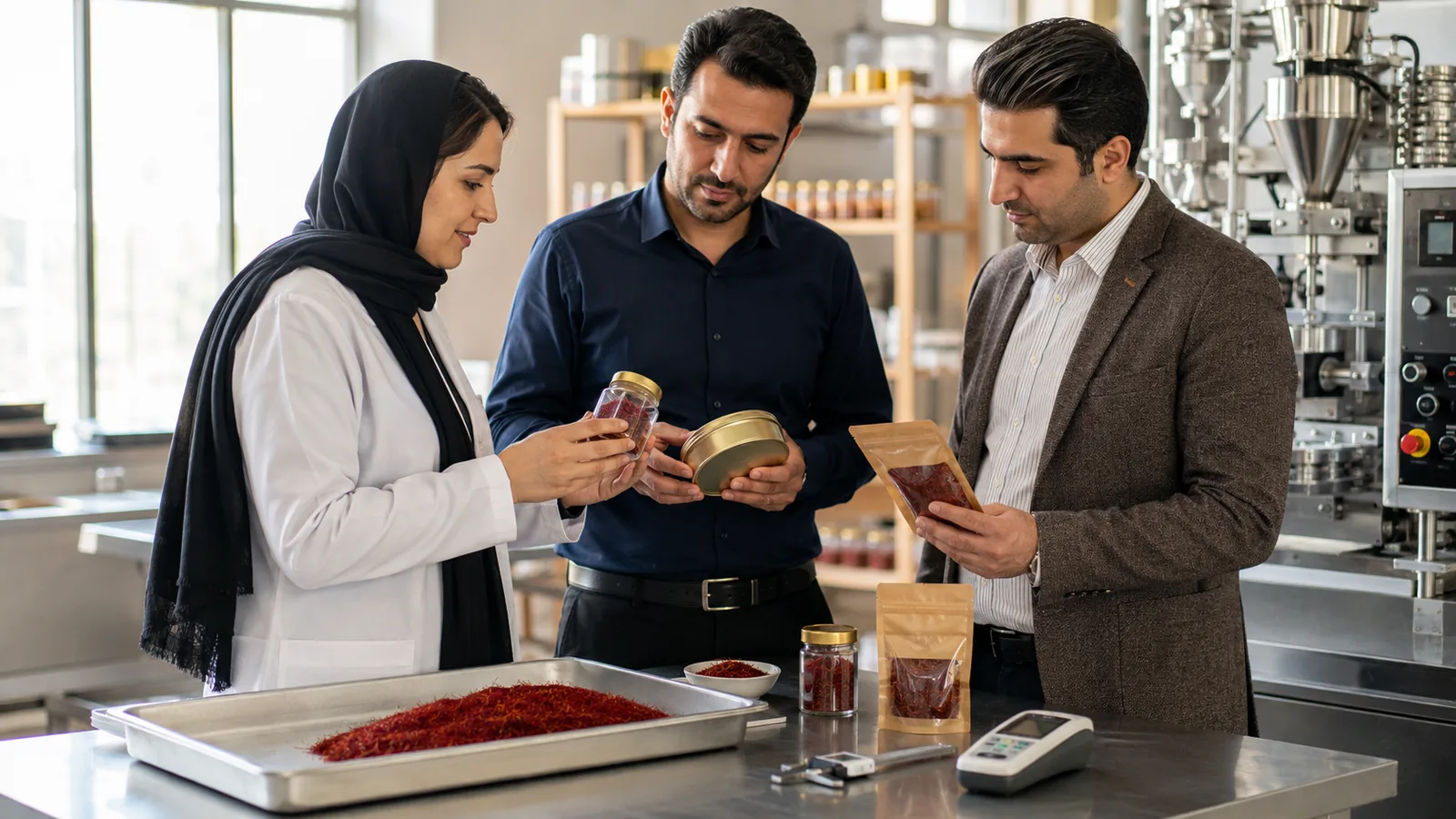
Research-based companies can test barrier materials, closures, pack weights and shelf-life assumptions before an exporter orders thousands of units. They can also design advanced processing and packaging lines that change formats without excessive waste. These improvements matter because they reduce cost and quality variation at the same time.
Product development needs evidence and restraint
Saffron is used in food, and researchers continue to investigate its compounds and possible applications. That does not allow an ordinary spice, tea or supplement to be marketed as a treatment. A health or therapeutic claim needs evidence appropriate to the exact product, dose and jurisdiction.
Responsible innovation may produce a convenient culinary format, a standardized ingredient or a better way to preserve sensory quality. Medical, cosmetic and wellness products follow different regulatory paths. Calling all of them “value added” without calculating compliance, stability and customer demand can replace one weak business model with another.
Traceability can protect origin and reputation
A traceability system should let a business move backwards from a shipment to its test result, processor, stored lot and supplier. It need not expose confidential commercial terms to the public. It does need to give authorized parties enough reliable information to verify what happened.
This is where software can help, but technology is only as good as the records entered. A QR code attached to an incomplete database does not prove origin. Clear responsibilities, routine checks and records that survive staff changes are the real innovation.
Export data should guide the work
Iran saffron export news can sound contradictory when one report measures crop production, another measures customs weight and another discusses retail sales. The Iranian Saffron Exporters Union’s customs-derived summary for year 1403 reports 214,707,000 grams, about 214.7 metric tonnes, exported during the Iranian year that ran from March 2024 into March 2025.
For the figures, units and reporting limits, see our Iran saffron export statistics guide. An exporter planning an innovation should look below the total: destination, pack-size category, customer type, value per kilogram, repeat orders and rejected lots reveal more about the problem to solve.
Nowruz tourism is a separate sales channel
The original article also described spring holidays and Nowruz as an opportunity for small saffron retailers in Mashhad. Pilgrims and tourists may indeed buy saffron as a souvenir, but the old report admitted that comprehensive sales statistics were unavailable. Its “early signs” should not be treated as a measured market increase.
Tourist retail still rewards innovation of a practical kind: tamper-evident small packs, clear storage advice, truthful origin information and formats that travel well. It is a local retail opportunity, not evidence that export demand or farm-gate prices have risen.
The “below 40 million tomans” price is historical
A prior version said saffron prices had stabilized below 40 million tomans per kilogram “in recent months.” It gave no publication date, grade, market level or source. That figure cannot describe today’s price and is retained here only so the historical statement is not silently converted into a current claim.
Price comparisons need the date, currency basis, grade, lot size and transaction level. A retail price for a small certified pack cannot be compared directly with a wholesale farm or export price. Stability in one short period also does not prove that innovation caused it.
What research-based companies can deliver
The most useful projects have an owner, a buyer problem and a result that can be measured. Depending on the business, that could mean:
- a repeatable drying and storage protocol with fewer out-of-specification lots;
- faster, well-documented authenticity and quality testing;
- packaging that protects saffron and meets a destination’s label rules;
- traceability from supplier lot to shipment;
- smaller production runs that let exporters test demand before scaling; or
- market research that identifies the pack, price and service a real buyer will accept.
Measure whether the innovation worked
Higher foreign-exchange earnings and wider international markets are possible outcomes, not automatic results. A business should compare rejection rates, storage loss, packing cost, average realized value, payment time, repeat-order rate and customer concentration before and after a change.
That discipline also protects farmers and workers. Khorasan Razavi and South Khorasan remain central to Iran’s saffron cultivation and trade, so a new process supports livelihoods only when it leads to dependable demand, sensible costs and safer, more consistent work. Counting prototypes or new package designs says little about those outcomes.
Transforming saffron exports one problem at a time
Innovation can help Iran retain more value from the crop it already grows, but only when it is grounded in product quality and buyer needs. The practical path runs from careful harvesting to controlled processing, lot-specific testing, suitable packaging, honest claims and reliable delivery.
That is less dramatic than promising to “regain” a market through technology alone. It is also more useful. Each solved problem gives an exporter a reason to compete on something stronger than an anonymous bulk price.

![Exporting Saffron to Turkey + Price Guide [Complete 0 to 100]](https://img.rowhanisaffron.com/20260827003933/saffron-export-turkey-quality-inspection.webp)



