


The 2019 story published as “Saffron cultivation in the endowments of Faroe Islands” is about Faruj County in North Khorasan, Iran—not the Faroe Islands. It reported approval to cultivate saffron on five hectares of endowed land in the following year. The project was presented as a way to earn income for charitable purposes while putting suitable agricultural property to productive use.
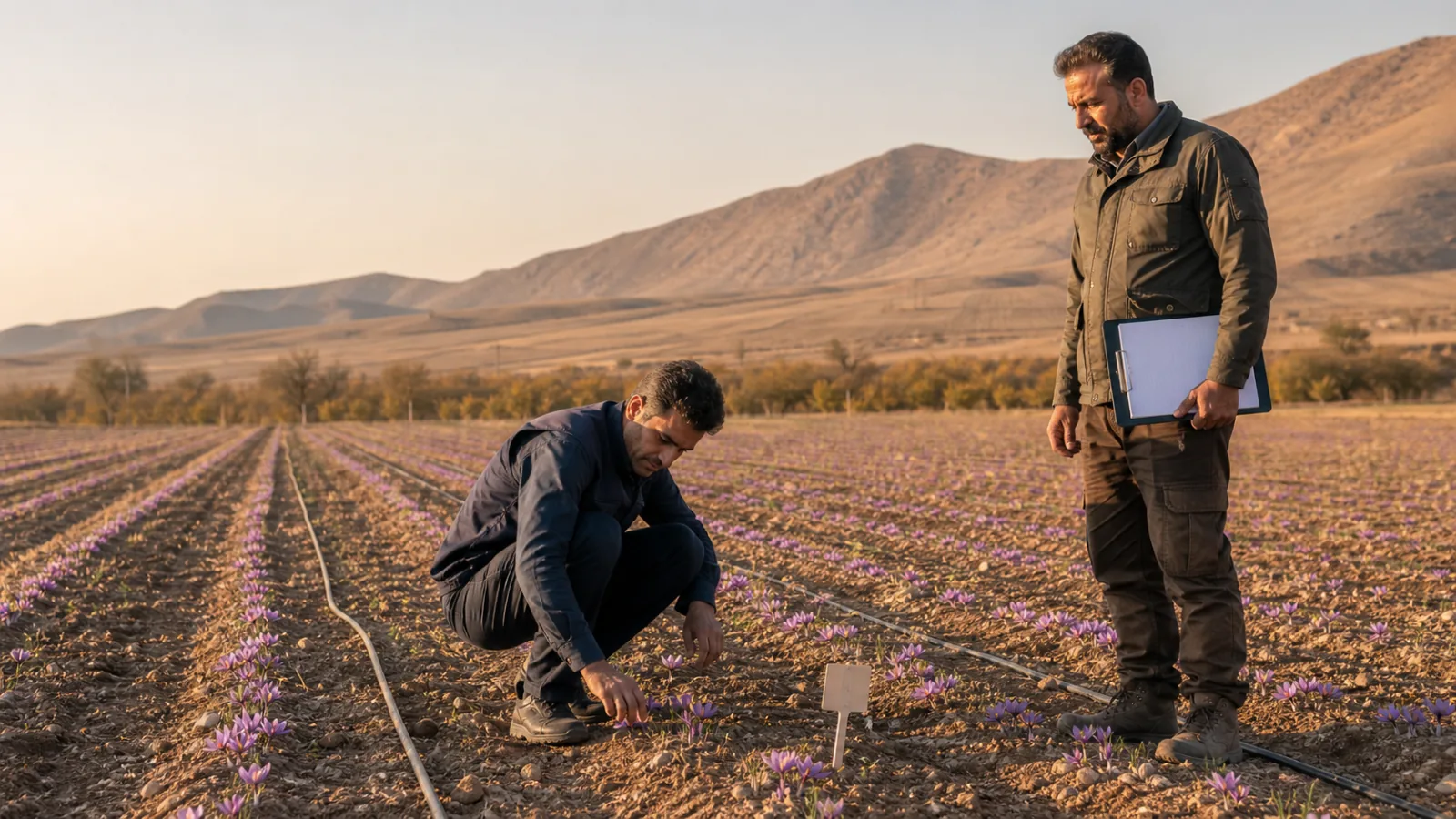
The location lost in translation
The English title inherited two machine-translation errors. “Faroe Islands” should be Faruj, a county and city in North Khorasan Province. The official quoted in the report, Saeed Alipour Sahra, was speaking through the local Endowments and Charity Affairs office. Nothing in the article concerns the North Atlantic archipelago.
A second sentence places a village called “Dalian” in Turkey. In context, it appears to refer to a deprived village in or near the Faruj area, roughly 30 kilometres from the city. The surviving English copy is not reliable enough to confirm the village’s Romanized spelling, so it would be misleading to turn that line into a precise modern location.
Faruj’s connection with saffron is well established. A 2020 report from Iran’s Agricultural News Agency said the county had 2,453 hectares under saffron and produced about 14 tonnes a year at that time, leading North Khorasan Province. The 2019 five-hectare endowment proposal was modest beside the county’s wider crop, but it fitted the local farming pattern.
What the five-hectare plan actually established
Alipour Sahra said permission had been obtained for saffron cultivation across five hectares and that planting was planned for the next year. That is the firm extent of the claim in the original report. It did not identify the individual parcel, water source, soil analysis, planting density, corm supplier, budget or farm operator.
It also did not publish a later harvest result. The area should therefore be described as an approved 2019 plan, not as proof that five hectares were planted successfully or produced a particular yield. Crop establishment, flowering and sale would each require separate evidence.
How endowed farmland can support a charitable purpose
An endowment places an asset or its benefit behind a stated charitable or religious purpose. Agricultural land can contribute recurring income rather than being sold, provided the property is managed within the deed, local law and sound farming practice. Revenue may come from leasing the parcel, sharing production or operating the farm through an appointed manager.
Saffron can suit that model because the corms remain in the ground for several seasons and the dried crop has high value relative to its weight. That does not make it effortless or automatically profitable. Establishment ties up capital, flowering creates a short labour peak, and the harvested stigmas need prompt separation and controlled drying.
For an endowed parcel, the financial plan should distinguish gross crop sales from the income available for charitable spending. Corms, land preparation, irrigation, labour, testing, packaging, storage and management all come before a distributable surplus.
What should be checked before planting endowed land
A licence or administrative approval is only one part of a responsible cultivation decision. The land manager and agronomist should record the basics before committing the parcel:
- the endowment deed and the permitted use of the land and income;
- soil texture, drainage, salinity and any contamination risk;
- a dependable irrigation source and its seasonal limits;
- healthy, traceable corms appropriate to the planned area;
- field history, rotation and disease risk;
- available labour during flower picking and stigma separation;
- a hygienic drying, storage and testing process; and
- a realistic buyer, quality specification and cash-flow budget.
Our guide to saffron cultivation and growing conditions explains these farm decisions in more practical detail. Local experience matters, but each field still needs its own assessment.
Why crop quality matters to the charitable return
The value of a saffron field is not determined by the planted area alone. Poor corm health, water stress at the wrong time, slow flower collection or careless drying can reduce both yield and saleable quality. A manager who reports only hectares can hide the costs and losses that decide the real return.
Traceability also matters. FAO’s current work with Mashhad University of Medical Sciences includes authenticity methods and training for farmers, traders and laboratory specialists across North, Razavi and South Khorasan. The aim is to protect quality after harvest and give buyers stronger evidence about what they receive. That work does not assess this particular endowment project, but it illustrates the standard a professionally managed saffron lot should move toward.
A charitable project benefits when records connect the field, harvest date, drying batch, test result, buyer and final payment. Those records help the trustee show that the asset was managed properly and that the stated beneficiary received the correct net income.
The health outreach reported alongside the farm plan
The 2019 article was not solely an agriculture story. Alipour Sahra described cooperation with doctors and the local health centre to operate a free health station in a deprived rural area. According to the report, 40 villagers were examined and three million rials was provided for medicine or patient support.
The wording of the surviving translation does not show whether the three million rials was the cost of medicine dispensed, direct aid to patients or a broader programme expense. The amount and the number of visits are preserved as reported figures, with that limitation.
The connection between the health activity and saffron income is also unclear. The article discusses both under the office’s effort to align endowment work with community needs, but it does not say the planned saffron field had already financed the clinic. Since planting was still in the future, that interpretation would be chronologically unlikely.
The endowment figures need the same caution
Alipour Sahra said 16 new endowments had been registered from the beginning of that reporting year, including 11 in its first six months. He also put the number of endowed properties or endowment records in Faruj at 688.
The translation says 85% had a “food and drink destination” in Muharram. The likely meaning is that most of the relevant charitable intentions involved providing food and refreshments during Muharram commemorations. The article does not supply a register extract or define the denominator, so the percentage should remain an attributed historical figure rather than a current inventory.
What would show that the project succeeded
Success would require more than planting saffron. A useful follow-up would confirm the parcel and planted area, the establishment date, production costs, annual dried yield, quality results, selling channel and net income transferred to the stated purpose. It should also disclose crop failures or years when maintenance consumed the revenue.
The corrected lesson from this page is local and practical. In 2019, officials in Faruj proposed using five hectares of endowed land for saffron and described separate community-health work. The idea was credible in an established saffron-producing county. Whether it delivered a lasting charitable return depends on evidence that the original report did not provide.

![Exporting Saffron to Turkey + Price Guide [Complete 0 to 100]](https://img.rowhanisaffron.com/20260827003933/saffron-export-turkey-quality-inspection.webp)



