


“Saffron and hands that want gold” is a story about the people behind a valuable spice. In the Khorasan harvest of 2019, growers described lower prices, rising costs, scarce water and difficulty finding enough workers, while flower pickers and stigma cleaners relied on a brief season of paid work. The gold in the title is not in their hands automatically; it depends on how the value and risk are shared.
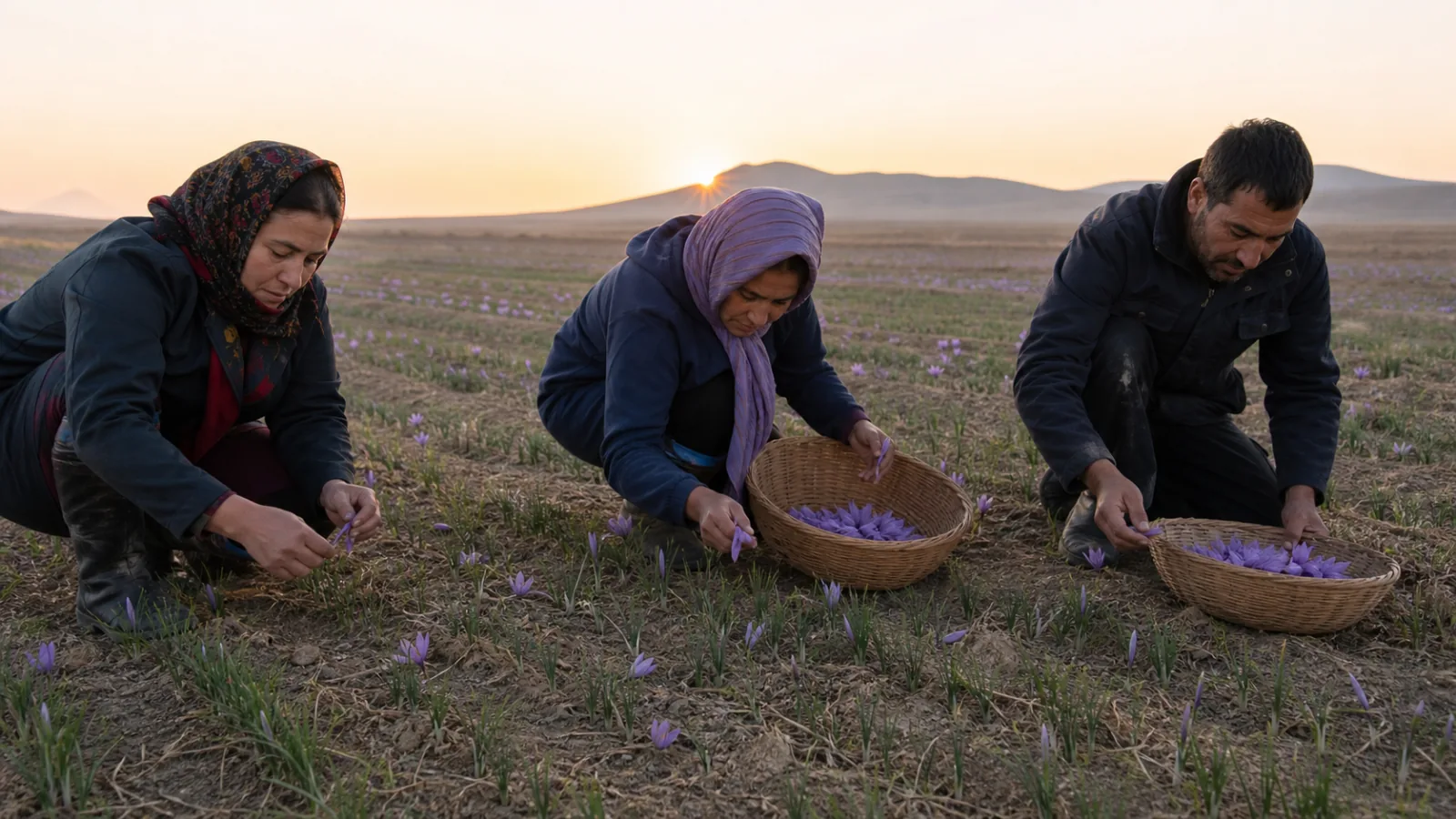
A harvest report from Khorasan
The original report called saffron za’faran and “red gold,” then asked why people across its production and sales cycle were not necessarily satisfied. It quoted the head of the Khorasan Razavi Agricultural Jihad Organization as saying that 80% of Iran’s saffron was produced in Khorasan. Because the statement was made in 2019 and did not specify a crop year or statistical method, that percentage should remain attached to the report rather than presented as a current figure.
The reporter spoke with several growers and people cleaning saffron flowers. For the cleaners, the short harvest created a seasonal earning opportunity. For the growers, a crop could be physically successful and still disappoint once labour, water and the selling price were counted.
What one 4,000-square-metre grower said
One interviewee farmed 4,000 square metres, or 0.4 hectares. The grower described that year’s harvest as “not bad” but below expectations. The translated report then compared prices of 60,000–65,000 tomans in the previous year with less than 45,000 tomans in 2019.
The unit is missing from the surviving English text. It may have referred to a customary local sales unit, a grade or another basis, but the article does not tell us. Those numbers cannot responsibly be relabelled as a price per kilogram, gram or mesghal, and they cannot be compared with today’s market. Their reliable meaning is narrower: the grower remembered a substantial year-on-year fall in the price received.
The same farmer said workers had struggled through harvesting and cleaning. Another grower complained about high costs, a shortage of labour, scarce water and buyers taking saffron cheaply. These are personal accounts, not a representative farm survey, but together they show why yield alone does not describe the harvest economy.
Why a small amount of saffron takes so many hands
Saffron flowers emerge over a concentrated period. Pickers work close to the ground and return repeatedly as new buds appear. The flowers then have to be moved carefully, opened and separated so the red stigmas can be dried without unnecessary delay or contamination.
A farm-efficiency study in Gonabad County used labour alongside corms, water, fertilizer, manure and land as a production input. In its sample, labour accounted for about a quarter of six-year farm costs, and the authors identified labour shortages and the expense of hand weeding and flower harvest as important local challenges. The figures belong to that sample; they are useful context, not a universal Khorasan budget.
The work continues indoors. Stigma separation is repetitive and time-sensitive, and mistakes reduce saleable yield or introduce yellow style and foreign matter. Calling saffron expensive without seeing this work makes the final jar look detached from the people who produced it.
Seasonal employment is valuable and fragile
A short harvest can bring income to families and neighbours who do not have year-round farm work. It can also be difficult to plan. The exact starting day moves with irrigation and weather, daily flower volume rises and falls, and a large flush cannot wait for a convenient shift.
For workers, a fair arrangement needs more than a headline wage. The farmer and crew should agree on whether payment is hourly, daily, by flower weight or by cleaned stigma, and who bears the risk of waiting or rejected work. The weighing method should be visible and consistent. Pickers need realistic breaks and a safe way to carry flowers; cleaning areas need light, clean surfaces, ventilation and seating that does not force the same strained posture for hours.
These details affect quality as well as working conditions. Exhausted or rushed handling makes bruising, contamination and poor separation more likely.
Why the farm price and shop price are different
A customer may see a high retail price and assume the grower receives most of it. The chain between field and jar can include flower collection, stigma separation, drying loss, sorting, laboratory work, packaging, finance, storage, rejected lots, export documents, transport, distributor margin and retail tax. Each real service has a cost.
That does not mean every gap is fair. A grower may have little bargaining power when flowers or newly dried saffron must be sold quickly, grading is unclear or only a few buyers are available. Conversely, a retail price from another country may include a tiny pack, expensive presentation and several downstream businesses. It is not a clean measure of the Iranian buyer’s margin.
Our article on the commercial face of Persian saffron follows those later functions. The practical question is which costs add verifiable value and which merely separate the grower from information and customers.
Water shortage changes both output and bargaining pressure
Saffron is suited to dry regions, but that does not make it a no-water crop. Irrigation timing affects emergence and the crop still depends on adequate soil moisture through its cycle. A weak water supply can reduce the quantity or uniformity of flowers and constrain replacement corm growth.
For a grower already paying for labour, a smaller-than-expected flush raises the cost per gram of dried saffron. A farm may then need cash before it can wait for a better buyer. That is why the 2019 complaint linked water, labour and the purchase price rather than treating them as three separate problems.
What a grower should record during harvest
Good records make the next sales conversation more concrete. For each field and picking day, a grower can record:
- area and approximate age of the saffron stand;
- flower weight or collection volume and the labour hours used;
- fresh stigma weight and dry saffron recovered;
- drying method, time, temperature basis and final moisture check;
- the physical grade or cut offered to the buyer;
- price, unit, payment date and any deduction; and
- water, hired labour, packaging and other material costs.
The missing unit in the old article shows why this matters. A number without the product form, weight basis, date and grade cannot be interpreted later, even when it felt perfectly clear to the people speaking at the time.
How more of the value can stay connected to the work
Growers do not all need to become consumer brands. Some can improve their position by selling a well-described lot: origin, crop year, physical form, net weight, drying and storage record, representative sample and an agreed test basis. Groups of small farms may be able to share drying, testing, storage or market information when governance and lot separation are trustworthy.
Buyers also have a role. Clear grades, prompt payment, documented deductions and forecasts that help farms plan labour are worth more than vague promises of a premium. Traceability should identify good work, not become paperwork that the producer completes without receiving useful feedback.
The meaning of hands that want gold
Saffron creates seasonal work because it cannot move from flower to stable spice without many careful hands. The 2019 interviews did not show people asking for luxury. They showed cleaners wanting worthwhile employment and growers wanting the harvest price to cover water, labour and the risk of producing the crop.
A fairer chain begins by making those contributions visible. Record the unit, grade, labour and losses. Pay people on terms they understand. Keep the lot’s identity as it moves beyond the farm. Red gold only supports Khorasan livelihoods when value remains connected to the hands that earned it.

![Exporting Saffron to Turkey + Price Guide [Complete 0 to 100]](https://img.rowhanisaffron.com/20260827003933/saffron-export-turkey-quality-inspection.webp)



