


A local development announcement described plans for aeroponic greenhouse saffron cultivation in Shirvan, including one 50-hectare project and a second 100-hectare medicinal-plant greenhouse. The announcement is historical; it records an intention and an investment estimate, not proof that every planned hectare was completed or remains in production.
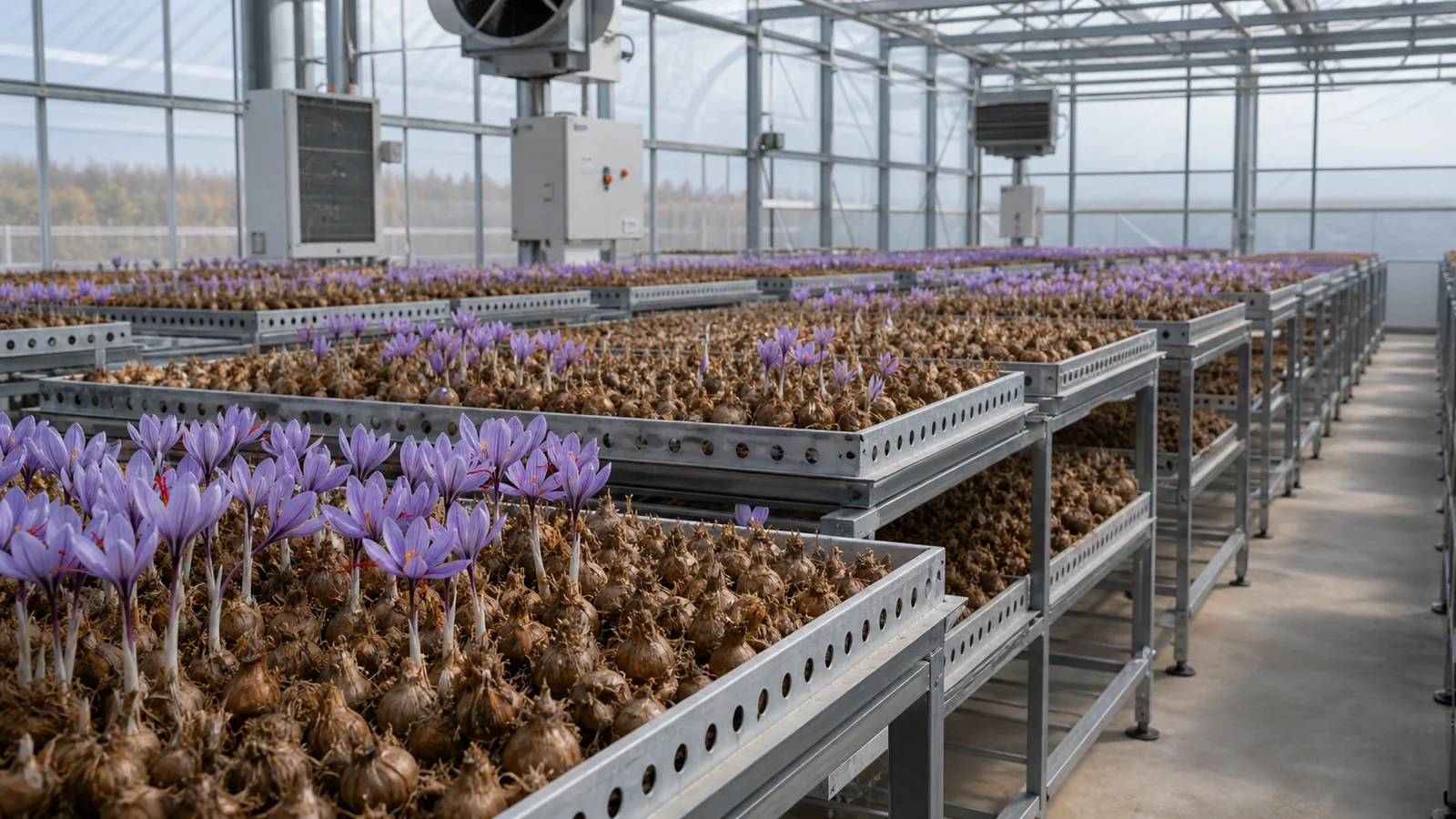
The central idea was to use protected space for saffron during its short flowering and harvest period, then produce other crops when that saffron cycle ended. That may improve use of a greenhouse, but it does not by itself establish that aeroponic saffron is more profitable than suitable field cultivation.
What was announced in Shirvan
Shirvan governor Amin Reza Meraati said saffron aeroponic greenhouse cultivation was being introduced in the city. The report described two greenhouse investments with a combined planned area of 150 hectares.
- A private-sector investor was associated with a 50-hectare greenhouse in which saffron would be grown seasonally.
- A financial and credit company was associated with a 100-hectare greenhouse intended for medicinal plants.
- The stated construction cost was three billion tomans for each hectare of greenhouse.
- Employment and greater farmer interest in protected cultivation were presented as expected local benefits.
All of those points should remain attributed to the announcement. The old article did not provide a completion date, operating results, harvest weight or audited return, so it cannot show whether the planned scale or economic outcome was ultimately achieved.
How a saffron greenhouse works
Growing saffron in greenhouse conditions usually means holding corms on trays or racks while temperature, humidity and light are managed. In an aeroponic or soil-free flowering system, the corm uses stored reserves to produce leaves and flowers. This can concentrate the flowering stage into a controlled indoor space and make picking easier.
However, flowering is only part of the plant’s annual cycle. A corm must also replenish its reserves and produce daughter corms if it is to support later seasons. Commercial descriptions sometimes blur the difference between forcing flowers indoors and maintaining the full crop cycle. A serious comparison should explain where and how the corms grow before and after the greenhouse harvest.
Why the greenhouse could host other crops
Saffron flowers over a limited autumn window. The Shirvan proposal therefore anticipated other production after the saffron stage. In principle, rotating use can keep an expensive structure productive for more of the year.
In practice, the next crop must fit the greenhouse’s sanitation, temperature, irrigation and market plan. Labour peaks also matter. A crop that looks compatible on a calendar may require different equipment or create disease risks for stored corms. Those operating details are as important as the floor area in an investment announcement.
Questions the original report could not answer
The three-billion-toman cost was tied to the period of the announcement. It is not a current construction quote. Building standards, energy systems, exchange rates, inflation and greenhouse specification can change the figure dramatically.
The report also offered no measured comparison of flower yield, dry stigma yield, labour, energy use, corm losses or product quality. Without those figures, a claim of economic superiority would be premature. A separate discussion on why saffron cultivation may not be profitable in a greenhouse provides a useful counterpoint to investment-led announcements.
How to evaluate an aeroponic saffron project
Before treating a greenhouse plan as a production model, growers and investors should ask for evidence from complete cycles rather than a single attractive flowering display. Useful records include:
- the number, size and health of corms entering the system;
- fresh flower and dried saffron yield by corm weight or usable area;
- labour hours for loading, monitoring, picking and unloading;
- energy and humidity-control costs;
- rates of mould, disease, corm loss and daughter-corm formation;
- the land, trays or storage needed outside the visible flowering stage;
- quality testing and the actual sale price achieved; and
- income and changeover costs for the greenhouse’s other crops.
What remains useful about the Shirvan report
The article captures a moment when Shirvan officials were exploring large protected-cultivation projects, with saffron positioned as a seasonal crop within a broader medicinal-plant programme. It also shows the scale of the stated ambition: 50 hectares for the private project and 100 hectares for the second greenhouse.
Its value is documentary, not predictive. Anyone considering saffron in a greenhouse today should verify whether the facilities were built, request current operating data and compare the whole corm cycle with a well-managed field system. The flowers may be the visible result, but the economics depend on everything that happens before and after harvest.

![Exporting Saffron to Turkey + Price Guide [Complete 0 to 100]](https://img.rowhanisaffron.com/20260827003933/saffron-export-turkey-quality-inspection.webp)



