


The cultivation of saffron is not profitable in the greenhouse was a warning from Iranian natural-resources researcher Rasoul Dervishian about expensive training schemes that promised easy returns. His criticism was aimed at a particular model: buying large saffron corms, forcing them to flower on trays or shelves, and then returning them to soil so they can rebuild and reproduce.
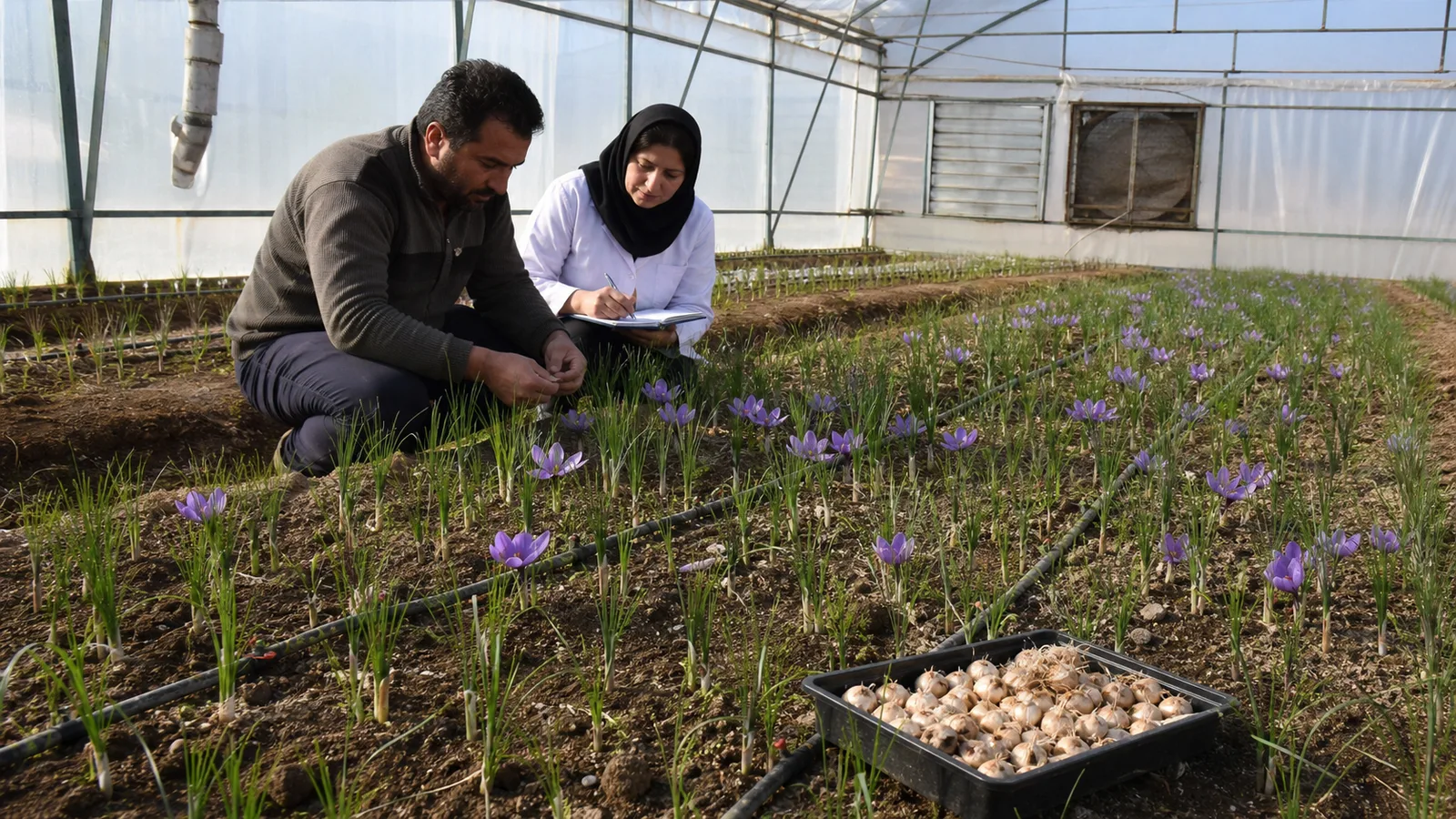
Can you grow saffron in a greenhouse? Yes. Does that automatically make saffron farming profitable? No. Research shows that controlled cultivation can produce flowers and quality spice, but profit depends on corm cost and survival, energy, labour, facility expense, yield, daughter-corm production and the price actually received. A biological success is not the same as a viable business.
Kesar is another widely used name for saffron. A claim that “kesar farming” is profitable should therefore face exactly the same full-cycle cost and yield test.
What the original warning was about
Dervishian said promoters were charging high fees for greenhouse saffron workshops while advertising large profits and employment opportunities. The appeal is easy to understand: more corms appear to fit into a smaller space, and shelving looks like a way to multiply production without buying farmland.
His objection was that the visible flowering stage tells only part of the story. In some tray systems, growers purchase large corms, hold them under controlled conditions until flowering, harvest the stigmas and then replant the corms outdoors. If the crop cannot complete its leaf and root growth properly, the corm may fail to replenish its reserves or produce healthy replacements.
The earlier English translation called saffron corms “onions.” They are not culinary onions. A corm is the underground storage organ from which saffron grows, and its condition influences whether the plant will flower and what it can contribute to the next crop.
Can saffron grow in a greenhouse?
Peer-reviewed trials show that it can. Researchers have grown Crocus sativus in greenhouses, controlled rooms and soilless systems. Temperature management can shift flowering, and protected cultivation can place more flowering corms in a given floor area.
Success is highly specific to the system and climate. Saffron has a seasonal cycle: flower initiation occurs within the corm, temperature helps regulate dormancy and flowering, and leaves support the development of new corms after bloom. A tray that produces flowers for one season has not necessarily demonstrated a sustainable multi-year crop.
A recent cooled-greenhouse study in a hot climate found that dense planting increased flower and stigma yield per square metre but reduced performance per plant and affected replacement-corm development. The researchers recommended a moderate density and shallower planting for their conditions, while stressing that economic results depend on corm, greenhouse, cooling and labour costs as well as saffron and corm value.
Why large corms do not guarantee profit
Large, healthy corms generally have greater stored reserves and are more likely to flower than undersized material. This does not mean that an expensive batch of large corms guarantees a profitable harvest.
The same corm-size advantage also applies in well-managed field cultivation. Dervishian’s point was that promoters should not attribute flowering caused by good planting material entirely to the greenhouse. A fair comparison uses corms of comparable size and health, then measures the complete cost and output of both systems.
Growers also need to count losses from disease, physical damage, failed flowering and small daughter corms. If large corms must be bought again every year, the enterprise may depend more on selling or replacing planting material than on the small dry weight of spice harvested.
The missing half of many yield claims: corm renewal
Saffron is sterile and is propagated vegetatively. After flowering, leaves continue photosynthesis and the mother corm supports the formation of daughter corms. Those replacements are the foundation of future planting.
A forcing system can separate flowering from later field growth, but that transfer creates labour, timing and survival risks. If corms are moved back to suitable soil, they need enough time and appropriate conditions to root, grow leaves and store reserves. If they stay in an inadequate tray without a viable root-zone system, flowering can deplete them.
This is why a business plan should record not just grams of dried stigmas per square metre, but also the number, weight and flowering size of replacement corms at the end of the cycle.
How to test whether greenhouse saffron is profitable
Profitability has to be calculated for a named location, system and sales channel. At minimum, include:
- purchase price, grade, disease status and expected life of the corms;
- greenhouse or indoor-room construction, racks, trays and depreciation;
- cooling, heating, ventilation, lighting, irrigation and monitoring costs;
- labour for handling corms, harvesting flowers and separating stigmas;
- flowering rate, flowers per corm and dry stigma yield after proper drying;
- losses and the number and size distribution of daughter corms;
- testing, packaging, storage, finance and marketing costs;
- the realistic wholesale or retail price, not the highest advertised price per gram.
Run the calculation with conservative, expected and strong yields. Include at least one failed or weak-flowering scenario. Claims based only on maximum shelf density, the retail price of a tiny packet, or a photograph of abundant flowers leave out the costs most likely to determine the result.
When greenhouse saffron may make sense
Protected cultivation can be rational where open-field climate is unsuitable, land is exceptionally constrained, disease-free propagation material has value, or a grower is producing a specialised research or pharmaceutical-grade crop with a contracted buyer. It may also help control flowering time or support experiments that would be difficult outdoors.
Those uses do not prove that the same system will beat field production in an Iranian saffron-growing climate. Cooling a greenhouse through warm conditions, repeatedly handling corms and maintaining infrastructure can add costs that a field does not have.
Dervishian’s alternative for Lorestan
Dervishian argued that applicants in Lorestan should be guided toward scientifically managed field cultivation, especially on suitable low-yield dryland, instead of being sold an expensive greenhouse package. He said about 75% of the province’s arable land was rainfed and viewed saffron as a possible diversification crop under favourable local conditions.
He also reported that growers following scientific planting principles in Lorestan had achieved 25 kilograms per hectare. That is a historical attributed figure, not a guaranteed benchmark. Yield varies with corm density and size, field age, soil, water, temperature, disease pressure and post-harvest handling. A local trial and soil-and-water assessment should come before extrapolating one result.
His further statement that Lorestan could become a centre of high-quality saffron production was an expression of regional potential. It should be judged against current agronomic evidence, market access and repeatable farm results rather than treated as an accomplished status.
Greenhouse versus field: the practical decision
Greenhouse saffron is neither a universal scam nor an automatic high-profit crop. It is a technically possible production method whose economics change by climate and design. Dervishian’s warning remains useful because it targets the gap between “a corm flowered on a shelf” and “a farm produced a repeatable profit.”
Before paying for a course or facility, ask for results from complete crop cycles, audited input costs, dried rather than fresh yield, corm survival and multiplication data, and sales records at the claimed price. Compare them with a field trial using equivalent corms. If a promoter cannot supply those basics, the promised return is not ready to be treated as a business forecast.
Sources
The Lorestan critique and 25 kg/ha claim are attributed to Dervishian’s statement preserved in the original report. The broader assessment draws on a recent open-access greenhouse density and planting-depth study, research on contained and hydroponic saffron production, and an agronomy study of corm performance in soilless cultivation. These experiments demonstrate possibilities under stated conditions; they do not guarantee commercial profit in another system or location.

![Exporting Saffron to Turkey + Price Guide [Complete 0 to 100]](https://img.rowhanisaffron.com/20260827003933/saffron-export-turkey-quality-inspection.webp)



