


Projection of 5 tons of red gold in Bardaskan in Iran was a historical harvest forecast based on 2,500 hectares of saffron and an expected average yield of 2 kilograms per hectare. Hussein Mohammadi, then director of Agriculture Jihad in Bardaskan, said harvesting had begun and would continue until mid-Azar. “Red gold in Bardaskan” refers to the district’s dried saffron.
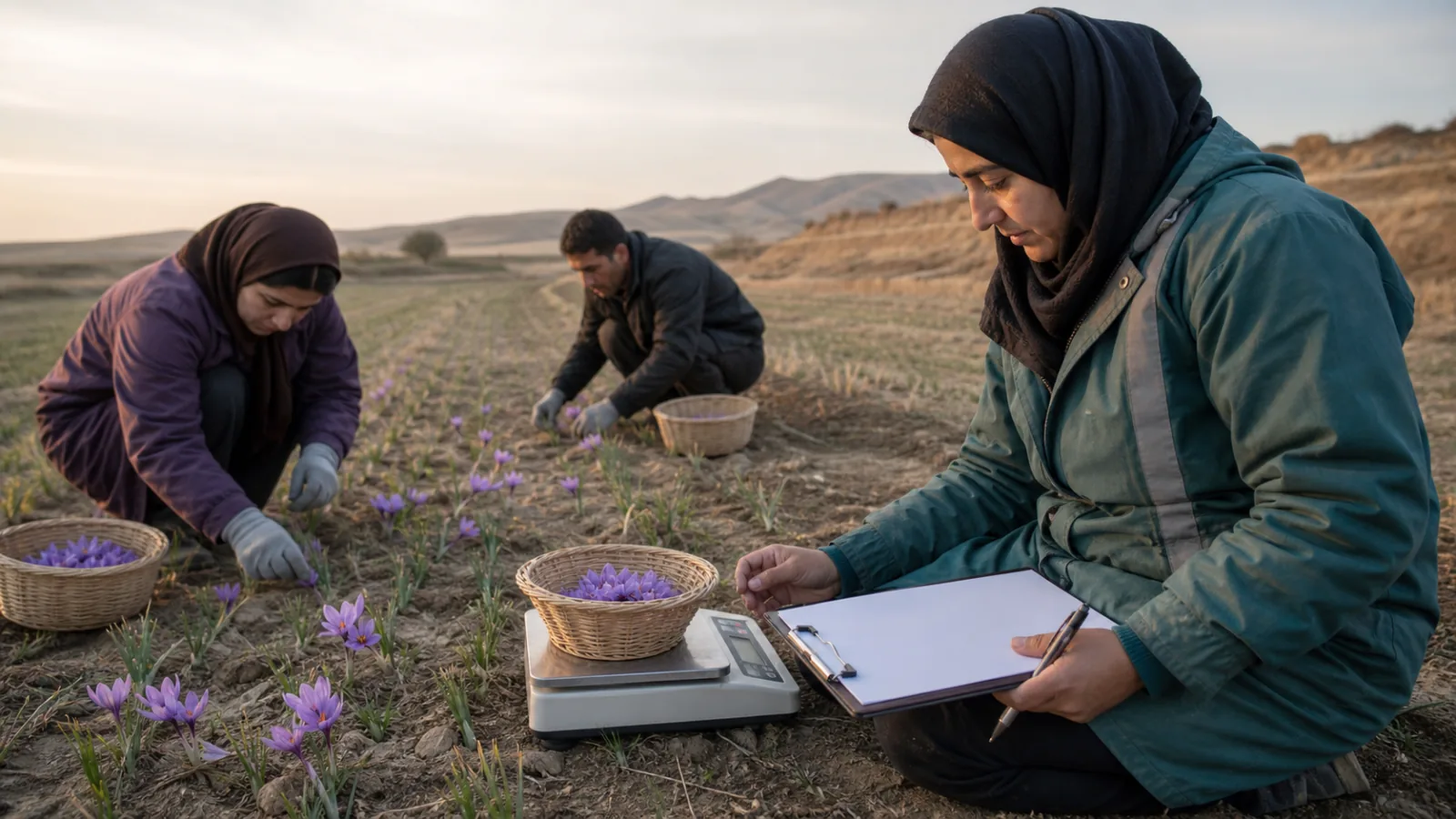
The calculation is internally consistent: 2,500 hectares multiplied by 2 kilograms per hectare equals 5,000 kilograms, or five metric tonnes. It remains a projection, not a documented final harvest. The announcement did not provide the actual delivered weight after the season.
The figures behind Bardaskan’s five-tonne forecast
Mohammadi put the cultivated area at 2,500 hectares and the expected dry-saffron yield at 2 kilograms per hectare. He estimated the total harvest value at 400 billion rials.
Dividing that projected value by 5,000 kilograms gives an implied average of 80 million rials per kilogram. That is a reading of the reported arithmetic, not a verified farm-gate price. The announcement did not state whether the 400 billion rials represented gross field value, wholesale transactions or another valuation point.
Mid-Azar falls around early December in the Gregorian calendar, but the exact date varies by year. Harvest timing within the county would also vary with elevation, temperature, corm condition and when flowering began.
Why an average yield can hide field differences
Two kilograms per hectare was the forecast average across the reported area. Individual fields may differ because of stand age, healthy corm density, soil, salinity, irrigation timing, weather, flower-picking speed and drying losses.
A reliable final estimate would separate:
- hectares planted from hectares that actually flowered and were harvested;
- fresh flowers from separated stigmas and final dry saffron;
- yield from young, mature and declining fields;
- saleable lots from rejected or downgraded material;
- gross reported value from farmer costs and net return.
Without those distinctions, a county average is useful for planning but cannot tell a grower what one field should produce.
Drought and water abstraction were reducing production
Mohammadi said climate change and successive droughts had reduced saffron production and land use in Bardaskan. He also named water abstraction in recent years as another cause of lower crop production.
Saffron’s dry-summer dormancy helps it fit semi-arid systems, but its active growth still depends on root-zone moisture. Falling groundwater can reduce the amount or reliability of irrigation, increase pumping cost and worsen salinity in some wells. Expanding a valuable crop does not repair an aquifer; total withdrawals and recharge still need to balance over time.
What modern irrigation can realistically change
Modern irrigation systems were one of the measures Mohammadi proposed for saffron. An efficient system can improve control over where and when water is applied, but the hardware does not guarantee a higher harvest.
A three-year saffron irrigation experiment in Qaen found that drip irrigation produced the highest dry stigma yield and water-use efficiencies among drip, sprinkler, furrow and basin methods under that site’s conditions. Bardaskan fields still need their own soil, water-quality, emitter and scheduling decisions.
Useful monitoring would record water delivered, soil moisture, clogged emitters, flower count, dry stigma yield and daughter-corm performance. A “modern” system that applies excess water by a fixed calendar can still waste water.
Packaging and processing should protect measurable quality
Mohammadi also named appropriate packaging and processing as ways to improve production value. For saffron, processing includes prompt stigma separation, controlled drying, cleaning, lot formation and storage. Each step can preserve or damage what the field produced.
Packaging should limit moisture, light, contamination and substitution while keeping the lot traceable. It should not be treated as proof of grade. The ISO 3632-1 saffron specification sets recognised categories and requirements, and representative testing is needed to apply them to a lot.
Market stability and export routes
The historical statement linked stable markets with exports to neighbouring and European countries. Market stability does not mean fixing one price. It means giving growers and buyers dependable information, consistent lots, clear contract terms and more than one viable sales route.
Export destinations also have different residue, traceability, packaging and documentation requirements. A lot that meets one buyer’s specification may need different evidence for another. Better packaging cannot compensate for missing compliance or uncertain origin.
Our guide to exporting Iranian saffron explains the quality and trade work behind those routes.
How the five-tonne projection should be verified
After the season, the forecast should be compared with weighed dry saffron from traceable lots, not repeated as an achieved total. The final record would include actual harvested hectares, total dry weight, yield distribution, test results, average realised price, gross value and farm-level costs.
That comparison would also show whether drought and water abstraction changed the assumed 2-kilogram yield. If the total came in lower, the gap should lead to field and water investigation rather than an automatic increase in planted area.
Bardaskan’s projection joined production, irrigation, post-harvest care and export in one local strategy. The safer conclusion is not that five tonnes were guaranteed, but that each of those parts needed measured evidence before the forecast could become a result.

![Exporting Saffron to Turkey + Price Guide [Complete 0 to 100]](https://img.rowhanisaffron.com/20260827003933/saffron-export-turkey-quality-inspection.webp)



