


Saffron flower petals can be distilled into an aromatic water, but “saffron petal sweat” is a literal translation, not a recognised medicinal product category. A clearer English name is saffron petal distillate or hydrosol. Its composition and effects cannot be assumed to match either the whole petal or the valuable red stigma sold as saffron spice.
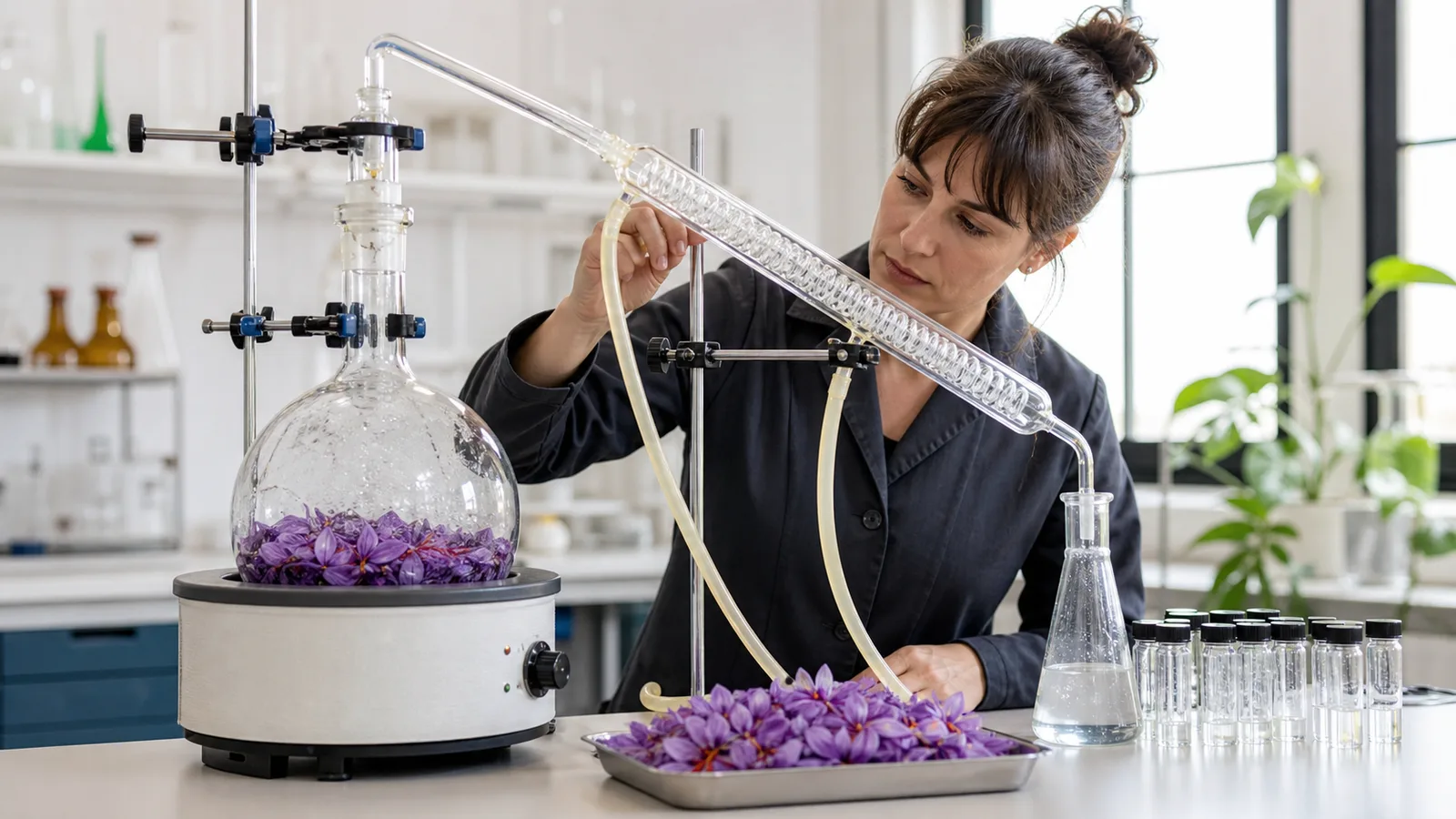
The archived report says researchers at a Torbat Heydariyeh institute produced the distillate and explored industrial manufacture. It also attributes several health claims to a person identified as Ahmadian. Those statements are retained below, then separated from what the accessible published evidence can support.
What are saffron flower petals?
The saffron spice consists of the dried red stigmas of Crocus sativus. The much larger purple structures surrounding them are commonly called saffron petals, although botanists often describe the six similar flower segments as tepals. After the stigmas are separated, saffron flower petals form the largest part of the floral residue.
Petals are not chemically empty. A comparative metabolomics study found many classes of compounds in both petals and stigmas, but also hundreds of differences in their metabolite profiles. Saffron petal, saffron petals and saffron flower petals therefore describe a potentially useful by-product—not a cheaper version of the spice with identical composition.
How a saffron petal distillate is produced
In hydrodistillation or steam distillation, heat carries volatile compounds from plant material into vapour. Cooling condenses that vapour into a liquid, which may separate into a small oil fraction and a larger aromatic water or hydrosol. The process variables—petal condition, water ratio, temperature, duration and equipment—affect what is recovered.
Many important petal flavonoids are not volatile. For example, laboratory research has identified kaempferol, quercetin and related glycosides in solvent or water-based petal extracts. Their presence in a petal does not prove that meaningful amounts enter a distilled water. The final product needs its own chemical analysis rather than a claim that it is “somewhat similar” to the starting petal.
The Torbat Heydariyeh project
The original account described the work as the first production of saffron petal distillate by researchers at the Torbat Heydariyeh Institute. Ahmadian said saffron was usually valued as a food seasoning while importing countries were interested in medicinal and therapeutic uses. He argued that finding value in petals could expand the crop’s economic use.
According to the report, tests found compounds in the distillate that were somewhat similar to those in the petal and made the material easier to consume. It also mentions research on 100 people over ten months and says “the same properties” were observed. The article supplies no study title, protocol, comparison group, measured outcomes, chemical specification, ethics record or publication. We could not match that description to an accessible peer-reviewed trial, so it cannot validate a health claim.
Ahmadian said the production method had been introduced to an established producer of rose waters and herbal distillates for potential mass and industrial production. A technology transfer does not by itself demonstrate that a consumer product reached the market, remained stable, or was approved for a medical purpose.
Can one kilogram of dried petals produce seven litres?
The report says about seven litres of distillate can be obtained from one kilogram of dried saffron flower petals. That is a process-yield statement, not evidence that seven litres of active petal compounds have been extracted. Most hydrosol volume is water introduced during the process, and yield depends on the equipment, cut point and desired concentration.
A reproducible production specification would need to define the petal moisture and identity, water-to-petal ratio, distillation time, collected volume, marker compounds, microbial limits, storage container and shelf life. Without those details, two products both called saffron petal water may be chemically different.
What does research say about petal health claims?
The archived article calls the distillate antidepressant and invigorating, says it intensifies blood flow inside the arteries, and claims it strengthens memory and the brain. These outcomes were not documented for the reported hydrosol.
Mood and depression
There is one relevant human signal, but it involves a different preparation. A six-week randomised trial in 40 adults tested a saffron petal capsule at 30 mg per day against placebo for mild-to-moderate depression and reported a better symptom-score outcome. The authors called for a larger trial. A measured capsule cannot establish the dose, effectiveness or safety of a petal distillate, and neither should replace professional mental-health care.
Blood flow, memory and “brain strengthening”
We found no clinical evidence showing that this saffron petal hydrosol intensifies arterial blood flow or strengthens memory. “Invigorating” and “strengthens the brain” are not defined medical outcomes. They need a specified preparation, dose, comparison and validated measurement before they can be assessed.
Laboratory antioxidant or enzyme results are not a substitute for those human outcomes. People with depression, memory change or circulatory symptoms should not delay an assessment in order to use an unverified distillate.
The by-product opportunity is still real
Saffron petal research does not need exaggerated medicine claims to be worthwhile. A study of sustainable petal processing found that dried tepals retained measurable phenolics, anthocyanins and antioxidant activity, and explored water or low-methanol extraction as part of a biorefinery approach. Other studies have examined petal pigments and antibacterial activity in laboratory systems.
Possible applications include researched ingredients for colour, cosmetics, foods or other formulated products. Each use has its own requirements. A cosmetic ingredient needs skin-safety and stability data; a food ingredient needs identity, contaminant and permitted-use controls; a medicine claim requires appropriately designed clinical trials.
The scale reported for Iranian saffron
The historical account estimated annual Iranian production at more than 300 tonnes of dried stigmas and 30,000 tonnes of fresh saffron flowers, saying only the dried stigmas were being fully valued. It also gave 70,000 hectares as the national saffron area and 8,400 hectares—12%—for Torbat-e Heydarieh.
Average stigma yield was stated as 4 kg per hectare in Razavi Khorasan and 4.2 kg per hectare in Torbat-e Heydarieh. These are dated production figures from the source, not a current census. Their continuing relevance is the scale relationship: a tiny mass of stigmas is selected from a much larger flower harvest, creating a substantial seasonal stream of petals.
What would make a petal distillate credible?
- Identity: confirm Crocus sativus petals and rule out contaminants or mixed floral waste.
- Process specification: document drying, water ratio, equipment, distillation time and collected fraction.
- Chemical profile: measure suitable marker compounds in the actual hydrosol, not only in the original petal.
- Safety and stability: establish microbial quality, packaging, shelf life and intended route of use.
- Claim-specific evidence: test the exact standardised product in an appropriate study before making a health promise.
A careful conclusion
Producing a saffron flower petal distillate is technically plausible and may help turn a seasonal by-product into something useful. Petal chemistry also deserves serious research. What is not established is that the Torbat Heydariyeh hydrosol has the same properties as whole petals or that it treats depression, improves arterial blood flow or strengthens memory.
The next step is not a stronger claim. It is a defined process, a measured product and published evidence that matches the way that product is actually intended to be used.

![Exporting Saffron to Turkey + Price Guide [Complete 0 to 100]](https://img.rowhanisaffron.com/20260827003933/saffron-export-turkey-quality-inspection.webp)



