


Production of 700 kg of saffron in Hamedan was reported from 215 hectares of cultivated land in a provincial agricultural account published at the end of 2020.
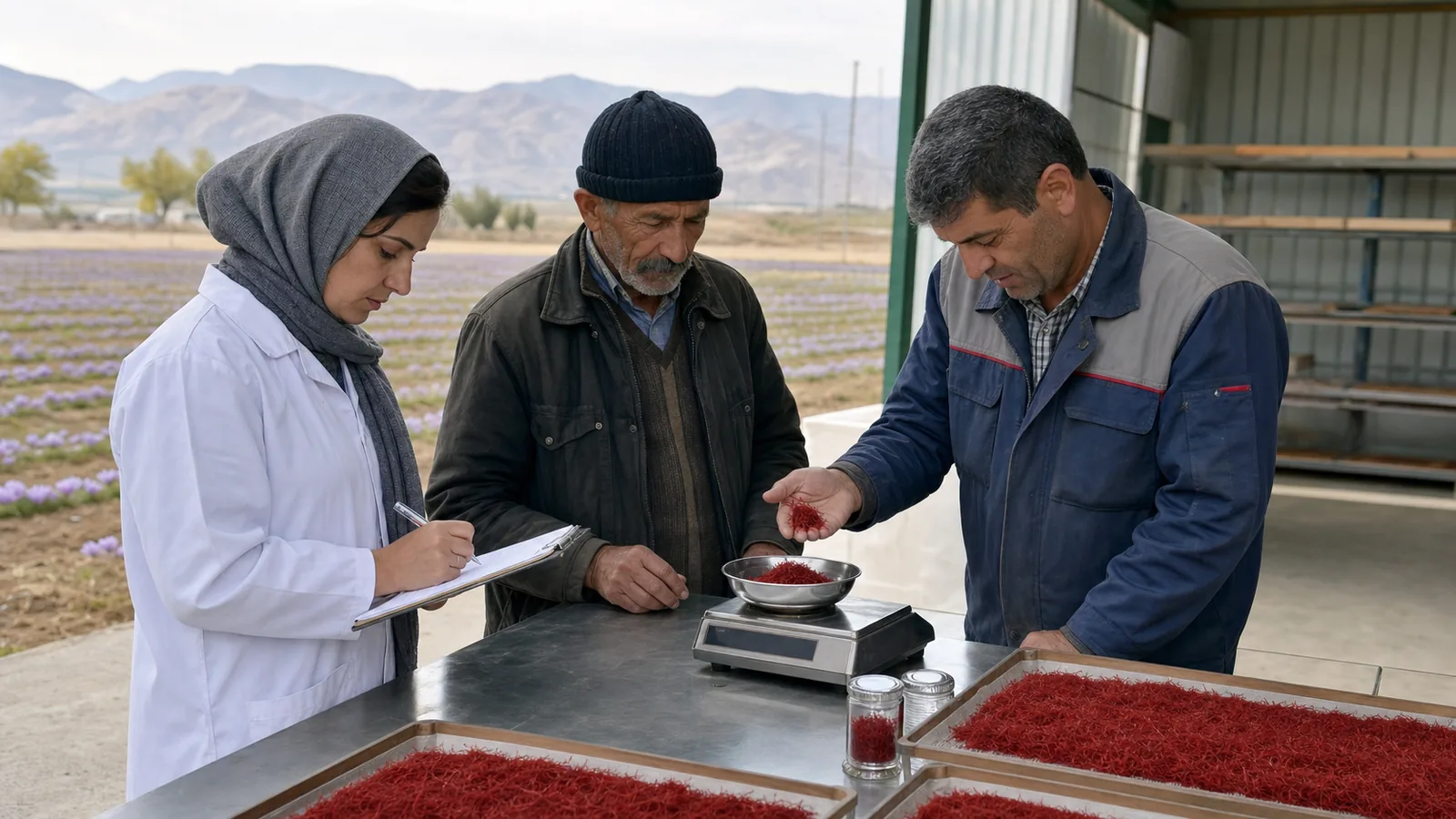
Rahim Bayat, a horticulture specialist with Hamedan’s Agricultural Jihad organization, said both the cultivated area and total harvest had increased from the previous year. His figures also show how cultivation was distributed among Malayer, Razan, Bahar and Kabudarahang.
The 700 kg harvest and 215-hectare area
Bayat reported that 215 hectares in Hamedan Province were under saffron cultivation during the year covered by the article. The harvest from that land was 700 kilograms.
The previous year’s figures were 161 hectares and 547 kilograms. That represents a reported increase of 54 hectares in cultivated area and 153 kilograms in total production.
What the two years suggest about yield
Dividing production by area gives an approximate provincial average of 3.3 kilograms per hectare in the 700 kg year. The preceding figures work out to about 3.4 kilograms per hectare.
These calculations are useful for interpreting the totals: production rose primarily alongside a larger cultivated area. They do not describe every farm, and the original report did not provide field age, weather, soil, irrigation or county-level yield data.
Malayer had the largest reported saffron area
Malayer accounted for 106 hectares, making it the province’s largest saffron-growing area in Bayat’s account. That was just under half of the reported 215-hectare provincial total.
Razan ranked second with 22 hectares. Bahar, whose name was translated literally as “spring” in the earlier text, had 17.4 hectares, while Kabudarahang had 16.5 hectares.
How the named counties fit into the total
- Malayer: 106 hectares.
- Razan: 22 hectares.
- Bahar: 17.4 hectares.
- Kabudarahang: 16.5 hectares.
Together, the four named areas account for 161.9 hectares. The article did not itemize the remaining 53.1 hectares, so they should not be assigned to other counties without a matching provincial source.
Expansion without a specific ministry plan
Bayat described saffron cultivation in Hamedan as being on an upward trend. He also said the ministry had not provided a specific provincial cultivation plan.
Those two points are compatible: the area could grow through local farmer decisions and provincial support even without a centrally assigned expansion target. The report recorded that growth, but did not predict how far it would continue.
Support available to saffron applicants
Prospective growers were directed to the Agricultural Jihad office in their city. Bayat said applicants could seek saffron planting corms and banking facilities through those offices.
The original translation called the planting material “saffron onions.” Corms is the more accurate term. The report did not state the value of the banking facilities, the quantity of corms supplied or the conditions for approval, so those details cannot be inferred.
What the Hamedan production figures mean
The headline’s 700 kg figure belongs with its 215-hectare base and reporting year. It records a provincial harvest, not a current annual guarantee or an expected yield for a new farm.
Compared with the previous report of 547 kg from 161 hectares, Hamedan had more land in saffron and a larger total crop. The county figures show that Malayer led the expansion, while Razan, Bahar and Kabudarahang also had established cultivation.
A dated record of saffron growth in Hamedan
This 2020 account preserves a useful benchmark: 215 hectares, 700 kg of saffron and four named cultivation centres. It also records the local route through which farmers could ask about corms and finance.
A current comparison would need a newer official dataset using the same boundaries and measurement method. Until then, the figures are best read as a historical snapshot of Hamedan’s saffron sector.

![Exporting Saffron to Turkey + Price Guide [Complete 0 to 100]](https://img.rowhanisaffron.com/20260827003933/saffron-export-turkey-quality-inspection.webp)



