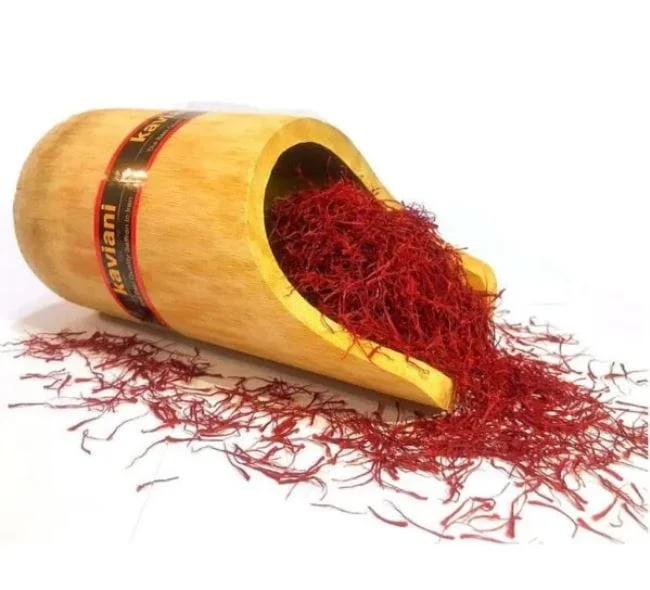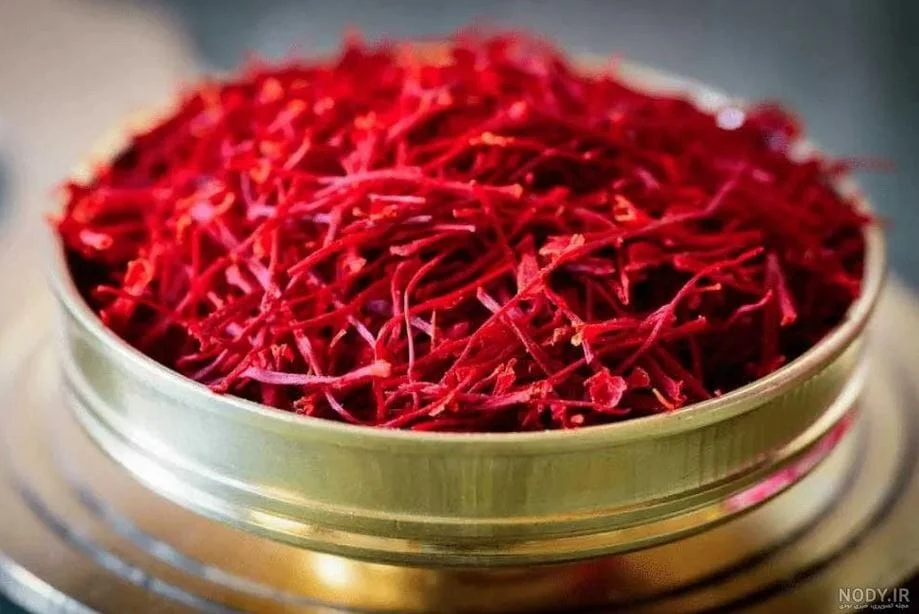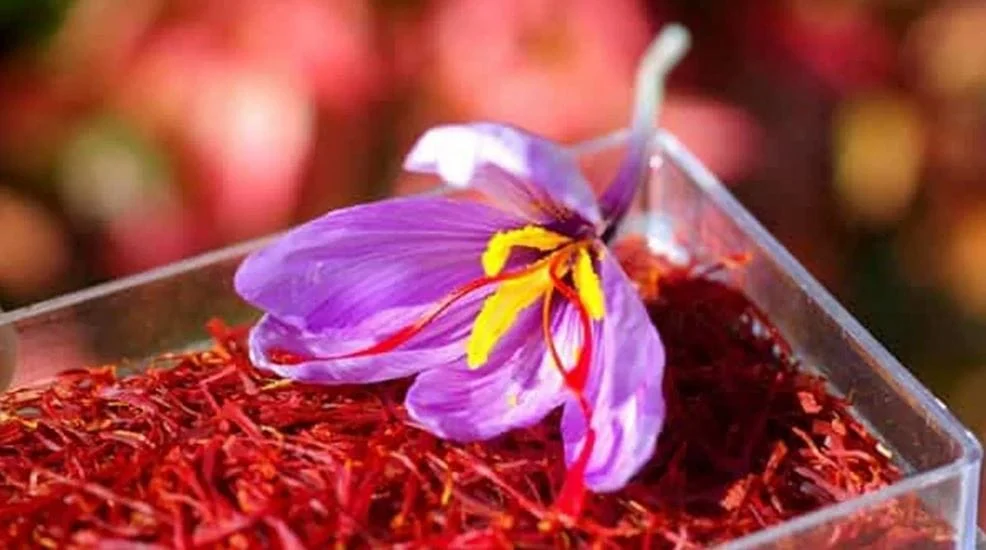
Production of 3000 kg of saffron in Kerman province was reported alongside a rise in cultivated area in northern Kerman. The statement is best read as a historical programme snapshot: it preserves valuable acreage, production and water-management figures, but it does not establish today’s output.

What the Kerman report said
Abbas Saeedi, identified in the source as head of the Jihad Agricultural Organization in northern Kerman province, said saffron production had reached 3,000 kilograms. He linked that output with 820 hectares under cultivation, up from 470 hectares in Iranian year 1392, and said the organisation was pursuing a five-year target of 1,000 hectares.
The report did not give the Gregorian year of the 3,000-kilogram figure or say whether it referred to northern Kerman only or the province as a whole. It also did not describe the survey method, field-age distribution or whether production meant dried stigmas accepted for sale. Those omissions matter when the number is used as more than a dated quotation.
If the 3,000 kilograms and 820 hectares cover the same place and season, the simple implied average is about 3.7 kilograms per hectare. That calculation is only a consistency check. It should not be presented as a measured yield because some of the 820 hectares may have been young, non-bearing or outside the reported harvest total.
From 470 to 820 hectares
The increase from 470 to 820 hectares is substantial: 350 additional hectares, or roughly 74 percent above the stated year-1392 baseline. Yet cultivated area alone does not show how many fields established successfully or how much saleable saffron they produced.
A reliable series would separate prepared land, newly planted area, productive area, replanted fields and land removed from production. It would also show dry yield by field age. Saffron is perennial, and daughter corms multiply over time, so a hectare in its first season cannot be treated as equivalent to an established hectare.
What reaching 1,000 hectares would require
The five-year goal implied another 180 hectares beyond the reported 820. That expansion would require healthy, traceable corms, suitable fields, planting labour, irrigation access and enough harvest and drying capacity. It would also need a market capable of handling extra production without sacrificing quality or grower returns.
A target becomes useful when it includes annual milestones and acceptance criteria. Each year’s report should disclose planted and productive hectares, corm losses, dry-stigma yield, quality results and sale channels. Otherwise, the programme can meet an acreage target while falling short on output or farm income.
The Water Partners plan figures need clear units
Saeedi also discussed approvals under a plan translated as “Homayaran,” or Water Partners. The source says 16,500 farmers or operators were trained and that more than 350 million cubic metres of water had been saved in the previous year. A repeated version of the statement refers to savings “per year” but ends with a broken phrase.
These figures are preserved because they were central to the report, but their boundaries are unclear. The text does not say whether 350 million cubic metres was measured, modelled or aggregated across all crops. It does not identify a baseline, reporting period, irrigation districts or verification method. Without those details, the number cannot safely be attributed to saffron.
New irrigation and the missing denominator
The report says new irrigation systems had been implemented across 16,550 hectares since the beginning of the previous year. It then gives a saving of 1,500 cubic metres without explaining whether that amount applies per hectare, per project or to a particular period.
The most plausible reading may be 1,500 cubic metres per hectare, but plausibility is not evidence. A current update should print the complete unit and show how it was calculated. Total water delivered before and after the change, irrigated area, weather and crop mix are needed to understand whether the system raised water productivity rather than merely reducing application.
Measure water productivity at field level
Saffron is often selected for dry regions because its seasonal water demand can be lower than that of many conventional crops. The right comparison still requires measurements. A field study indexed by FAO AGRIS calculated technical and economic water-use indicators from farm yield, irrigation source, flow rate, number of irrigations and their duration.
That study was conducted in Qaenat, not Kerman, so its numerical results should not be transferred. Its measurement approach is relevant: record actual water and marketable dry yield together. For Kerman, energy used to pump water, conveyance losses and water quality also belong in the assessment.
Pipelines and land integration are supporting measures
The original statement recorded nearly 200 kilometres of agricultural piping installed since the previous year. It also said 450 hectares of land in Baft and Bam had been integrated or consolidated. Neither figure was explicitly assigned to saffron fields.
Piping can reduce conveyance loss, while land consolidation may simplify irrigation layout and machinery access. Their value depends on where the work occurred, what the old system lost and how farms used the change. Reporting a kilometre or hectare total without an outcome can show activity, but not the water saved or production improved.
Training and service capacity
Saeedi said the organisation worked through 16 city or county administrations and 40 agricultural and rural service centres. The agenda included reorganising service centres, extending coverage, improving office buildings and managing vehicles. These administrative points may sound separate from saffron production, yet extension capacity affects whether new growers receive timely field support.
The training total of 16,500 operators should be accompanied by subject, attendance period and practical follow-up. A farmer who attended a general water meeting is not necessarily trained in saffron corm health, planting, harvest or drying. Outcome records could show how many trainees adopted a practice and whether it improved establishment, quality or measured water use.
Production quality matters as much as kilograms
Three thousand kilograms is meaningful only if lots are dried consistently, protected from contamination and kept traceable to their source. Fast expansion can strain flower-picking labour and drying space during the short harvest window. Delays and uneven heating can reduce the value of otherwise sound field production.
Each receiving or processing centre should record grower, plot, harvest date, fresh flower intake, drying method, dry weight and lot result. Combining material before these details are captured makes it harder to investigate a quality problem or reward careful growers.
Efficiency is broader than water alone
A peer-reviewed study of Iranian saffron farms assessed water together with corms, fertiliser, machinery, fuel and environmental outputs. Its central lesson for an expansion programme is that reducing one input does not automatically make the whole system efficient.
For northern Kerman, monitoring should include corm survival, diesel and electricity use, fertiliser and fungicide records, labour, dry yield and net return. This avoids celebrating nominal water savings while another cost or environmental burden rises unnoticed.
What a current Kerman update should publish
- The exact reporting year and whether figures cover northern Kerman or the entire province
- New, productive, replanted and retired saffron hectares by district
- Dry-saffron production and yield range by field age
- The calculation behind the 350-million-cubic-metre claim
- The missing denominator and period for the 1,500-cubic-metre saving
- Location and measured effect of the 200 kilometres of piping
- Purpose and outcome of the 450 hectares integrated in Baft and Bam
- Training subjects, participant counts and verified adoption
- Corm-health, processing-capacity and quality results
How to read the 3,000-kilogram milestone
The report documents a period when northern Kerman’s saffron area was said to have grown from 470 to 820 hectares while output reached 3,000 kilograms. It also places saffron inside a broader provincial programme of training, irrigation modernisation, pipelines, land integration and service-centre reform.
Those facts are worth preserving, but they should not be converted into a current production claim or a guaranteed water-saving story. A dated, district-level update can show whether the 1,000-hectare goal was reached and whether added land delivered consistent quality, verifiable water productivity and a sound return for growers.
![Exporting Saffron to Turkey + Price Guide [Complete 0 to 100]](https://img.rowhanisaffron.com/20260827003933/saffron-export-turkey-quality-inspection.webp)