


A provincial agriculture report described saffron production in Mazandaran as a small but promising activity in the province’s cooler upland districts. The figures are historical rather than a current forecast, but they show why farmers outside Iran’s best-known saffron regions were testing the crop.
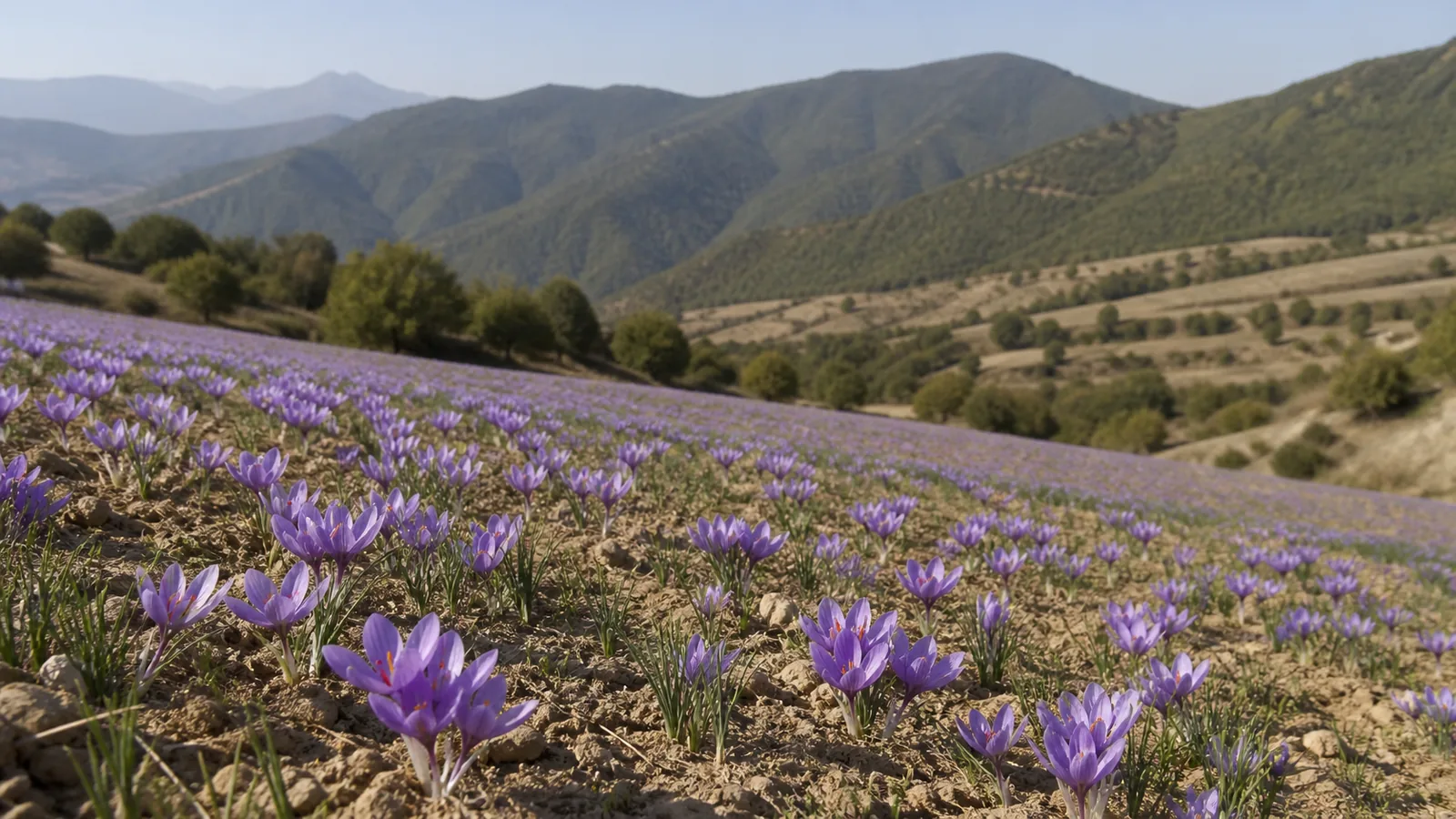
The original headline referred to “11 billion,” while the body of the report stated an economic value of 1.125 billion tomans. Because the publication date and source table are not supplied, neither figure should be read as today’s market value. What can be retained with confidence is the report’s production picture: about 25 hectares under saffron, an estimated 125 kg crop and an average yield of roughly 5 kg per hectare.
Where saffron was being grown in Mazandaran
According to Hossein Mollai of Mazandaran’s horticulture administration, cultivation was concentrated in elevated areas, roughly 800 to 2,300 metres above sea level. Behshahr had the largest reported planted area at about 20 hectares. Sari, Galugah and Nur were also named among the participating counties.
That geography matters. Mazandaran is widely associated with the humid Caspian coast, yet its higher districts can offer colder, drier conditions and lighter soils. Saffron corms need drainage and a distinct seasonal rhythm; a waterlogged coastal field is not interchangeable with a well-drained upland plot.
The reported cultivation calendar
The provincial account placed planting in spring and harvest in October and November. Local timing still depends on altitude, temperature and the condition of the corms. Growers should therefore treat those months as a record of the programme described here, not as a universal planting prescription.
Flowers must be collected promptly during the short harvest window. The red stigmas are then separated and dried with care, because rough handling, excess moisture or delayed drying can reduce the quality of the finished spice.
Corm requirements and plant-health controls
The report estimated that one hectare would require 4 to 6 tonnes of saffron corms. Much of that planting material was being transferred from Khorasan, Iran’s principal saffron-producing region. It also carried a clear warning: corm movement was subject to quarantine and plant-protection rules and should be coordinated with the responsible agricultural authorities.
That remains a sound practical lesson even when regulations change. Corms can carry soil, pests and disease from one field to another. A grower should obtain traceable, healthy planting stock and confirm the current local rules before arranging transport. The quantity alone does not determine a successful planting; corm health, grading, depth, spacing, drainage and field history all matter.
Why farmers were interested
Saffron was attractive in the upper reaches of Mazandaran because the crop could suit relatively dry land and produce a high-value spice from a limited area. The plant’s best-known natural compounds include crocin, picrocrocin and safranal, which contribute respectively to much of saffron’s colour, taste and aroma.
Those compounds help explain the spice’s commercial value, but they do not guarantee a particular farm income. Yield and price vary, and the historical 5 kg-per-hectare average in this report should not be presented as a promise. Labour at flowering time, drying quality, corm costs, irrigation, losses and access to buyers all affect the result.
A note on soil-free saffron systems
The same official said research centres were still studying cultivation without conventional soil and had not yet established its technical or economic case for local producers. The provincial agriculture organisation therefore did not endorse that method at the time of the report.
That caution is important. A visually impressive indoor flowering system does not by itself prove a sustainable multi-year production model. Anyone evaluating hydroponic or soil-free saffron should compare full corm replacement, energy, labour, disease control and flower-to-spice yield against a suitable field system, using current local research rather than a promotional claim.
What this historical report tells us
The value of this Mazandaran account lies less in its old monetary headline than in the regional detail. It records a 25-hectare programme centred on Behshahr, mentions Sari, Galugah and Nur, identifies the 800-to-2,300-metre upland range, and documents both corm-transfer controls and caution around soil-free cultivation.
For readers considering saffron cultivation in Mazandaran province today, those details are a starting point, not a farm plan. Current planting advice, quarantine requirements, input costs and market figures should be confirmed with the provincial agriculture and plant-protection authorities before money or corms are committed.

![Exporting Saffron to Turkey + Price Guide [Complete 0 to 100]](https://img.rowhanisaffron.com/20260827003933/saffron-export-turkey-quality-inspection.webp)



