


The production forecast of 300 kg of saffron in Kermanshah was based on 92 hectares of fields, including 12 hectares planted that year. The figures form a useful record of an emerging growing region, but they need to be read as a historical forecast rather than a current production total.
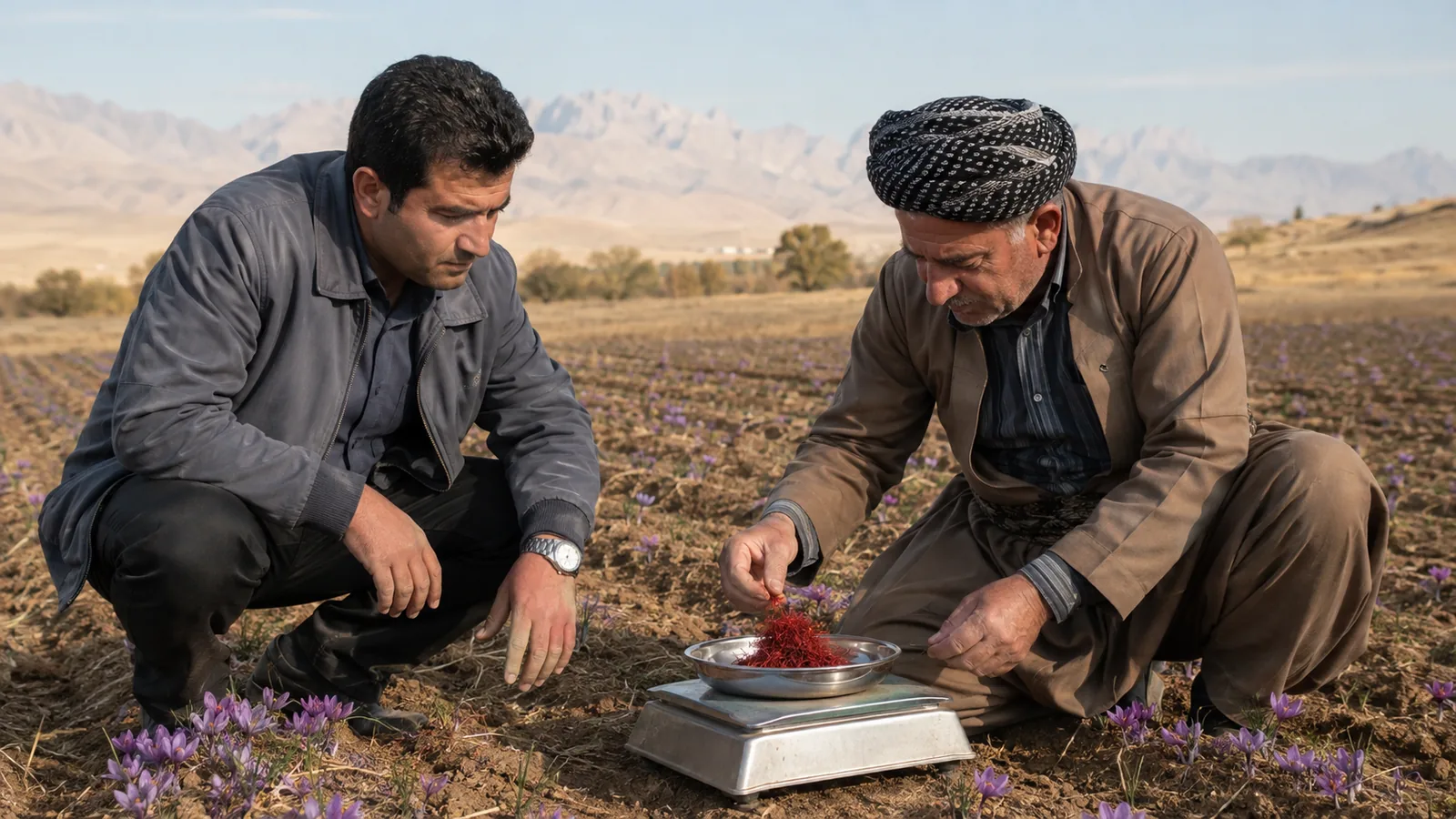
What the 300 kg forecast covered
Safdar Rostami, identified in the archived report as the saffron and medicinal-plants expert at the Kermanshah Agricultural Jihad Organization, said saffron cultivation was being developed across the province. At the time of his statement, 92 hectares were under saffron, with 12 new hectares planted between June and September.
Rostami expected the province to produce 300 kilograms of dried saffron during that harvest. He gave an average yield of 3.5 kilograms per hectare, although the forecast was slightly below a simple multiplication of total area by average yield.
The Rowhani Saffron page was published in December 2021, but the stored English report does not give the date of Rostami’s original statement. Phrases such as “this year” and “last year” therefore belong to the reporting period and should not be treated as present-day figures.
How the forecast compares with the previous harvest
The previous season’s figures were 80 hectares and 265 kilograms of saffron. That works out to about 3.31 kilograms per hectare. The stated provincial average of 3.5 kilograms per hectare would produce roughly 322 kilograms across 92 fully productive hectares.
A 300-kilogram forecast was therefore plausible as a cautious estimate. It may also reflect the age of the fields. Twelve of the 92 hectares had only just been planted, and Rostami noted that a saffron field produces little in its first year.
Those calculations explain the relationship between the reported numbers; they do not replace an official harvest result. The archived article contains no later measurement showing how many kilograms were actually collected.
Why the age of a saffron field matters
Saffron is grown from corms and remains in the ground for several seasons. According to the report, growers in Kermanshah expected a field to be used for around seven years. A newly planted field and an established field should not be assigned the same expected yield.
The first season may produce relatively few flowers while the planting becomes established. Output can rise as daughter corms develop, then change again as the bed becomes crowded or field conditions deteriorate. Planting density, corm size, soil, weather and farm management also affect the result.
For that reason, a useful provincial forecast separates new hectares from mature hectares. The old Kermanshah estimate did this at a basic level by identifying the 12 newly planted hectares instead of presenting all 92 hectares as equally productive.
Where saffron was being cultivated in Kermanshah
Rostami said saffron was cultivated in 12 counties or cities across Kermanshah Province, depending on how the administrative term in the translated report is read. Kermanshah city had the largest area under cultivation.
This spread matters because the province does not have one uniform growing environment. Elevation, autumn temperature, rainfall, soil drainage and access to irrigation can vary from one district to another. A province-wide average is helpful for planning, but it cannot predict the yield of every field.
The expansion programme had reportedly been supported since Iranian year 1389, corresponding broadly to 2010–2011. Rostami said facilities were available to applicants. The archived text does not define those facilities, identify recipients or show how much support was provided, so it would be unsafe to present that statement as a current grant or entitlement.
The early-November harvest window
The historical harvest began in early November and was expected to continue until about 10 November. Rostami associated picking with cool conditions, which is consistent with the short autumn flowering period that makes saffron harvest labour-intensive.
Flowers need to be collected promptly and their red stigmas separated and dried with care. A forecast expressed in kilograms refers to the finished dried spice, not the much heavier weight of fresh flowers. Labour availability and the speed of processing can therefore influence how much usable saffron reaches the end of the harvest.
The dates should not be used as a permanent calendar. Flowering can shift with seasonal temperature, moisture and field conditions, and growers must follow the crop rather than an old news report.
Saffron, rainfall and water management
The report described saffron as a crop with a low water requirement and linked its expansion to water-resource management. The FAO’s account of Iran’s qanat-based saffron system likewise says that saffron does not require large quantities of water, while stressing the value of a reliable irrigation source.
Rostami went further, saying the crop needed one irrigation and could then rely on rain. That may describe the local programme or a particular season, but it is not a safe universal instruction. Rainfall timing, stored soil moisture, soil type, field age and the weather after flowering all influence irrigation needs.
Low water demand does not mean no water management. Before expanding cultivation, growers need a field-specific plan for establishment, autumn growth and dry periods. The forecast offers evidence that Kermanshah officials saw saffron as a useful option under water pressure; it does not establish one schedule for every farm.
How to interpret the historical origin claim
The original report also attributed a much broader claim to Rostami: that saffron had been cultivated in Kermanshah for 2,500 years, that the province was the origin of Iranian saffron cultivation, and that cultivation in Khorasan and other provinces dated back 700 years.
That statement should remain clearly attributed. The stored article gives no archaeological reference for those precise dates. A peer-reviewed review of ancient artworks and saffron genetics describes evidence of ancient crocus use and cultivation in several regions, including material connected with Persia, while finding strong evidence for the cultivated plant’s early origin in Greece. It does not establish Kermanshah as the sole origin of modern saffron.
Kermanshah has a deep agricultural and human history, but that fact alone cannot prove where Crocus sativus was first domesticated. The 2,500-year and 700-year figures are best understood as the official’s historical account until a directly relevant archaeological or documentary source can be produced.
What would be needed for a current Kermanshah estimate
A present-day production forecast would need more than the old headline. It should record the current cultivated area, the age of each field, expected yield by district, seasonal rainfall and irrigation conditions, flower collection, drying losses and the final measured harvest.
It should also distinguish a target from an outcome. In the archived figures, the previous season’s 265 kilograms was described as harvested production, while 300 kilograms was a prediction. Keeping that distinction prevents a forecast from being repeated later as a confirmed total.
The historical report still shows why Kermanshah attracted attention as a saffron-growing region: cultivation had reached 12 parts of the province, new fields were being established, and officials expected output to rise from the previous year’s 265 kilograms. Its value is in that documented snapshot, together with the questions its figures allow us to ask about field age, yield and responsible water planning.

![Exporting Saffron to Turkey + Price Guide [Complete 0 to 100]](https://img.rowhanisaffron.com/20260827003933/saffron-export-turkey-quality-inspection.webp)



