


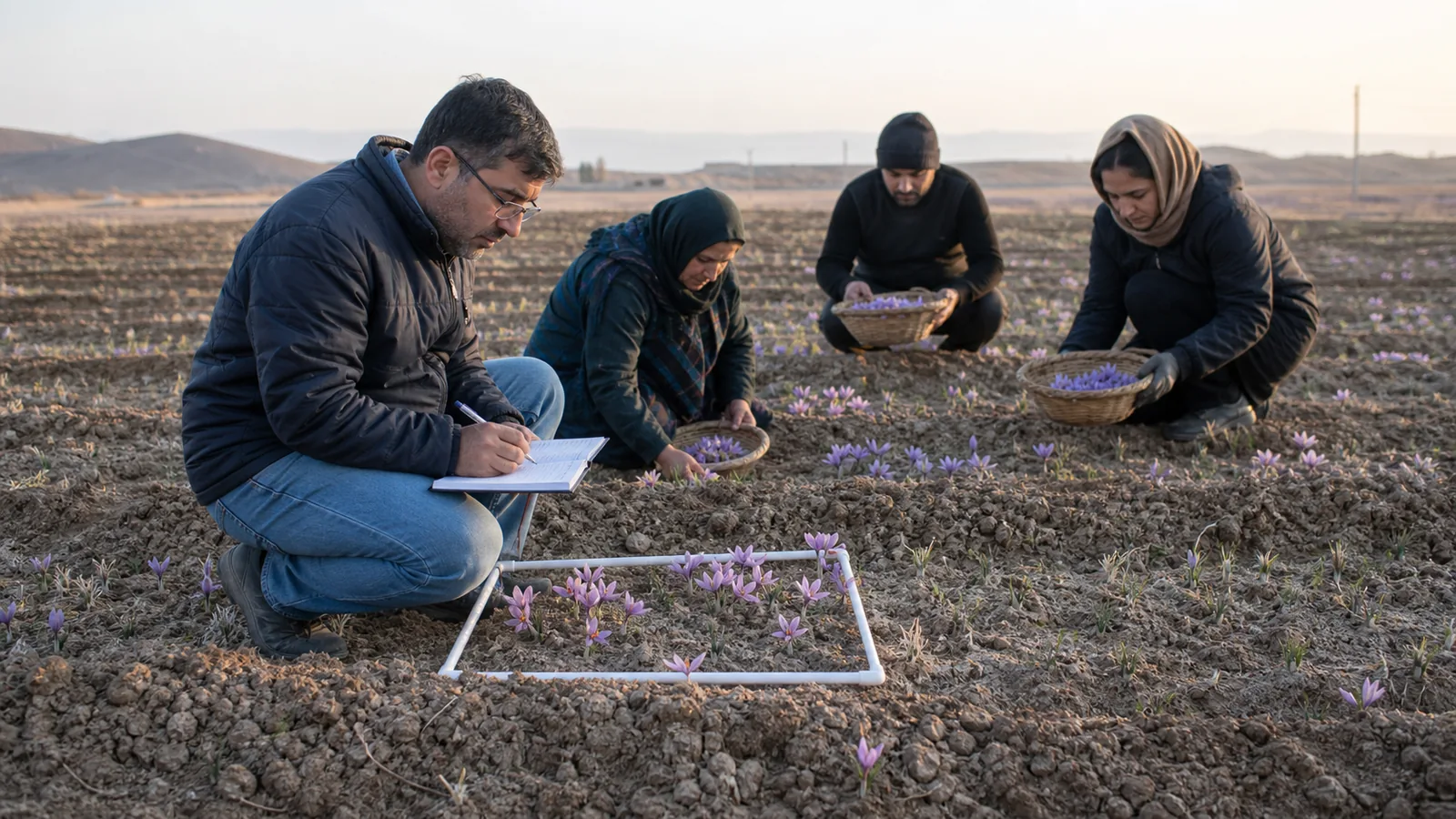
A 40% reduction in saffron harvest in Torbat Heydariyeh was reported near the end of the 2017 season. The local agriculture director linked the fall to severe winter cold and low spring rainfall, while growers also faced weak buying and disappointing prices.
What the 40% harvest reduction meant
Mohammad Reza Abbaspour, then director of Agricultural Jihad in Torbat Heydariyeh, said dry-saffron yield had fallen by roughly 30 to 40 percent compared with previous years. The statement was made as that season’s harvest was ending.
He put Torbat Heydariyeh’s saffron area at 8,700 hectares and said the earlier average had been about 4 to 4.2 kilograms of dried saffron per hectare. The reported decline was in yield, not a statement that planted area had fallen by 40 percent.
If the percentage were applied evenly to the old average, the implied range would be about 2.4 to 2.94 kilograms per hectare. That calculation helps explain the scale of the report, but it is not a measured provincial average. The source gives neither total dry output nor field-level results, and farms may have been affected differently.
The date and source matter
The detailed Persian account was published on 29 Aban 1396, corresponding to 20 November 2017, by the Khorasan Razavi Saffron Exporters Union and attributed to an interview with ISNA. The figures belong to that harvest and should not be read as a description of current Torbat Heydariyeh production.
The union’s archived report preserves Abbaspour’s area, yield, labour, purchasing and price statements. It also supplies details that were missing from the shorter English version, including the quantity purchased under the programme and its grade-specific prices.
Cold and low rainfall were the stated causes
Abbaspour attributed the reduction to severe cold in the preceding December and February, followed by a sharp fall in rainfall that April. These were his observations; the source does not include weather-station records, an untreated comparison or a field survey capable of assigning a percentage of loss to each cause.
The timing is agronomically relevant. Saffron is perennial and its corms support both the current plant and later flowering. Moisture and temperature during the growth cycle can affect leaves, replacement corms and the next crop, even though the flowers appear during a short autumn period.
The FAO Ecocrop profile for saffron describes a preference for temperate, fairly dry climates but notes that rain at important stages supports corm and flower development. “Drought tolerant” does not mean that timing and depth of moisture cease to matter.
Why one loss percentage cannot describe every field
Fields differ in age, corm density, soil, drainage, irrigation, exposure and management. A cold event may be more damaging in a low-lying plot than on a neighbouring slope. A farm with access to timely irrigation may respond differently to poor rainfall.
Harvest measurement also matters. Flower weight, fresh stigma weight and dried-saffron weight are different figures. A valid comparison uses the same final dry-product definition and records the productive area, not simply all land registered with saffron.
A stronger assessment would sample farms across Torbat Heydariyeh, group them by field age and conditions, and compare dry yield with the same farms’ earlier records. That would show whether the 30–40 percent estimate was widespread, concentrated in particular locations or influenced by changes in harvested area.
The labour behind each hectare
Abbaspour said one hectare of saffron required an average of 200 to 220 person-days of work. That figure appears to cover labour across the crop and harvest rather than 200 people working at once, although the source does not define its accounting period.
He estimated that about 30 percent of workers came from neighbouring areas for harvesting, flower picking and the work of spreading or separating flowers. Most were said to come from Torbat Jam, Bakhrez and Qaen.
This movement of workers shows why a lower harvest affects more than landowners. Saffron flowers open over a compressed period, and delayed picking or separation can reduce the condition of the final product. Growers need enough trained labour at the right time even in a poor-yield year, while seasonal workers depend on the number of days available.
Torbat Heydariyeh sits inside a larger saffron belt
Abbaspour said Zaveh had the largest saffron area, at 12,000 hectares, and produced more than the other cities in his comparison. He identified the wider belt around Torbat Heydariyeh, Zaveh, Mahvelat, Roshtkhar and Khaf as the source of much of the country’s saffron.
Those numbers and rankings refer to the report’s period. Administrative records, productive area and crop conditions can change, so they should not be reused as a current league table without a dated source.
Torbat Heydariyeh’s role was not only agricultural. Abbaspour said saffron from the surrounding cities came there for buying and selling. That distinction between production and trade helps explain why a harvest problem in several counties could be felt in one commercial centre.
Weak buying added a market problem
The 2017 report described poor prices and limited purchases by traders. A smaller harvest does not automatically raise the farm-gate price if buyers are cautious, growers need immediate cash, quality varies or the route to export is uncertain.
Abbaspour said agreed purchasing began on 1 Aban, around 23 October 2017. The Rural Cooperative Center in Torbat Heydariyeh and Zarrin Saffron Mashreq Zamin Company were acting on behalf of the Central Organization of Rural Cooperatives of Iran.
Agreed purchasing differs from a permanently guaranteed price unless the programme rules say otherwise. Farmers need to know which grades will be accepted, how representative samples are taken, when payment will arrive, what deductions apply and whether there is a quantity limit.
How much saffron the programme had bought
The fuller archived report says 2,000 kilograms of dried saffron had been purchased in Torbat Heydariyeh by the interview date. It listed historical purchase prices of 4.4 million tomans for ordinary Pushal, 4.9 million tomans for premium Pushal and 5.4 million tomans for Negin.
The commercial context indicates prices per kilogram, but the source text should have stated the unit directly. These amounts belong to 2017 and are not usable as current quotes. Inflation, currency values, grade expectations and market conditions have changed substantially.
A fair evaluation of the programme would compare those purchase prices with private bids for the same verified grades, then include payment timing and transaction costs. The quantity purchased also needs to be compared with total eligible production to show how much of the local market the intervention reached.
Exports were still a separate question
Abbaspour said the main export season had not yet begun. He added that one company in Torbat Heydariyeh had exported 1.5 tons during the first six months of that year.
One company’s shipment cannot establish total regional exports. Saffron may also be bought in Torbat Heydariyeh, consolidated elsewhere and recorded under a different exporter or customs location. Production, local trade and export statistics therefore answer different questions.
For growers, the important connection is how an export order translates back into a grade-specific farm price. Traceable lots, credible testing and clear deductions make that connection visible. Without them, a headline export price may say little about what an individual producer receives.
What should have been measured after the season
The 40% reduction in saffron harvest in Torbat Heydariyeh was a serious contemporary estimate, but the article does not provide the final evidence needed to close the season’s account.
A complete follow-up would publish actual dry output, productive hectares and yield distribution across farms. Weather records could test the cold-and-rainfall explanation, while field-age and irrigation data could identify which growers were most exposed.
The market review would add quantities offered and accepted under agreed purchasing, grade results, payment dates, private-market comparisons and final sales. Together, those records would show whether the programme protected growers during a difficult harvest and what should change before the next one.
The lasting lesson is not that every short crop follows the same pattern. It is that climate, labour and market access met in the same season, and each part needed to be measured before a sound response could be designed.

![Exporting Saffron to Turkey + Price Guide [Complete 0 to 100]](https://img.rowhanisaffron.com/20260827003933/saffron-export-turkey-quality-inspection.webp)



