


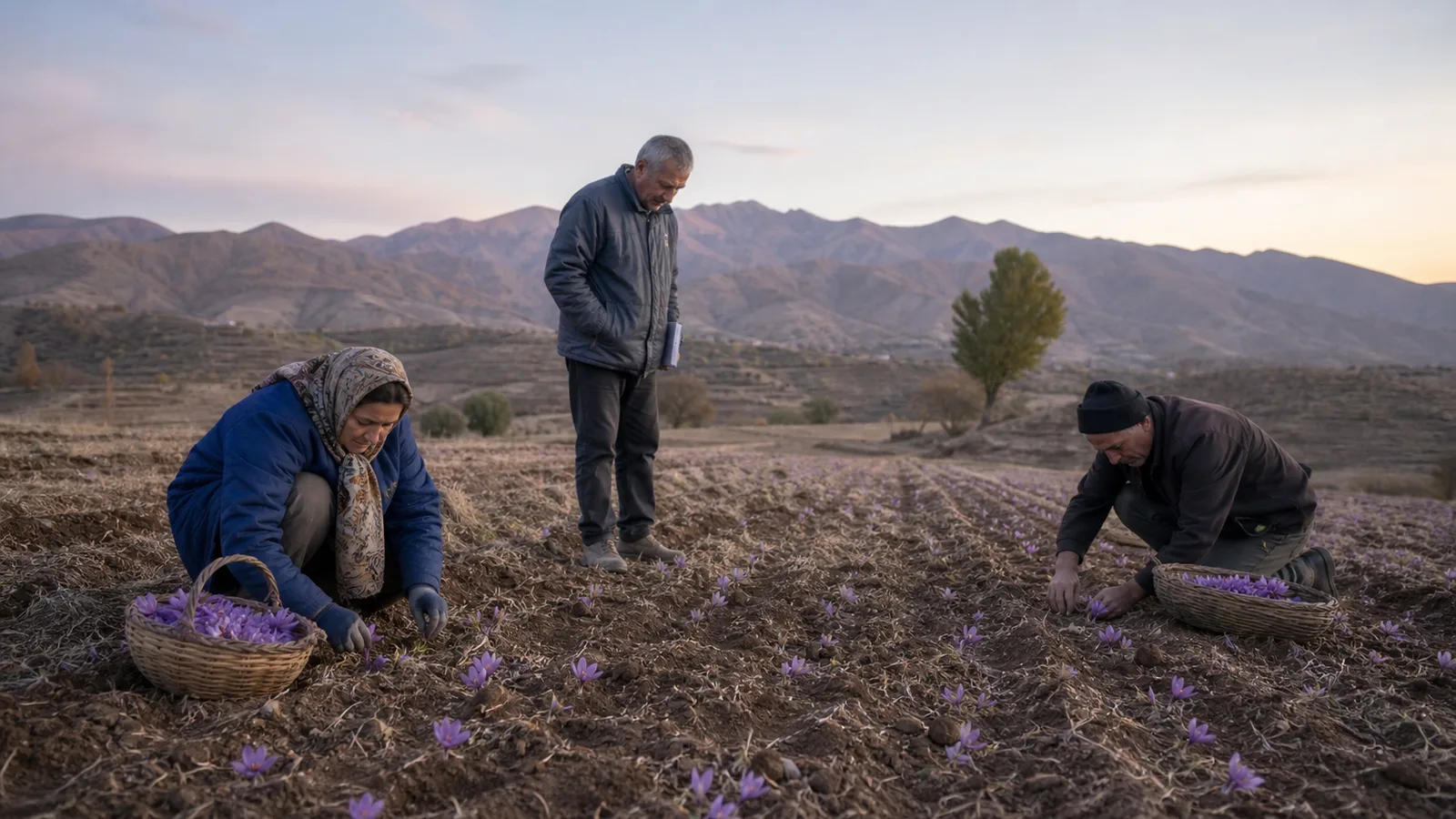
Producing 27 kg of saffron in Namin city of Iran marked an early stage in the crop’s development in this part of Ardabil Province. Mohammad Hassani, then director of Namin’s Agriculture Jihad office, said the harvest came from about 10 hectares and had an estimated value of 300 million tomans.
Those figures describe one reported season around 2019–2020. They are not today’s production total or price. Read together, they imply an average of roughly 2.7 kilograms per harvested hectare and about 11.1 million tomans per kilogram at the value used in the announcement.
The Namin saffron figures in context
Hassani said saffron cultivation was still relatively new in the county. The area had been about 10 hectares in the previous year and had reached approximately 15 hectares, with more than 20 operators involved.
The 27-kilogram crop was reported from 10 hectares, while the wider planted area was said to be 15 hectares. That can occur when newer fields are not yet counted as bearing area or when the figures refer to slightly different reporting points. The source does not provide a field-by-field breakdown, so the two numbers should not be forced into a single 15-hectare yield calculation.
The estimated 300-million-toman value is also historical. It reflects the reported crop and market assumptions of that season, before production costs. Corms, field preparation, irrigation, labour, drying, grading, packaging and sales expenses would all have to be deducted to estimate farm profit.
Why saffron was added to Namin’s crop plan
Hassani linked the initiative to climate change and pressure on water resources. Namin’s agricultural managers were looking more seriously at crop rotation and alternatives for land where established crops offered weak returns. Saffron and other medicinal or lower-water plants were placed on the local agenda because of their potential value and climate fit.
“Low water” needs careful interpretation. Saffron is dormant in summer and does not require summer irrigation in the way many field crops do. It still needs water at critical stages, and poor timing or waterlogged soil can damage yield and corm health. Rainfall, soil water-holding capacity and field drainage change the requirement from one site to another.
A 2016 agricultural extension report documents model saffron planting by a rural women’s cooperative in Anbaran, within Namin County. The programme included free corm distribution and practical training. That earlier work supports the description of saffron as a developing, extension-led crop rather than a long-established large industry in the county.
Flowering and harvest in Namin
The local account placed flowering and harvest between October and November, with a flowering period of about 20 days depending on the field. Calendar dates vary with autumn temperatures, elevation, planting material and management, so growers should watch the crop rather than rely on a fixed date.
Harvest is normally carried out in the cool early hours, often before sunrise or soon after. Closed or newly opened flowers protect the stigmas from direct sun and make handling easier. Picked flowers then need prompt, clean processing; delay can reduce quality and create a backlog during the short peak.
The earlier translation called the first hours of the day the best “flowering time.” Hassani was describing the preferred flower-harvest time, not claiming that the plant flowers only before sunrise.
Elevation, temperature and site suitability
The statement gave 1,200–2,300 metres above sea level as a suitable elevation range. Elevation is a useful clue because it influences temperature, but it is not a stand-alone planting rule. Current Iranian agricultural research likewise treats height, seasonal temperature, soil and nutrition as a combination.
Cool conditions in early autumn can help trigger flowering, while the plant also needs a suitable warm, sunny period during corm development. A field assessment should therefore use local temperature records, frost pattern, slope, drainage and water quality—not elevation alone.
Soil requirements behind the old advice
Hassani warned against highly saline soil. The old sentence saying “the less the soil texture is, the quality rises” is not meaningful agronomy in English; it appears to refer to a lighter, friable soil rather than an absence of texture.
A practical saffron site should drain freely and allow corms to root without prolonged saturation. Very compact or waterlogged soil increases risk, while excessive salinity can limit growth. Soil structure, organic matter, pH, salinity and nutrient status should be tested before planting. Fertiliser recommendations belong to that result, not to a generic recipe.
What would improve yield per hectare?
Hassani expected expert management to raise Namin’s output. For a young production area, the main levers include:
- healthy, correctly sized corms from a traceable source;
- appropriate planting depth, density and field drainage;
- irrigation timed to local weather and plant development;
- disease, rodent and weed management;
- rapid picking and same-day stigma separation;
- controlled drying and moisture-safe storage; and
- records that separate bearing area from new planting.
Yield should be tracked over several years because a saffron field changes as daughter corms multiply. A single county total cannot show whether all farmers achieved the same result or whether a few mature plots supplied most of the crop.
Processing and packaging as local employment
Hassani saw complementary industries beside the farms as a way to create jobs and retain more economic value in Namin. That includes hygienic flower handling, drying, laboratory checks, grading and appropriate packaging.
Earlier provincial plans had already identified processing and packaging units for Namin, Khalkhal and Germi. The need is practical: selling an anonymous bulk product leaves less regional identity and traceability than supplying a verified lot with consistent quality.
Facilities must still match the available volume. At a 27-kilogram annual crop, cooperative or shared processing may be more sensible than oversized equipment. Capacity, operating cost, food-safety controls and confirmed buyers matter as much as the machinery itself.
What the 27 kg milestone did—and did not—prove
The harvest demonstrated that saffron could be produced commercially in parts of Namin and that a group of local operators had moved beyond a single demonstration plot. It also provided a baseline against which later acreage and yield could be measured.
It did not prove that every Namin field would be profitable, that 2.7 kg/ha was the county’s permanent yield, or that the crop’s economic value would remain 300 million tomans. Those questions require current area, harvest, grade, sale-price and cost data.
Hassani said local Agriculture Jihad experts were available to advise farmers through planting, crop care and harvest. For anyone considering the crop now, current local guidance and a small site-specific trial remain safer than projecting an old county total onto a new field.
Sources
The 27 kg, 10/15-hectare, 20-operator and 300-million-toman figures are attributed to Hassani’s statement preserved in the original report. The earlier extension history comes from the Iran Agricultural News Agency’s Anbaran report, and the processing context from its Ardabil production and employment plan. Site-suitability context is consistent with a recent national agronomic study reported by IANA.

![Exporting Saffron to Turkey + Price Guide [Complete 0 to 100]](https://img.rowhanisaffron.com/20260827003933/saffron-export-turkey-quality-inspection.webp)



