


Preventing the sale of saffron is a priority is a misleadingly broad translation of a statement about selling saffron as an unprocessed raw material. During a historical visit to a knowledge-based agricultural company in South Khorasan, Sorena Sattari, then Iran’s vice president for science and technology, argued that the province should retain more value by developing tested, market-ready saffron products.
He connected that goal with local companies, educated people and the growth centre for technology units in Qaen. The priority was not to stop legitimate saffron sales. It was to strengthen the infrastructure that allows producers and businesses to move beyond anonymous raw or bulk trade when a viable higher-value market exists.
Why Qaen’s technology centre was part of the discussion
While visiting South Khorasan, Sattari said the centre for the growth of technology units in Qaen had considerable potential and needed stronger infrastructure. He also praised companies already working in the province.
His development argument focused on place. Towns with fewer established opportunities should use the skills and natural capacities they already have. South Khorasan’s saffron knowledge is one such asset, but turning it into durable businesses requires more than access to the crop.
He described the province’s people as an important form of capital and pointed to its high proportion of educated workers. For a saffron business, that human capacity can support laboratory work, process design, quality records, packaging engineering, market research and traceability systems.
What “raw saffron” means in this context
The original statement used “raw selling” to describe a familiar economic concern: valuable material leaves a producing region with little transformation, differentiation or direct customer relationship, while later stages capture more of the final value.
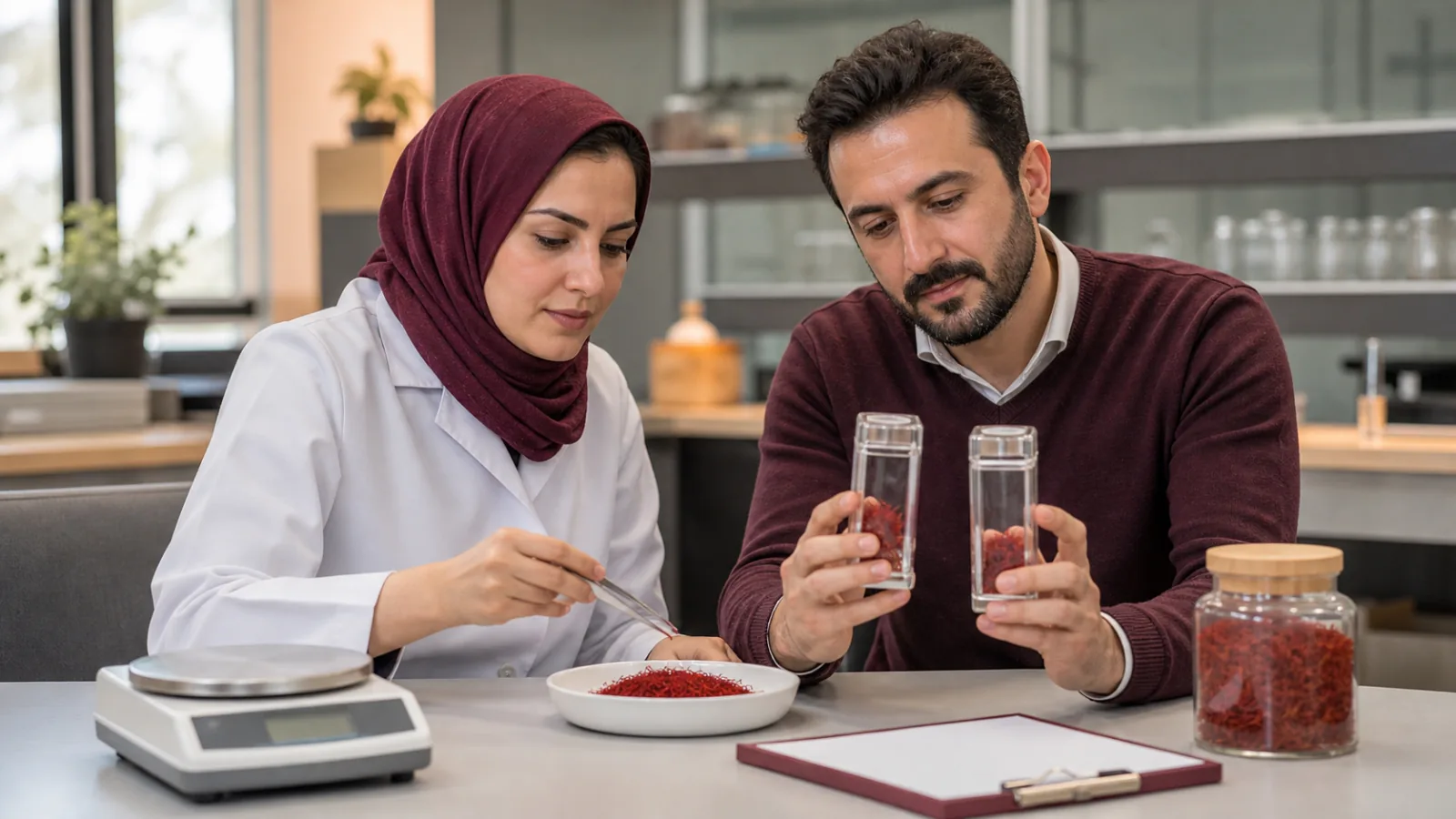
In saffron, the line is not simply raw versus processed. Dried saffron threads are already the result of harvesting, separating and drying the stigmas. The commercial distinction may instead involve bulk, minimally differentiated lots compared with products that add verifiable services or features, such as:
- documented grading and representative test results;
- traceable origin, lot identity and custody records;
- packaging suited to the buyer’s quantity, light and moisture exposure;
- standardised saffron ingredients developed for a defined food application;
- reliable fulfilment and a direct relationship with the final business customer.
Decorative packaging alone is not meaningful value addition. It must protect the product, communicate truthfully and solve a customer need without making the lot harder to verify.
The $9 billion and $500 million comparison needs caution
Sattari was reported as saying that global saffron export turnover was $9 billion while Iran’s exports were about $500 million. The report supplied no year, dataset, product definition or method. Those figures may not measure the same thing: a downstream market estimate can include retail products and other value-chain activity, while customs export value usually measures goods at a different stage.
The comparison should therefore be read as his argument that Iran captured too little value, not as a verified calculation of market share or an estimate of guaranteed lost revenue. A sound comparison would use the same period, product codes, valuation point, countries and treatment of re-exports.
Knowledge-based saffron products still need evidence
Sattari said South Khorasan’s internal capacity should be used to produce knowledge-based products. That label should describe the work behind a product, not function as a marketing badge.
For whole or ground saffron, the ISO 3632-1 specification sets recognised categories and requirements, and ISO 3632-2 covers test methods. A new ingredient, extract or food product may need different validation and destination-market compliance. The business must know which claims its evidence supports.
This is especially important when a product is associated with health. Traditional use, laboratory findings and a finished product’s proven effect are not interchangeable. A knowledge-based company should not turn preliminary research into treatment or cure language.
When selling bulk saffron can still make sense
Preventing raw-material sales should not become a blanket rule. A farmer, cooperative or exporter may have a sound reason to sell a tested bulk lot to a trusted commercial buyer. Developing a consumer brand or processed ingredient adds design, compliance, inventory, marketing and distribution costs, and those costs do not automatically produce a better return.
The decision is commercial and evidence-led. A higher-value route is worthwhile when the expected margin remains stronger after testing, packaging, finance, rejected stock, sales work and delivery are counted. It should also return a fair portion of that value to the people producing and handling the saffron.
How local capacity can become durable value
The practical role of a technology growth centre is to reduce the distance between an idea and a repeatable product. Shared technical facilities, competent advice and links between growers, researchers and businesses can help small teams test a process before spending heavily on scale.
For South Khorasan, useful outcomes would include:
- more lots sold with trustworthy grade and origin records;
- products designed for a clearly researched customer rather than produced speculatively;
- lower quality losses between drying, storage and shipment;
- qualified local work in testing, product development and export operations;
- transparent evidence that the added step improves net returns.
Our guide to exporting Iranian saffron explains the trade and quality work that must sit behind an international sale.
The priority, stated precisely
Sattari’s message was that South Khorasan should use its companies, educated workforce, natural capacity and technology infrastructure to create more value around saffron. Read precisely, it does not mean blocking the sale of saffron. It means avoiding needless loss of value when local businesses can meet a real market need with a safe, verified and economically sound product.

![Exporting Saffron to Turkey + Price Guide [Complete 0 to 100]](https://img.rowhanisaffron.com/20260827003933/saffron-export-turkey-quality-inspection.webp)



