


A local agriculture official predicted production of 36 kg of saffron from 14.1 hectares in Islamabad-e Gharb. That forecast works out to about 2.55 kg of dried saffron per hectare, but it was a seasonal estimate rather than a verified final harvest. Understanding the difference is essential when comparing saffron yield per hectare.
What the 36 kg forecast means
The original announcement came from Karimi, director of Agriculture Jihad in Islamabad-e Gharb. It said that roughly 36 kg of saffron was expected from 14.1 hectares in the county that year. The report did not publish the actual end-of-season harvest, the age of the fields or a field-by-field yield range.
Dividing the forecast production by the stated area gives an implied average of approximately 2.55 kg/ha. This arithmetic is useful, but only if all 14.1 hectares were mature, bearing fields. Newly planted saffron may produce little in its first season, so combining young and established plots can make a county average look lower than the performance of its mature fields.
How it compared with Kermanshah province
An October 2021 report from the Iranian Agricultural News Agency recorded 417 hectares of saffron across Kermanshah province and forecast more than 1,700 kg of production. Those figures imply a provincial average a little above 4 kg/ha. The same report said saffron was grown in most of the province apart from Qasr-e Shirin and Sarpol-e Zahab, and that harvesting generally began in the first ten days of Aban and lasted about one month.
The provincial and Islamabad-e Gharb estimates should not be treated as a controlled comparison. They may refer to different seasons and mixes of field age, irrigation, planting density and weather. They do show why a bare production total is incomplete: area and stand age are needed before the number tells us much about productivity.
What growers were advised to manage
Karimi’s announcement linked yield improvement to correct and timely planting, crop nutrition, and the control of pests, diseases and weeds. Those are reasonable management categories. The archived version also gave a fixed recommendation of 50–100 kg of nitrogen fertiliser per hectare after flower harvest, followed by micronutrient sprays in March.
That fixed fertiliser rate should not be copied as a universal prescription. Soil fertility, corm density, irrigation water, organic inputs and previous applications vary from one field to another. Official Iranian saffron guidance has specifically advised soil testing before fertilisation so the field’s actual nutrient needs can be identified. Any nitrogen or micronutrient programme should therefore be set by a qualified local agronomist from a soil test and field history.
Plant at the right site and time
A saffron field needs free-draining soil and healthy corms. Water that remains around the corm raises the risk of rot, while weak or diseased planting material can limit the stand before nutrition has any chance to help. Planting date and depth should follow local conditions rather than a generic calendar copied from a different province.
Protect leaf growth after flowering
The crop does not finish when the flowers are picked. Its leaves continue feeding the replacement corms that support future seasons. Unnecessary leaf damage, unmanaged weeds, severe nutrient imbalance or poorly timed irrigation can therefore reduce the next harvest even when the current flower crop has already left the field.
Record pests and diseases before treating
Control begins with identifying the problem. Growers should record affected patches, symptoms and corm condition, then use locally approved measures when thresholds and diagnosis justify them. Routine pesticide use without a diagnosed problem increases cost and can create food-safety and environmental risks.
How to calculate saffron yield per hectare correctly
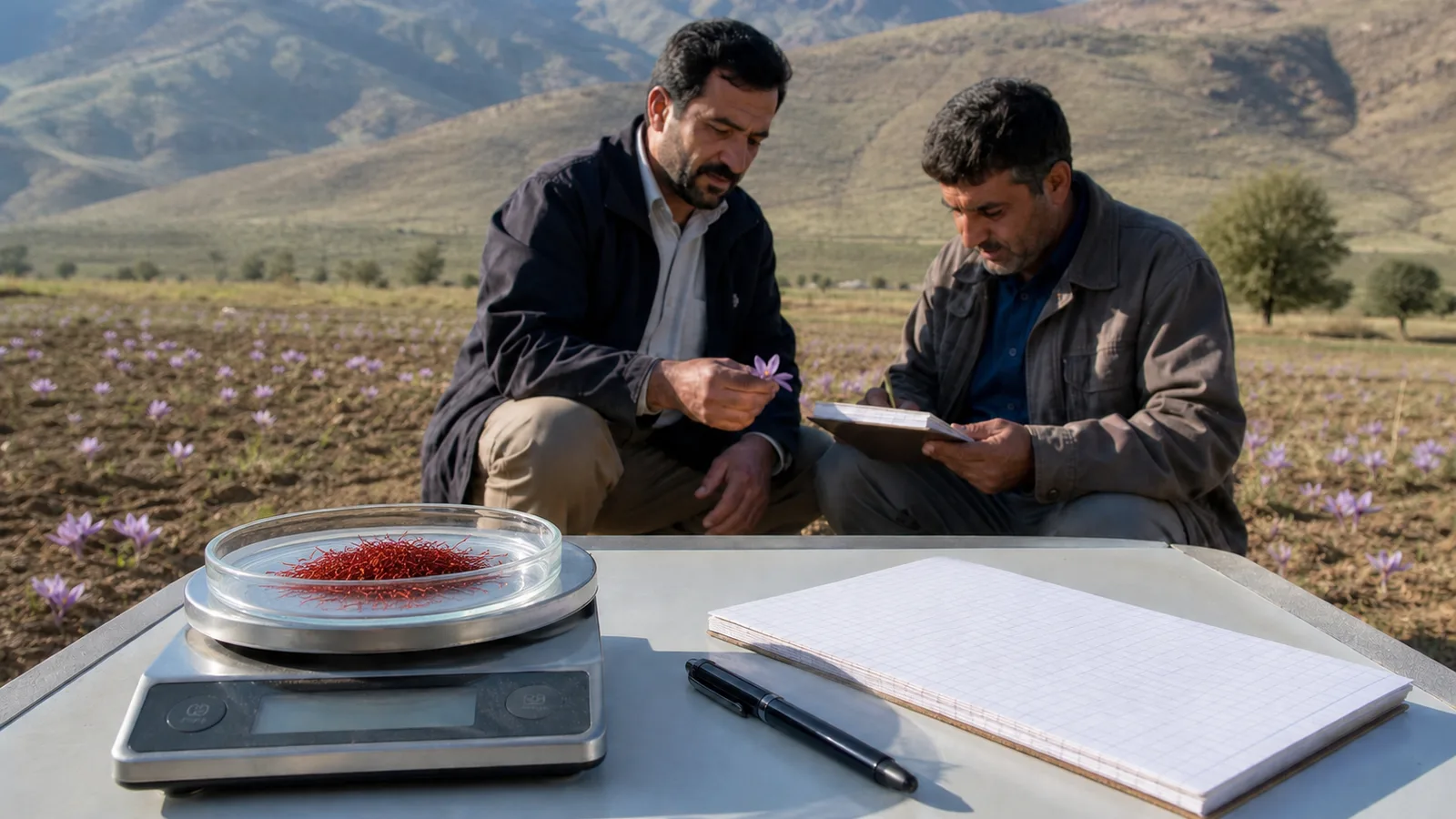
For a meaningful field result, weigh fully dried stigmas from a known bearing area. Do not use flower weight, fresh stigma weight or the entire owned area if only part of it flowered.
- Record the exact harvested area in hectares.
- Dry the separated stigmas consistently and keep lots identified by field.
- Weigh the dry product on a calibrated scale.
- Divide dry saffron kilograms by harvested hectares.
- Record field age, corm density, irrigation and unusual weather alongside the result.
For example, 36 kg divided by 14.1 hectares equals 2.55 kg/ha. If only 10 of those hectares were actually bearing, however, the bearing-area result would be 3.6 kg/ha. This is why the denominator must be defined before comparing farms or seasons.
Support mentioned in the original report
Karimi also referred to Ministry of Agriculture Jihad support through low-cost finance and the free distribution of saffron planting material—the “saffron onions” in the old translation are more accurately called corms. Such support can reduce the cost of establishing a field, but corm health, traceable origin and suitability are more important than a free supply alone.
Islamabad-e Gharb is a county in Kermanshah province in western Iran, centred on the city of the same name. Kalhori Kurdish is among the languages spoken locally. The county has a substantial wider agricultural economy, so saffron should be assessed within local labour, water and market conditions rather than presented as a replacement for every crop.
What a useful follow-up should report
The original 36 kg figure was a forecast. A proper follow-up would publish the final dry harvest, bearing and newly planted hectares separately, average and range of field yields, product quality, production cost and the proportion sold. Those measurements would show whether the programme improved farm results, not merely whether more corms were distributed.

![Exporting Saffron to Turkey + Price Guide [Complete 0 to 100]](https://img.rowhanisaffron.com/20260827003933/saffron-export-turkey-quality-inspection.webp)



