


Organic saffron in international markets depends on evidence that travels with the product. A historical ceremony in Qaenat recognized the laboratory associated with Tarvand Saffron after an ISO/IEC 17025:2017 accreditation process. That was a meaningful laboratory milestone, but it did not by itself certify every Tarvand product as organic or prove that every batch met every buyer’s standard.
What recognition did Tarvand Saffron receive?
The original account was filed from Birjand by Mohammad Ghorbani for The World of Economics. It reported that the agricultural and production group Tarvand Saffron had equipped a laboratory in Qaenat and received recognition based on ISO/IEC 17025:2017 from Iran’s national accreditation system. At the ceremony, the Director General of Standards for South Khorasan and the Governor of Qaenat presented the document to the company’s chief executive.
The earlier English version called the authority the “National Certification Center of Iran.” In this context, the more accurate name is the National Accreditation Center of Iran: it assesses the competence of a laboratory rather than certifying the saffron product.
Mohsen Ehtesham, whose surname was rendered Etesham in the earlier English text, said the work had taken more than three years. He connected the laboratory programme with buyers’ requirements for saffron and barberry and with the company’s wider effort to maintain quality from local farms through processing and export.
It is more accurate to call this laboratory accreditation than product certification. ISO explains that accreditation bodies use ISO/IEC 17025 as the criteria for assessing laboratories. The standard remains current, but an individual laboratory’s accreditation also has its own scope, identifying details and surveillance status. The ceremony is a historical event; buyers should request the current accreditation certificate and scope rather than assume that an old announcement proves present status.
What ISO/IEC 17025:2017 actually covers
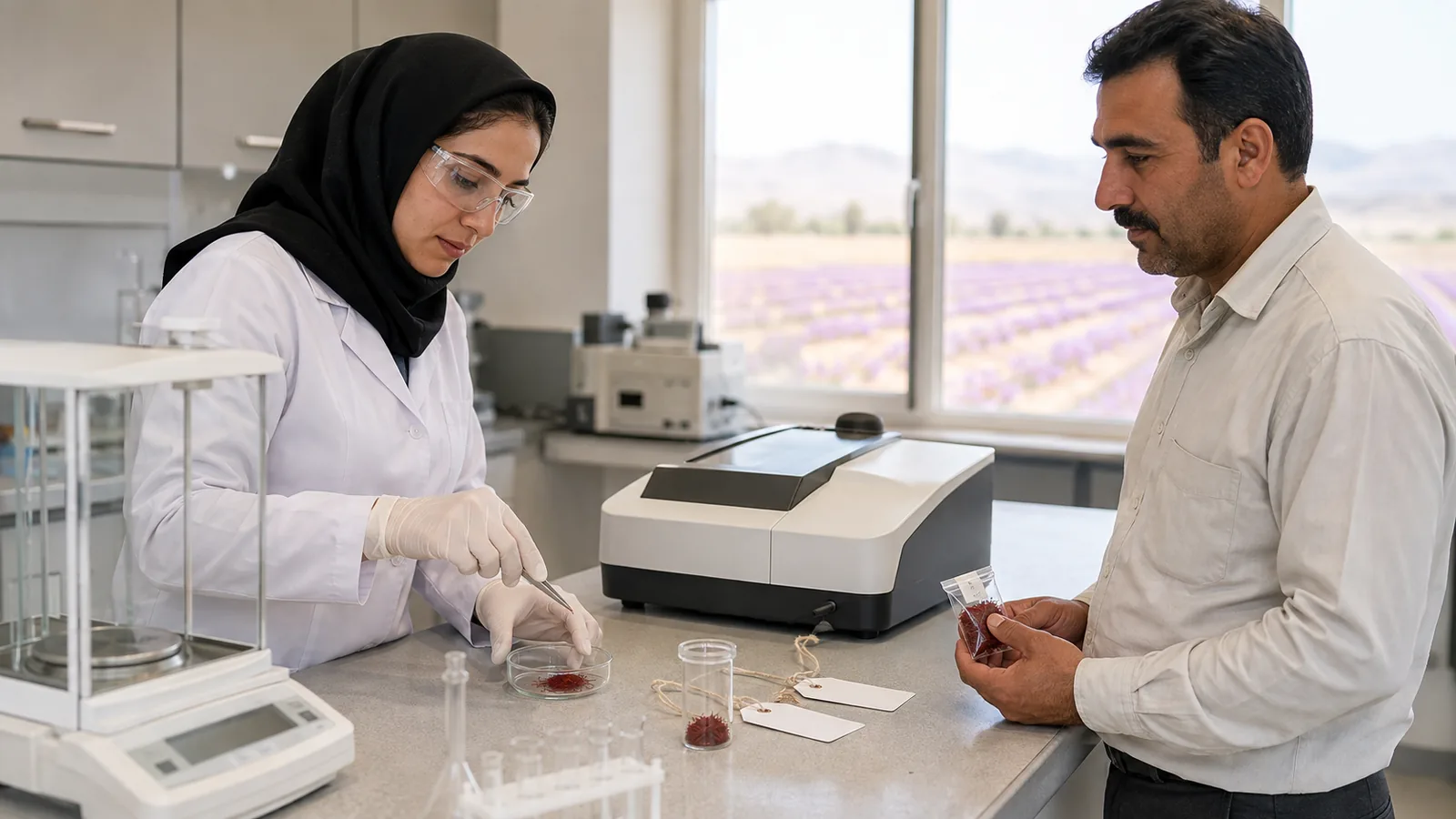
ISO/IEC 17025:2017 sets requirements for the competence, impartiality and consistent operation of testing and calibration laboratories. In practical terms, an assessor looks beyond whether a room contains expensive equipment. The laboratory must have competent personnel, suitable methods, controlled records, calibrated equipment and a system for reporting reliable results.
This matters to exporters because a buyer needs confidence in a test report. When competent laboratories and accreditation bodies participate in international recognition arrangements, results may be accepted more readily across borders. That can reduce unnecessary repeat testing, though an importing authority or customer may still require its own analysis.
The scope is crucial. A laboratory may be accredited for certain products, properties and methods but not for every possible saffron test. Seeing “ISO/IEC 17025” on a document is only the start. A careful buyer checks that the named laboratory, method and measurement needed for the batch appear within the accredited scope.
Laboratory accreditation is not an organic certificate
The earlier article blended the laboratory award with claims about organic production. They belong to related quality work, but they prove different things.
ISO/IEC 17025 concerns a laboratory’s ability to carry out specified tests. It does not certify a farm’s production system as organic. Lower pesticide residues can be an important result, but “low residue,” “pesticide-free” and “certified organic” are not interchangeable labels.
Organic status follows the rules of the market where the saffron will be sold. For example, the European Commission says food producers, processors and traders wishing to market food as organic in the EU must be registered with a control agency or body that verifies compliance with the organic rules. A non-EU exporter must therefore check the recognized control body, operator, product category and validity that apply to the intended destination.
For any shipment described as organic saffron, the useful documents are the organic certificate and scope, the lot’s traceability records and any transaction certificate required by the destination. A laboratory report supports the evidence; it does not replace the organic control system.
How ISO/IEC 17025 differs from ISO 3632
These two standards are often mentioned together and should not be confused. ISO/IEC 17025 assesses the laboratory. ISO 3632 addresses dried saffron and the methods used to examine it.
The current ISO 3632-1:2025 specification covers dried saffron in filament, cut-filament and powder forms. The testing framework considers characteristics tied to identity and quality. The familiar laboratory measures associated with saffron include the compounds responsible for colour, bitterness and aroma, as well as moisture and foreign matter.
An ISO/IEC 17025-accredited laboratory may test saffron using ISO 3632 methods if those tests fall within its scope. That is the strong combination: a relevant product method carried out by a laboratory whose competence for that work has been assessed.
Our overview of Iranian saffron standards explains how product specifications, sampling and buyer requirements fit together beyond one laboratory certificate.
Neither standard means a product “surpasses global standards.” A result shows conformity with a stated requirement for a tested sample and date. Marketing language should not stretch it into an unlimited claim about every future batch.
Tarvand’s farmer network and contract-production model
Ehtesham described the company’s approach as beginning at farm level. The historical account says Tarvand had worked with more than 2,000 local farmers since 2002, when its activities were linked with national saffron and barberry festivals. It also describes the group as an early user of contract farming for saffron.
Those figures and “pioneer” language are company statements from the period, not a current independent census. Their underlying model is nevertheless relevant. Training farmers before the crop is planted or harvested can be more effective than rejecting an unsuitable lot after it reaches the factory.
A sound contract-production programme defines the permitted inputs, field records, harvest handling, separation of lots and payment terms. If the crop is to be sold as organic, the participating fields and handlers must be inside the applicable certification scope. A farmer owning the field and supplying the company directly helps traceability, but ownership alone does not establish organic status.
The company also said its local suppliers took an active role in production and that it had focused on reducing pesticide residues. These are useful practices when documented. Residue monitoring should include the compound tested, method, reporting limit, sample identity and destination-market limit; “safe” cannot be inferred from an unnamed test.
What the award means for saffron buyers
A buyer should read an award or accreditation as a reason to examine the evidence, not as a substitute for doing so. The practical checks are straightforward:
- Confirm the legal name and location of the laboratory on the accreditation document.
- Check the accreditation number, status and scope for the relevant saffron methods.
- Match the test report to the batch or lot being offered.
- Read the reported result, units, method and date rather than relying on a logo.
- Verify organic certification separately for the farm, handler and destination market.
- Confirm the buyer’s own limits for residues, microbiology, labelling and packaging.
This is how a laboratory investment can improve customer confidence. It gives an exporter a disciplined way to produce evidence and investigate variation. It does not remove the buyer’s need to read the evidence attached to the particular consignment.
The “Crescent Award” needs careful interpretation
The old English account also says Tarvand received South Khorasan’s first “Crescent Award,” presented in a ceremony involving Standards Director General Morteza Dastourani. The original Persian name and an official issuing record for that translated title could not be confirmed from the available public material.
For that reason, the phrase is preserved as a reported local recognition, not treated as another name for ISO/IEC 17025 accreditation, a halal mark or an organic certificate. Those are different conformity claims. Anyone relying on the award should request its original title, issuing body and criteria.
Dastourani’s wider remarks concerned the move from purely provincial recognition toward nationally valid accreditation and better alignment with international requirements. He also highlighted Qaenat’s industrial capacity, including work involving barberry, and discussed the need for clearer standards for products such as saffron extract.
Saffron extract needs its own evidence
A dried saffron standard does not automatically cover every extract or saffron-based product. Extraction changes the product form and may introduce carriers, solvents, concentration claims or stability questions. The required tests depend on what is being sold and how it will be used.
The older report said work was under way on standards for saffron extract after earlier delays. It did not establish that one universal extract standard had already been completed. An exporter should identify the actual national or destination-market specification in force for the product, then use a competent laboratory for the relevant methods.
What organic saffron needs in international markets
A certificate can open a conversation; consistent batches keep the relationship. International buyers normally need a clear product specification, defensible organic status, traceable origin and test reports that match the shipment. Packaging must protect the threads from moisture, light, odours and substitution after testing.
FAO’s current saffron work in Iran reinforces this whole-chain view. Its programme with Mashhad University combines advanced authenticity testing with practical post-harvest guidance. That is important because a technically valid test cannot repair damage caused by poor drying, storage or lot control.
Tarvand described itself as Iran’s first producer and exporter of organic saffron and said its quality work had built customer loyalty over more than 30 years. That “first” is retained as the company’s historical claim; no complete independent register was found that could establish priority across every Iranian producer. Current buyers should judge the current certificate, scope and shipment rather than the age of the claim.
The lasting value of the Qaenat ceremony is therefore specific. It recognized the effort to build competent testing into a saffron and barberry business and to connect laboratory practice with farmers. For organic saffron in international markets, that is one strong part of the evidence chain—provided it stays current, its scope is relevant and it is never confused with the organic certification of the product itself.

![Exporting Saffron to Turkey + Price Guide [Complete 0 to 100]](https://img.rowhanisaffron.com/20260827003933/saffron-export-turkey-quality-inspection.webp)



