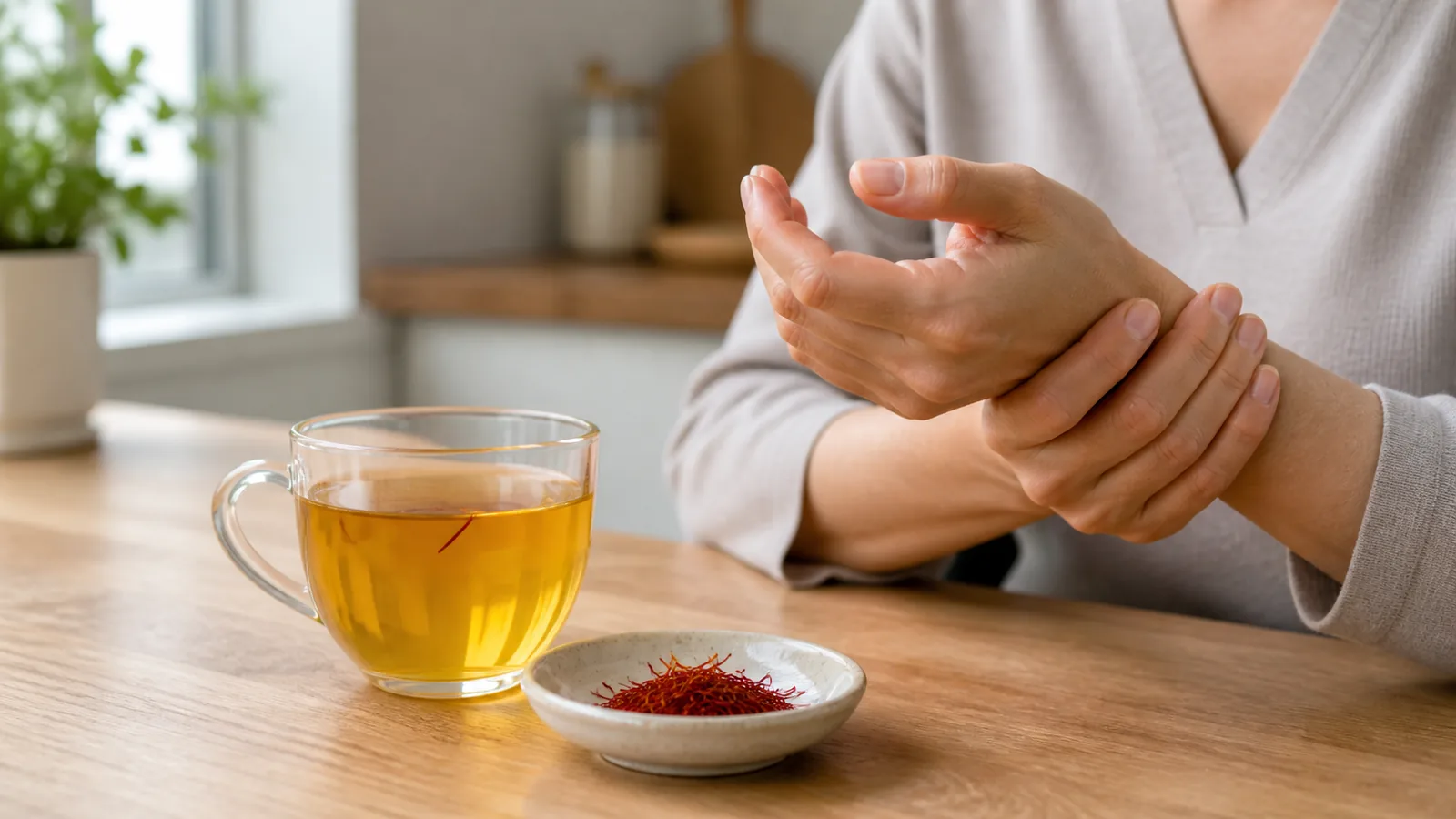
“Saffron freshness potion” was a translated slogan in an autumn harvest-health report from Torbat-e Heydariyeh—not a drink recipe or medical treatment. Its useful message was that a healthy saffron crop starts with the people who pick it: sun protection, safer posture, clean handling and sensible precautions around pollen.
The original article attributed the advice to Elahe Gerami, a health-education and promotion specialist associated with the local Faculty of Medical Sciences. This update preserves each harvest point while separating occupational guidance from unsupported claims that eating saffron prevents heart disease or cancer.
Autumn saffron harvest in Torbat-e Heydariyeh
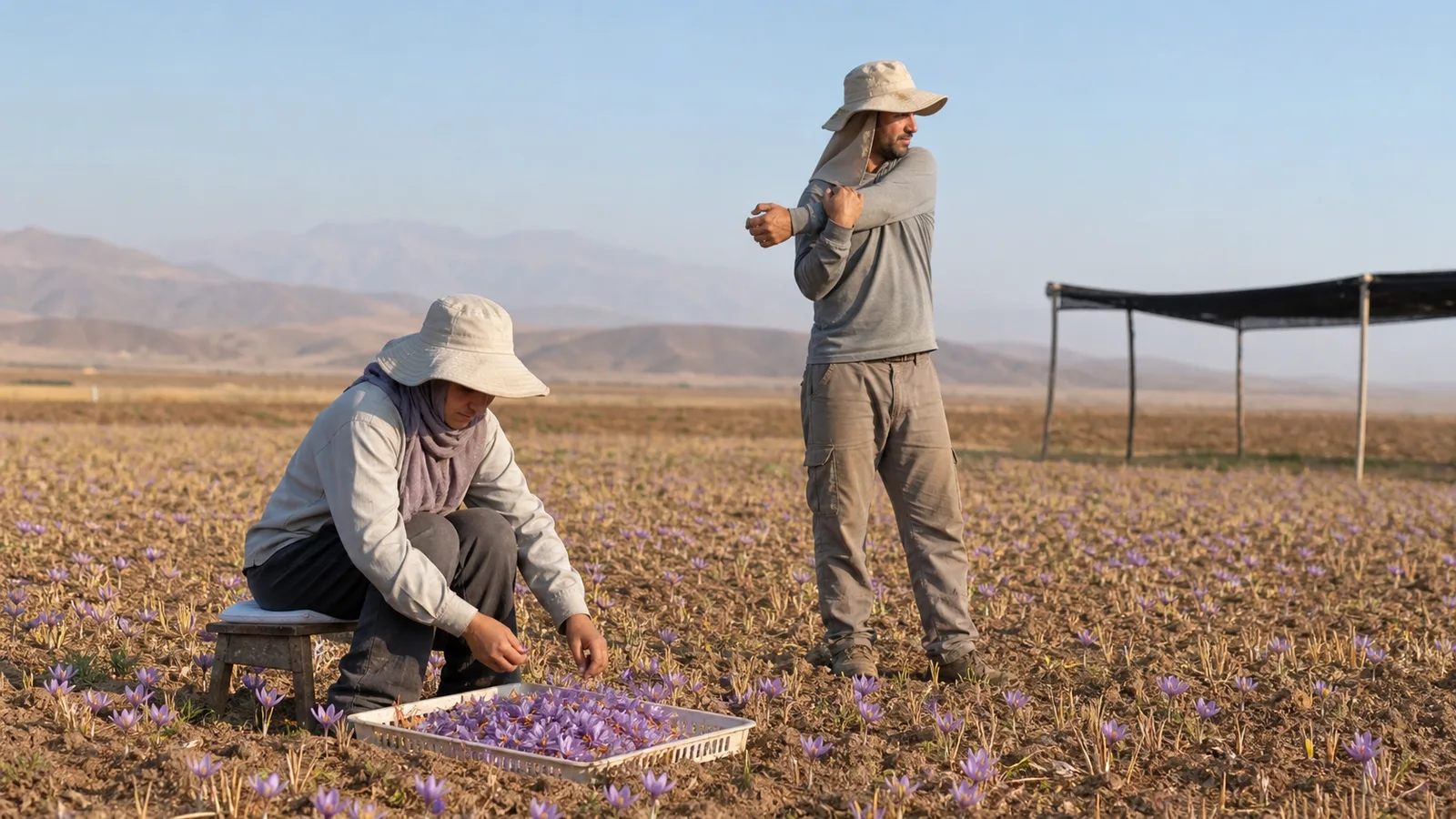
During the short autumn flowering period, saffron fields in Torbat-e Heydariyeh fill with purple Crocus sativus flowers. Growers usually collect flowers early, then separate and dry the three red stigmas. Colour, aroma and final quality depend on the crop, harvest timing and careful post-harvest handling.
The old introduction praised the “capable hands of women and men farmers.” That human element is worth retaining. Saffron’s value comes from concentrated manual work, and worker health should not be treated as secondary to the product.
Protect skin during long hours outdoors
Gerami advised harvesters to wear a sun hat. That remains sensible, but a hat works best as part of a wider plan. The US Centers for Disease Control and Prevention recommends shade, covering clothing, a wide-brimmed hat, sunglasses and broad-spectrum sunscreen when ultraviolet exposure cannot be avoided.
- Use a wide brim that shades the face, ears and neck rather than a narrow cap.
- Cover arms and legs with breathable work clothing.
- Take shade and water breaks, especially as the day warms.
- Reapply sunscreen according to its label, particularly after sweating.
- Do not assume cool autumn air means ultraviolet exposure is absent.
No single hat can “prevent skin cancer” in every worker, but reducing repeated ultraviolet exposure lowers avoidable risk.
Reduce back and knee strain
Saffron flowers sit close to the ground. Repeated bending, squatting and carrying can strain the lower back and knees. The original advice—change position, stand periodically and stretch—was directionally useful. A safer work pattern adds task rotation and better load handling.
- Alternate between kneeling, supported squatting and standing rather than holding one posture.
- Use a low stable seat or knee support where the field layout allows it.
- Keep collection containers small enough to lift without twisting.
- Place filled containers at an accessible height instead of repeatedly lifting from ground level.
- Rotate picking, carrying and sorting tasks during a long shift.
- Stop when pain becomes sharp, causes weakness or continues after rest.
Brief stretching can relieve a fixed posture, but it cannot compensate for hours of overloaded or awkward work. Persistent back or knee pain deserves assessment rather than being treated as an unavoidable cost of harvest.
Keep manure away from harvest contamination
The local health advice warned against spreading unprepared manure around first irrigation. The food-safety principle is broader: raw or inadequately treated manure can carry human pathogens, and its timing and handling need a controlled agricultural plan.
Use properly treated soil amendments, prevent runoff onto flowers and harvest containers, and follow the applicable local interval and production rules. Workers handling manure should not move directly into flower sorting without handwashing and clean clothing or gloves. “Natural fertiliser” does not automatically mean microbiologically safe.
Collect flowers in clean, shallow containers
The report rejected large bags because compacted flowers heat, bruise and become harder to sort hygienically. It suggested clean cotton bags. A clean breathable cloth is better than a dirty sack, but a shallow, rigid, food-grade basket or tray usually protects the flowers more effectively because it prevents crushing and allows airflow.
- Clean and dry containers before the harvest begins.
- Keep them off manure, standing water and dirty vehicle floors.
- Do not overfill or compress the flowers.
- Move flowers promptly to a shaded, clean sorting area.
- Separate visibly mouldy or contaminated material.
- Wash hands before stigma separation and after breaks or soil contact.
Good containers cannot rescue flowers left hot and compacted for hours. Time, shade, cleanliness and gentle handling work together.
Saffron pollen can be an occupational allergen
The old article said children should never contact saffron flowers because the pollen “will cause allergies.” That is too certain. Most contact does not guarantee an allergic reaction, and age alone does not determine sensitisation.
There is, however, documented occupational allergy. A study of 50 saffron workers identified sensitisation in three people, including work-related asthma or rhinoconjunctivitis. Researchers later characterised Cro s 1, an allergen from saffron pollen.
Workers who develop repeated sneezing, itchy eyes, wheeze, cough or rash around flowers should reduce exposure and seek medical advice. Breathing difficulty, throat swelling or faintness requires urgent help. Children should not be used as unsupervised harvest labour, but the safety reason is broader than a claim that every child is allergic.
Does saffron prevent heart disease or cancer?
No. Saffron contains antioxidant compounds, but antioxidant activity is not evidence that eating the spice prevents heart disease or cancer. Those outcomes depend on disease-specific human evidence, dose, duration and clinically meaningful results. A harvest-health article should not turn a chemical property into a prevention promise.
Saffron is also not automatically safer than every artificial colour. A culinary spice and a regulated food colour have different compositions and uses. Purity, dose, allergy and product quality still matter.
Mood, joy and the “freshness potion” phrase
The final line told readers to eat saffron to remain fresh, happy and smiling. Human research on measured saffron preparations and mood is more nuanced. A 2026 review of 34 randomised trials found improvement on some self-reported depression and anxiety scales, while several clinician-rated outcomes did not show the same result and studies varied substantially.
That evidence does not turn food into an antidepressant or guarantee joy. Persistent low mood, loss of interest, severe anxiety or thoughts of self-harm needs qualified support. Saffron should not replace counselling or prescribed treatment.
A better meaning for saffron freshness
If “saffron freshness potion” has a useful modern meaning, it is not a potion at all. Fresh saffron begins with shaded flowers, clean containers, careful sorting and workers whose skin, backs, knees and lungs are protected. Those practical measures strengthen both the crop and the community without making medical promises the spice cannot support.