


Increasing the price of Iranian saffron to more than $ 1000 was reported in early 2021, when Ali Hosseini said export volume was nearly unchanged but the value of each kilogram in the world market had risen.
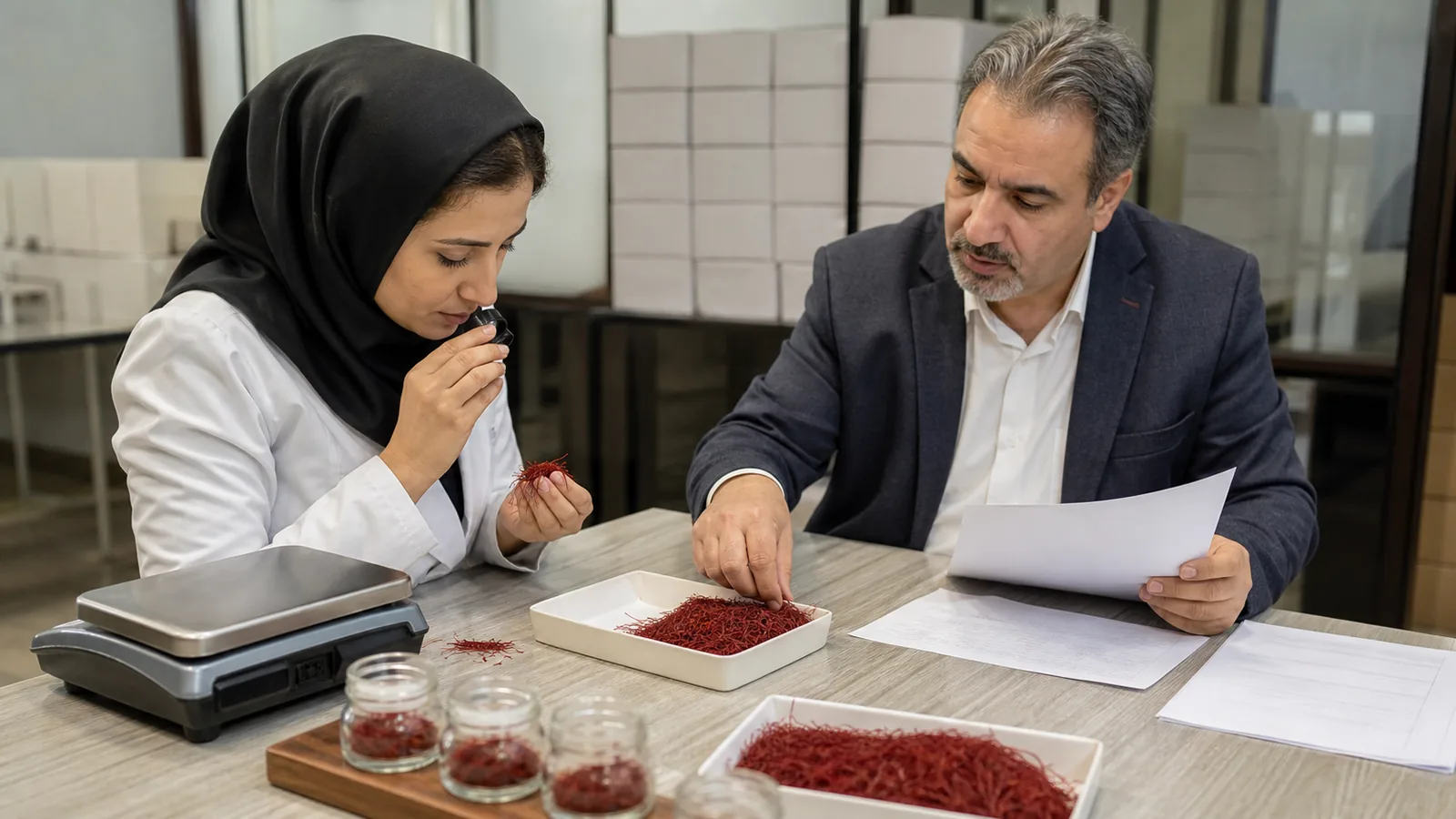
Hosseini, identified as a member of Iran’s National Saffron Council, compared the first ten months of two consecutive reporting years. He also discussed unofficial trade, product quality, national production, yield and domestic prices. Every figure below belongs to that historical market snapshot, not today’s saffron price.
Iranian saffron above $1,000 per kilogram
Hosseini said the international price of Iranian saffron had increased to more than $1,000 per kilogram. Although export tonnage had not grown as much as expected, he anticipated a higher total export value if that price held through the end of the year.
The distinction between volume and value is central to the report. A market can ship roughly the same quantity while earning more if the average price per kilogram rises.
Export volume was close to the previous year
Preliminary statistics for the first ten months were described as nearly level with the same period a year earlier. Hosseini placed the preceding ten-month export volume at more than 100 tonnes.
The article did not publish an exact current-year tonnage or final full-year result. It therefore supports a comparison of “nearly unchanged” volume, not a precise growth rate.
The $600–$700 unofficial-market concern
Hosseini argued that saffron moving through smuggling channels was being offered for $600 to $700 per kilogram. In his view, that lower price could pull down the international value attached to Iranian saffron and limit export revenue.
He also linked unofficial trade to inconsistent or poor-quality product entering the market under Iran’s name. His concern was reputational as well as financial: a buyer who received inferior saffron might judge the wider origin by that experience.
Production of 404 tonnes from 110,000 hectares
The report attributed national production of 404 tonnes to the Ministry of Agricultural Jihad for that year. Hosseini welcomed the total but said performance remained weak relative to the 110,000 hectares under cultivation.
Dividing those figures gives roughly 3.7 kilograms per hectare. The earlier English text rendered Hosseini’s average as “3.5 tons per hectare,” but tonnes cannot be reconciled with the stated national total and area. The consistent unit is kilograms per hectare.
Why average yield mattered to the price discussion
Hosseini viewed the approximately 3.5-kilogram average as evidence of low productivity and wasted production resources. His argument was that a larger cultivated area does not automatically create an efficient sector.
That point sat beside the export problem. Production had increased, yet formal exports had not expanded at the same pace, while unofficial supply was said to be competing at a lower price.
Domestic saffron prices in the report
For the Iranian market, Hosseini gave a range of 6.5 million to 10.5 million tomans per kilogram. The spread reflects the historical market described in the article; it is not a current quote and does not specify grade, format or transaction size.
Domestic toman prices and international dollar prices also describe different markets. They should not be compared directly without the exchange rate, grade, trade terms and date used in the original transactions.
The figures preserved from the 2021 account
- More than $1,000 per kilogram: the reported international price of Iranian saffron.
- More than 100 tonnes: the preceding year’s first-ten-month export volume.
- $600–$700 per kilogram: the unofficial supply range cited by Hosseini.
- 404 tonnes: the national production figure attributed to the ministry.
- 110,000 hectares: the cultivated area used in the productivity comparison.
- 6.5–10.5 million tomans per kilogram: the reported domestic-market range.
A historical price report, not a live quotation
The page explains why Hosseini expected export value to rise even without much growth in volume: the international price had moved above $1,000 per kilogram. It also records his warning that unofficial low-priced trade could weaken both price and reputation.
Because currency values and commodity prices change, none of these numbers should be used as a present buying or selling quote. Their value here is historical: they show how price, formal exports, production efficiency and product reputation were being discussed at that point.

![Exporting Saffron to Turkey + Price Guide [Complete 0 to 100]](https://img.rowhanisaffron.com/20260827003933/saffron-export-turkey-quality-inspection.webp)



