


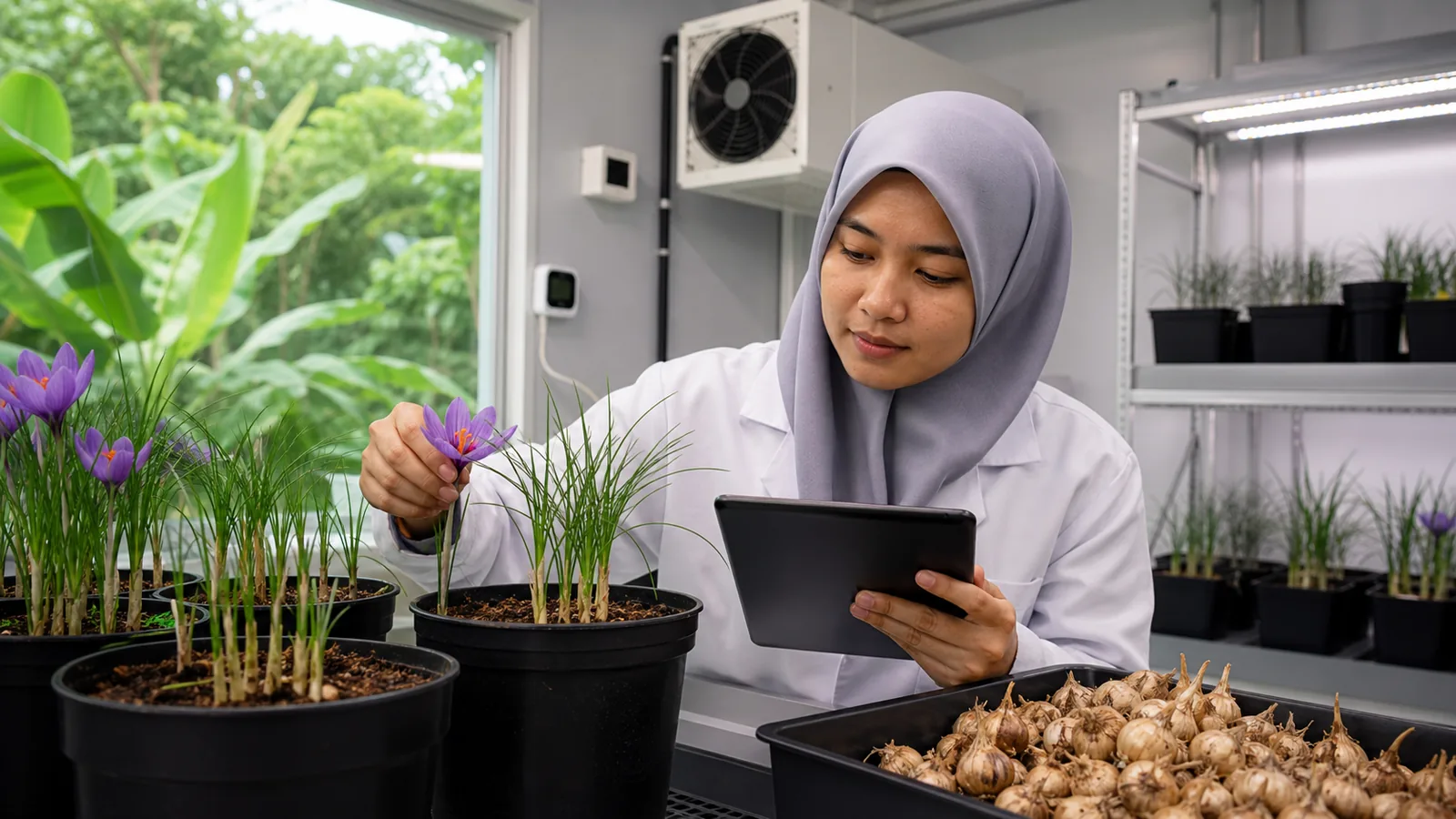
Can saffron grow in Malaysia? Yes, but the strongest evidence is for a carefully controlled indoor environment, not an ordinary open field in Malaysia’s equatorial climate. University of Malaya researchers succeeded in bringing Crocus sativus corms into flower by managing temperature, soil and pre-treatment. Their result showed that the saffron plant can complete the critical flowering stage in Malaysia when growers reproduce the seasonal cues it would normally receive in a temperate growing region.
This distinction protects an important part of the original 2016 report. A flower produced in a research room proves biological feasibility. It does not, by itself, prove that outdoor cultivation will be reliable, that the harvested stigmas will meet a commercial grade, or that a Malaysian saffron farm will be profitable.
What the Malaysian experiment achieved
The project was led by Professor Rosna Mat Taha at the University of Malaya’s Institute of Biological Sciences. Work on saffron cultivation and propagation began in 2014, and the first results were reported in Malaysia after corms flowered under controlled-room conditions. The research team included Nordiyanah Anuar, Asif Khan, Behnaz Nowrouzi, Sakinah Abdullah and Sadegh Mohajer; a later University of Malaya bulletin credits Mat Taha, Anuar and Noraini Mahmad for its account of the flowering trial.
The university reported this as the first successful attempt at saffron cultivation and flowering in Malaysia. After pre-treatment, plants grown in black soil at 16°C reached 100% flowering after 57 days. The flowers had the expected violet petals, three red stigmas and three yellow stamens, and the researchers found their shape, scent and size comparable with flowers from temperate countries.
That is a meaningful result. It answers whether a saffron plant can flower in Malaysia under managed conditions. The trial was conducted indoors, however, so it should not be recast as evidence that saffron thrives outside in constant tropical heat and rainfall.
Why Malaysia’s equatorial climate is difficult for saffron
Saffron has a seasonal life cycle. The plant develops from a corm, forms flower buds during a warmer phase, then needs a marked fall in temperature for reliable flower emergence. In its traditional growing regions, that sequence is supplied by hot, dry summers and cooler autumn conditions.
Lowland Malaysia does not naturally reproduce the same pattern. Warm nights, high humidity and frequent rain create different conditions around the corm. Excess moisture can also increase the risk of rot. For that reason, the most credible Malaysian approach is a controlled room or another protected system where temperature, drainage, humidity and airflow can be measured rather than guessed.
The phrase “tropical saffron production” can therefore be misleading. The trial took place in a tropical country, but the plant itself was given a cooler artificial environment at the flowering stage.
Temperature is a sequence, not one magic number
The 2016 news account described good growth and flowering between roughly 15°C and 20°C. It also reported reduced success at 21–28°C and no flowering above 30°C. The University of Malaya’s formal account gives a more precise result for that trial: black soil and 16°C produced full flowering after the corms had received the necessary pre-treatment.
Later work by the same research group made the sequence clearer. In a 2024 study of corm germination and flowering, the researchers tested 10°C, 23°C and 30°C for germination, followed by 16°C, 23°C or 30°C for flowering. The plants developed best when corms first experienced a higher temperature in the 23–30°C range and were then moved to 16°C for flower formation.
This matches wider saffron research. Flower initiation and flower emergence are separate stages. Controlled-environment studies have found that an inappropriate temperature at either stage can delay development, interrupt it or cause flower abortion. A grower who holds the room at one temperature from start to finish may therefore get leaves without a useful flower crop.
Saffron grows from corms, not ordinary seed
People often search for “saffron seeds,” but cultivated Crocus sativus is sterile and does not produce viable seed in the usual way. New plants are raised from daughter corms that form around a mother corm. The corm stores the energy needed for early growth and flowering, which is why its size, health and treatment history matter.
A poor or diseased corm will not become a strong saffron plant simply because it is placed in an air-conditioned room. Growers need correctly identified planting material, a clean starting stock and a way to isolate any corm showing rot. The corms must also be large enough to have a realistic chance of flowering.
For the broader planting cycle, soil and irrigation requirements, see our saffron planting guide. Malaysian growers should adapt those fundamentals to a protected system rather than copying an outdoor calendar from Iran or Spain.
What the black-soil result does and does not tell us
The University of Malaya team analysed the trial soil and reported that the major nutrients in Malaysian black soil were approximately comparable with those in the Iranian soil used for reference. That helped explain the plant growth observed in the experiment.
“Black soil” is not a complete growing specification. Colour alone says little about drainage, structure, salinity, pathogens or nutrient availability. Anyone attempting to repeat the work needs a tested medium that drains freely and does not remain waterlogged around the corm. The Malaysian finding should be treated as a result from a defined experiment, not a promise that any dark garden soil will work.
From one flowering trial to reliable production
A commercial system has to do more than produce a flower once. It must deliver repeatable flowering across a large number of corms, then support daughter-corm development for the following cycle. It also needs to control disease, electricity use, labour and the quality of the dried stigmas.
Before scaling up, a Malaysian trial should record:
- the origin, size and health of every corm batch;
- temperature and humidity throughout dormancy, sprouting and flowering;
- germination, flowering and flower-abortion rates;
- the number and dry weight of stigmas harvested per corm;
- corm survival and daughter-corm production after flowering;
- electricity, cooling, labour and disease-control costs; and
- the colour, aroma and flavour quality of the finished saffron.
Without those measurements, a high selling price can make a trial look more profitable than it is. Cooling a room in an equatorial climate and handling each flower by hand can account for a substantial share of production cost.
The 2016 Malaysian price figures are historical
The original IRNA report, citing the Borneo Post, placed saffron in Malaysia at 25,000–32,000 ringgit per kilogram, or about USD 7,000–8,000 at the exchange rate used in that report. It also quoted an Iranian price of roughly 60–65 million rials per kilogram and said saffron sold abroad in foreign or European packaging could command more than twice its price in Iran.
Those numbers describe the market as reported in 2016. They are not current retail quotes, and they do not establish what a Malaysian grower would receive. Saffron prices vary with grade, test results, origin, package size, seller and currency movements. A kilogram retail equivalent is also different from a bulk farm-gate return.
Quality has to be tested after harvest
The successful Malaysian flowers looked and smelled comparable with flowers produced in temperate regions, but appearance is only the beginning of quality assessment. Commercial saffron is the dried stigma, and its value depends on harvesting, separation, drying and storage as well as cultivation.
Researchers associated with the University of Malaya later studied crocin, crocetin and zeaxanthin in saffron grown under a controlled Malaysian environment. That work helps move the discussion beyond “did it flower?” toward what the harvested material contained. A production claim still needs representative sampling and recognised laboratory methods; one attractive bloom cannot certify an entire crop.
Can it be grown outdoors in Malaysia?
The available Malaysian work does not establish reliable open-field production in the lowland equatorial climate. A hobby grower might see some vegetative growth under unusually favourable conditions, but flowering is the commercially important hurdle. Constant heat, wet soil and the absence of a suitable temperature transition make an uncontrolled outdoor attempt much less predictable.
Higher-elevation or protected sites may offer different conditions, but they still need local measurements and repeated trials. It would be unsafe to infer feasibility from altitude alone. Temperature, rain exposure, humidity, soil drainage and corm health all interact.
Why the researchers saw commercial potential
Malaysia imports saffron for food and other products, so a locally managed crop was commercially interesting. The university project also explored in-vitro propagation because natural multiplication through daughter corms is slow. Controlled production could reduce some outdoor pest exposure and give researchers tighter control over the flowering schedule.
The project received a University of Malaya Research Grant and was recognised at innovation competitions in 2015 and 2016. Those achievements support the novelty of the research, but awards and market demand are not substitutes for a production-scale cost study.
The original report also placed the Malaysian experiment beside concerns raised in Iran. Gholam Reza Miri of Iran’s National Saffron Council was quoted warning that saffron corms had been moved to China and Afghanistan and that wider cultivation could affect Iran’s future production and exports. The same article described Iran as producing about 92% of the world’s saffron and forecast production of roughly 350 tonnes. These are period-specific statements from 2016, not current global-share or crop estimates.
The practical answer for a Malaysian grower
Saffron can grow and flower in Malaysia when the corms receive the right staged temperatures in a controlled environment. The University of Malaya result is real and has since been reinforced by a peer-reviewed temperature experiment. What remains uncertain is whether a particular setup can repeat that result at a cost and quality suitable for commercial sale.
A careful pilot is the sensible starting point: use authenticated corms, keep the batch small, log every environmental change and judge success by dry stigma yield and daughter-corm health rather than by foliage alone. If the system cannot provide a warm preparatory phase followed by a cooler flowering phase near 16°C, the evidence does not support promising a dependable saffron harvest in Malaysia.
Research sources: the University of Malaya’s 2016 research bulletin on saffron flowering in Malaysia; Anuar and colleagues’ 2024 temperature study in the Journal of Animal and Plant Sciences; and published horticultural research on temperature effects on saffron flower formation.

![Exporting Saffron to Turkey + Price Guide [Complete 0 to 100]](https://img.rowhanisaffron.com/20260827003933/saffron-export-turkey-quality-inspection.webp)



