


The report “Making saffron flower harvesting machine in 6 hours” described an Iranian row-harvesting project that claimed it could collect flowers from a 3-hectare saffron field in a six-hour working day. The figure was the project team’s stated target and performance claim, not an independent certification of a commercially available machine.
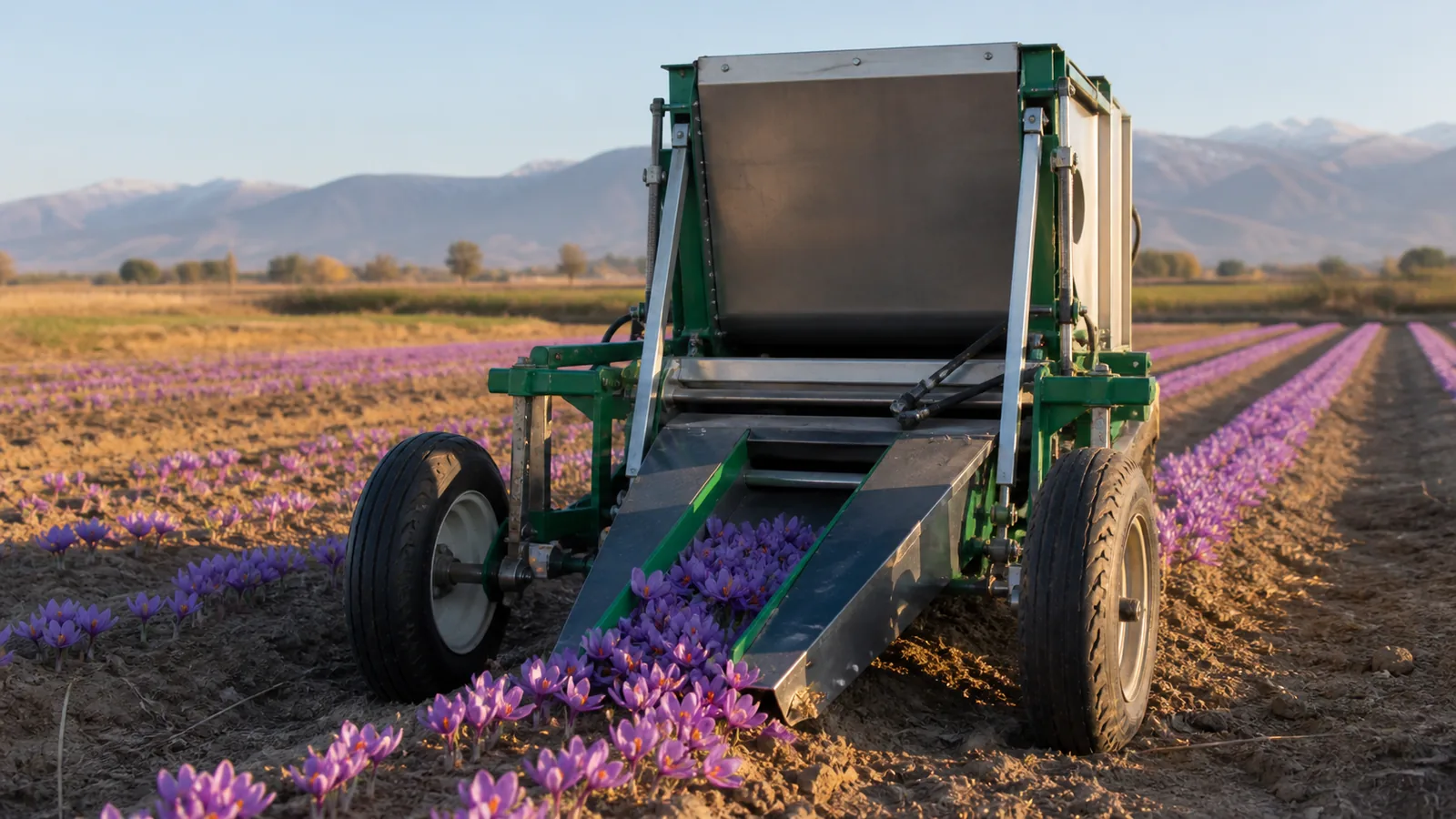
That distinction matters because people searching for a saffron harvesting machine may mean several different tools. A saffron picking machine collects whole flowers, a saffron picking robot detects individual blooms, and a saffron processing machine handles flowers after they leave the field.
What the six-hour saffron harvester was designed to do
Javad Nemati, identified in the original report as the project lead, said the design and construction programme began in the Iranian year 1394, roughly 2015–2016. The machine was designed to move along planted rows and harvest whole saffron flowers.
Nemati reported a capacity of 3 hectares per day, with the same area harvested in about 6 hours. Row planting was an explicit condition: a machine needs a predictable route and enough clearance to work without running over the crop.
How the claim compared with hand harvesting
The project team compared its six-hour target with an estimate of 10 days and at least 10 workers to pick a 3-hectare field manually. Those numbers came from the project announcement and will vary with flower density, field layout, weather, worker experience and how the field area was measured.
The comparison nevertheless identifies the real pressure behind mechanisation. Saffron flowers emerge during a short season and are normally picked early, so a grower may need many people at the same time.
How saffron is harvested by hand
So how is saffron harvested when no machine is used? Workers move through the field by hand, selecting flowers as they emerge rather than cutting the plant for its leaves or corm.
In a traditional harvest, workers pick the whole purple flower close to the ground, usually early in the morning. The flowers are moved promptly to a clean processing area.
The three red stigmas are then separated from each flower and dried under controlled conditions. Picking the flower and separating the stigma are different jobs; a field harvester does not automatically complete the post-harvest work.
The investment and commercialisation plan reported
The old report said a contract had been signed for industrial production and that commercialisation was expected within 3 years. It named Hassan Chehel Amiran as an investor and put the announced investment at 1 billion tomans.
Those statements record the plan at that point in the project. They should not be read as proof that the machine entered mass production, achieved nationwide coverage or remains available for purchase today.
Why row planting is central to a flower harvesting machine
A row harvester has to place its wheels, cutting or picking mechanism and collection path consistently. Irregularly spaced plants make it harder to reach flowers without damaging unopened buds or compacting the soil.
For that reason, mechanisation begins before harvest. Corm spacing, row width, field levelling and turning space all affect whether a machine can work at its intended speed.
Field harvesting and saffron processing are not the same
- Field harvesters collect whole saffron flowers from the soil.
- Picking robots use cameras and an end effector to identify and remove individual flowers.
- Processing machines handle harvested flowers indoors, including stigma separation or cutting.
- Planting machines place saffron corms in prepared rows and solve a different labour problem.
Confusing these stages can make a machine sound more complete than it is. A grower evaluating equipment should ask exactly which stage is automated and what manual work remains.
What research says about automated saffron harvesting
A 2013 open-access study on an autonomous vehicle for saffron harvesting set out to collect flowers without damage and without continuous human supervision. It was a design-and-development project, which shows that autonomy has long been an engineering goal rather than proof of universal commercial adoption.
Post-harvest automation has followed a separate path. A 2009 study of an automated saffron flower cutting system used computer vision to identify a cutting point for releasing the stigma. That system worked on flowers after collection; it did not pick them from a field.
Questions to ask before choosing a saffron harvester
- Does the machine require straight rows, and what row spacing does it need?
- Does it pick closed buds, open flowers or both?
- What proportion of flowers does it miss or damage under field conditions?
- Does it collect soil, leaves or other material with the flowers?
- How quickly must the harvested flowers reach stigma separation and drying?
- Is the quoted capacity based on continuous operation, and does it include turning, unloading and cleaning?
- Are service, spare parts and field demonstrations available?
What the six-hour claim tells us
The machine described in the original announcement addressed a genuine bottleneck: collecting a short-lived crop quickly while labour demand is at its peak. Its stated 3-hectare, 6-hour capacity was ambitious and depended on row planting.
The site’s earlier report on a new saffron flower harvesting invention provides related historical context. For a current buying decision, however, a grower still needs a live field demonstration, measured loss and damage rates, and confirmation that the exact machine is supported commercially.

![Exporting Saffron to Turkey + Price Guide [Complete 0 to 100]](https://img.rowhanisaffron.com/20260827003933/saffron-export-turkey-quality-inspection.webp)



