


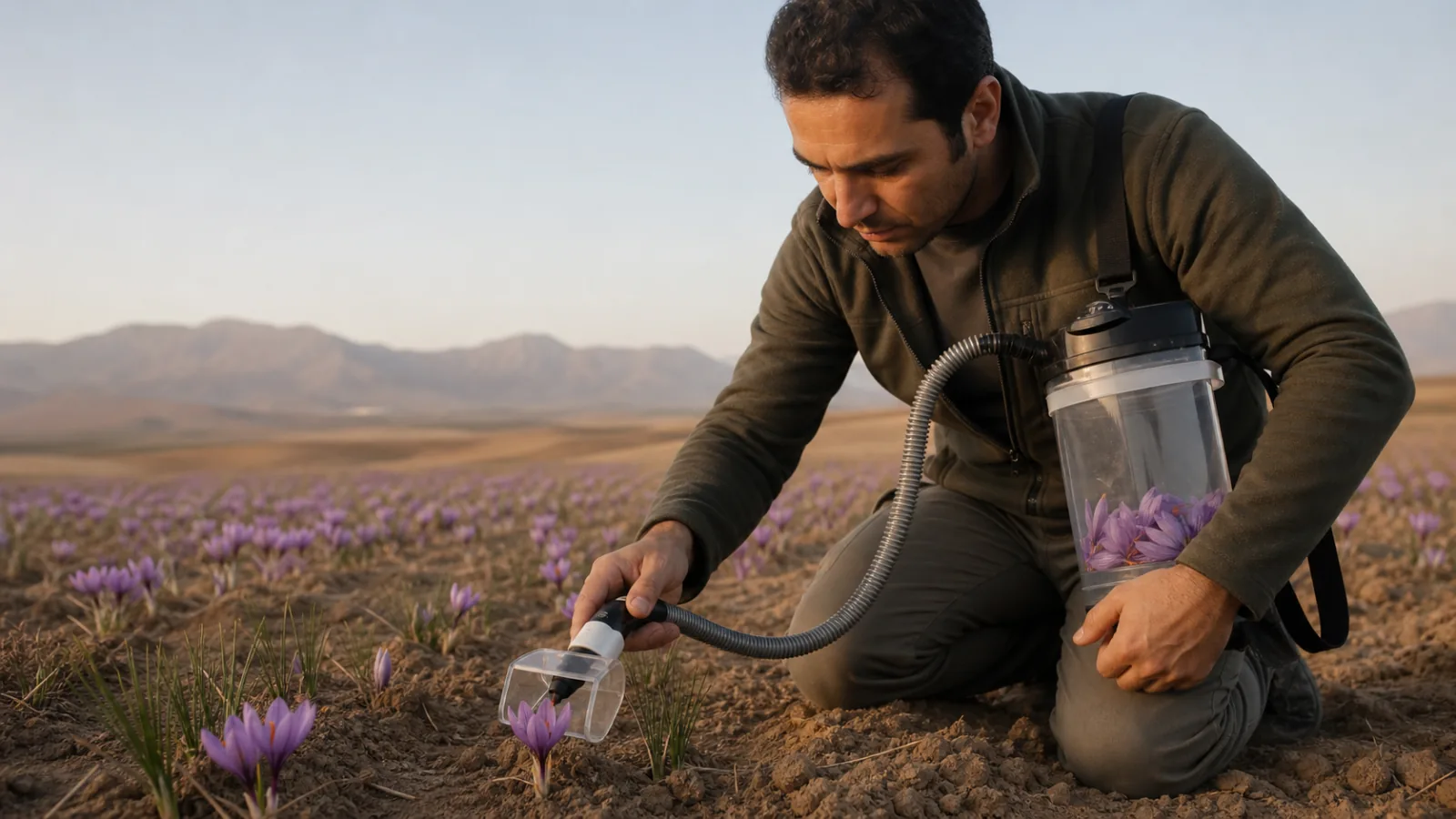
New invention for saffron flower harvesting was unveiled at the University of Birjand in 2019: a lightweight, sensor-assisted saffron harvester intended to collect flowers without damaging leaves or unopened buds. The announcement described an ambitious prototype, but it did not publish independent field-test data or confirm that the machine entered mass production.
What the University of Birjand unveiled
The original report named Amir Hossein Asadiyan, a faculty member at the University of Birjand, as the inventor. A second reference called him Amir Hassan Asadiyan; the article provides no record that resolves that first-name difference. The saffron flower harvesting machine was shown on the sidelines of a harvest ceremony at the Faculty of Agriculture.
According to the announcement, the device was light enough to carry and could harvest one metre of a planted row in one second on level ground. Sensors were said to help it avoid saffron leaves, white emerging buds and flowers that would be ready the following day. The report also claimed that different flower heights and crop quantities would not limit the machine.
Those are the prototype’s stated design claims, not independently verified performance figures. There is no sample size, field condition, missed-flower rate, damage rate, operating time or comparison with trained hand pickers in the source. The promise that it would reach the market after mass production in the next crop year should likewise remain a 2019 plan unless a later commercial record confirms it.
Why “the world’s first” needs qualification
The announcement called the Birjand saffron harvester the world’s first invention of its kind. Earlier published work makes that absolute wording unsafe. Researchers described an autonomous saffron-harvesting vehicle in 2013, and a 2014 mechanical saffron flower harvesting system used a portable detaching head and vacuum collection. Those projects may differ substantially from Asadiyan’s mechanism, but they show that mechanical flower-picking concepts already existed.
A more defensible description is a new Iranian saffron harvesting-machine prototype with a particular lightweight and sensor-assisted design. A patent search and technical comparison would be needed before making a novelty claim about its mechanism.
How saffron is harvested by hand
Saffron flowers emerge close to the soil during a short autumn season. Pickers normally move through a field repeatedly because buds do not all open on the same day. Flowers are collected early, placed in clean containers and taken for prompt separation of the three red stigmas inside each bloom.
The work does not end with picking. Stigmas must be separated carefully, dried under controlled conditions, cooled and protected from moisture and contamination. A saffron processing machine may assist with flower transport, separation, drying or sorting; those are different tasks from a field saffron picking machine.
ISO 21983:2019 provides guidelines for saffron harvesting, transport, stigma separation, drying and storage before packing. It does not prescribe one harvester, but it helps explain why field speed cannot be the only measure of success.
The hard problems a saffron harvester must solve
A saffron flower harvesting machine operates in a difficult visual and mechanical environment. Purple flowers may be partly closed, tilted, hidden by leaves or surrounded by weeds and clods of soil. Their height changes across a field. Lighting, dust and morning moisture vary, while the stem has to be detached without pulling the plant from the ground.
The machine also has to protect what should remain. Saffron leaves continue supporting the corm, and an immature bud may be the next day’s flower. A device that collects today’s bloom but damages those tissues can reduce the rest of the harvest.
Useful design work therefore covers at least four linked functions:
- detection: recognize a harvestable flower or bud against soil, leaves and weeds;
- positioning: locate the stem accurately enough for a gripper, cutter or suction head;
- detachment: remove the flower with acceptable force and minimal damage; and
- collection: carry it away without crushing or contaminating it.
A fast detector is not automatically a complete harvester. Equally, a reliable gripper in a laboratory may fail if the vision system cannot find the flower in a real field.
What the one-metre-per-second claim tells us
Harvesting a metre of row per second sounds impressive, but row speed alone cannot show whether the machine is better than hand picking. Planting density determines how many flowers lie within that metre. A level demonstration plot is easier than uneven commercial ground. Turning, emptying the collector, missed flowers, jams, battery changes and operator setup all affect work rate.
A fair field trial would report total area and flower count, flowers collected, flowers missed, damaged leaves and buds, visible flower damage, labour required, downtime and repeat performance across plots. It should also compare the quality of saffron after separation and drying, not simply the number of blooms removed.
Can sensors protect saffron leaves and buds?
Sensors can help, but the claim depends on what they sense and how the mechanism responds. A camera may distinguish the purple flower from green leaves under familiar lighting. Depth or proximity sensing may estimate position. Force sensing can limit pressure at the gripper. None of these guarantees zero damage in every field.
Research on machine vision has reported strong flower-recognition results in controlled datasets. That is an important step, not the finish line. A field system needs to handle partly hidden flowers, immature buds, different cultivars and soils, shadows and objects it did not see during training.
The Birjand announcement’s reference to “white buds” is valuable because it recognizes tomorrow’s crop as part of the design problem. Any commercial test should count damage to both leaves and buds after the machine passes, then check whether the same plants flower normally on later days.
Where mechanization can help most
Harvest labour is concentrated in a short window, so even a semi-automatic tool can be useful if it reduces bending or helps a worker cover a row with less fatigue. A portable harvester may also be easier to introduce than a fully autonomous vehicle because a person can choose the path and respond to irregular ground.
The economic case varies by farm. Purchase price, repair access, spare parts, energy, operator training and field layout belong beside headline speed. Small or fragmented plots may favour a lightweight assisted tool. Larger uniform fields may justify navigation and automated collection if reliability is high enough.
Mechanization should also fit the steps after the field. If a machine delivers crushed flowers or mixes soil and leaves into the collector, separation becomes slower and hygiene can suffer. The best system is the one that improves the complete harvest workflow rather than shifting labour from picking to cleanup.
Other inventions attributed to Asadiyan
The 2019 source also attributed two earlier inventions to Asadiyan. One was translated as an “Iranian gun for genes transfer,” apparently referring to a gene-delivery or gene-gun device. The other was described as “motivational stimulation of embryonic growth.” Neither phrase is clear enough to reconstruct a technical invention, and the article supplies no patent or publication number. They are preserved here as attributed claims, not converted into specifications.
What to verify before buying a saffron harvesting machine
A grower evaluating any saffron harvester should ask for a demonstration in a field resembling their own. The machine should be tested across more than one harvest day, with counts made before and after it passes. Damage, missed flowers, collection cleanliness, operator time and running cost should be written down.
Ask which stage the product actually performs. A flower harvester, a stigma-separation machine and a saffron processing machine are not substitutes for one another. Confirm who supplies parts and service, what maintenance sensors require and whether the claimed throughput includes setup and interruptions.
The Birjand prototype addressed the right challenge: collecting delicate flowers quickly while protecting saffron leaves and buds. Its 2019 unveiling deserves a place in the story of saffron mechanization. Its commercial success, however, should be judged by transparent field evidence rather than the launch-day claims alone.

![Exporting Saffron to Turkey + Price Guide [Complete 0 to 100]](https://img.rowhanisaffron.com/20260827003933/saffron-export-turkey-quality-inspection.webp)



