


Lorestan has a good climate for saffron cultivation, according to a historical statement attributed to Maryam Dolphani. She pointed to saffron’s relatively modest seasonal water requirement, an autumn harvest that can fit around other farm work and the potential for local families, including rural women, to take part in production.
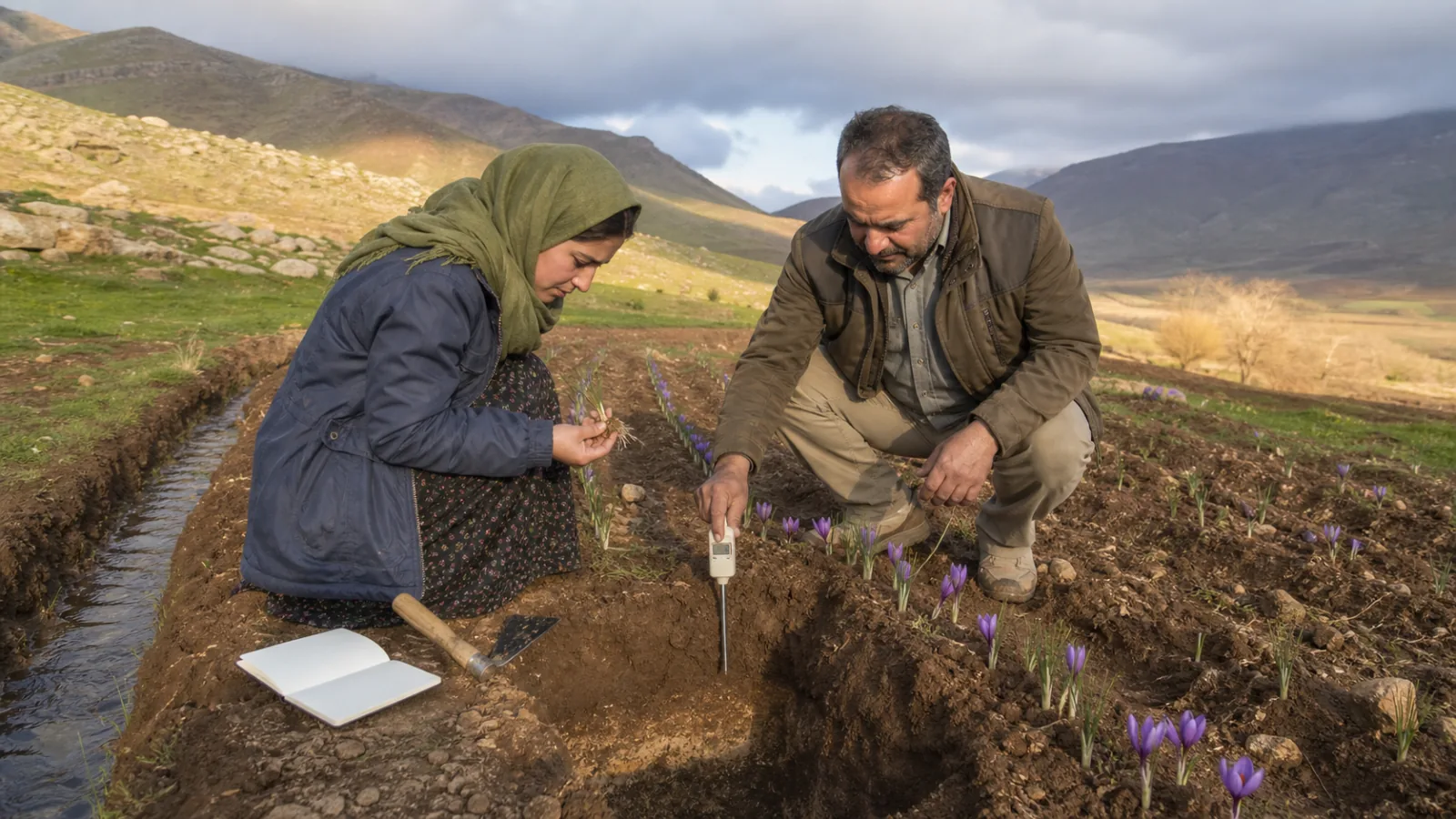
Those advantages make saffron worth testing in Lorestan; they do not make every field suitable. Rainfall timing, drainage, temperature, corm health, labour and access to drying and sales all decide whether a particular farm can produce a dependable crop.
What the Lorestan statement claimed
Dolphani said the area under saffron remained small because farmers lacked sufficient information and cultivation had not yet become established across the province. She described Lorestan saffron as high quality in its aromatic characteristics and argued that farmers needed support if planting was to expand.
She also saw an income opportunity for rural women. Because the flowers are picked in autumn and the plant is dormant through summer, some of the work can fall outside the busiest periods for other local crops.
The surviving English translation does not state Dolphani’s formal role, identify the quality test or provide the date and location of the underlying measurements. Those claims should remain attributed rather than treated as a province-wide laboratory result.
What “good climate” means for a saffron field
Saffron’s seasonal cycle can suit parts of Lorestan. The corm is dormant through the hot summer, flowering is triggered in autumn and leaves support new corm growth through the cooler months. A cold winter is not automatically a problem, but waterlogged soil, poorly timed moisture or an unsuitable planting depth can be.
A field assessment should examine:
- well-drained soil without persistent standing water;
- autumn temperature and the timing of the first effective rain;
- water availability if rainfall is late or insufficient;
- soil salinity, texture, fertility and previous disease;
- healthy, correctly identified Crocus sativus corms;
- enough people to pick flowers and separate stigmas promptly;
- a clean, controlled drying and storage process.
Describing most Lorestan counties as having capacity is therefore a reason to run local trials, not to plant every available hectare.
Low water demand does not mean no irrigation risk
Dolphani’s account said saffron might be watered once or twice in early autumn and then rely on the onset of rain. That schedule can only work when rainfall arrives in the needed amount and the soil stores usable moisture.
A semi-arid Iranian field study of rainfed saffron found that low seasonal rainfall and omission of pre-flowering irrigation sharply reduced yield in its conditions. The experiment was not a Lorestan-wide trial, but it shows why a fixed promise of one or two irrigations would be unsafe.
Growers should record rain and applied water separately. The irrigation decision should respond to soil moisture, crop stage and local forecast, with drainage considered alongside water supply.
Autumn harvest changes the labour calendar
Saffron can spread employment into a season when some other farm work is quieter. Yet harvest itself is not low-labour. Flowers need to be picked quickly, often in the morning, and the stigmas separated and dried without delay.
Family participation can reduce the need to hire a large outside crew on a small plot, but household labour still has a cost and a limit. A farm plan should calculate peak flower volume, hours available each day, hygienic work space and dryer capacity before expanding.
Rural women should be treated as trained growers, processors and business participants, not as an invisible source of free labour. Access to corms, field advice, testing, packaging and buyers affects whether the work produces reliable income.
What local evidence around 2020 showed
A separate February 2020 report from Iran’s agricultural news agency IANA described saffron cultivation across Lorestan and quoted provincial figures of 381 hectares and more than 1,000 kilograms of annual production. It also recorded farmers’ concerns about limited branding and traditional packaging.
Those are dated reported figures, not current statistics. They do, however, add context to Dolphani’s point: by that period the crop was established in the province, while knowledge, scale and market development still constrained it.
“Low-yield land” still needs agronomic screening
The historical statement suggested saffron for land with low yields from other crops. A field’s poor performance may result from a cause that also harms saffron, such as waterlogging, severe salinity, compacted soil or disease. High-value planting material should not be committed before the cause is known.
A small comparison plot is safer than immediate expansion. Record corm size and density, flowering, dry stigma yield, quality results, water, labour and losses over several seasons. Compare the actual return with the best alternative use of that land.
Our saffron cultivation guide covers the practical soil, corm, irrigation, harvest and drying decisions behind such a trial.
A useful climate claim needs a complete farm system
Lorestan’s autumn conditions and farm calendar can support saffron in suitable locations. Success still depends on more than climate: training, verified planting material, rainfall contingency, concentrated harvest labour, controlled drying, quality evidence and a buyer all have to work together.
That is the practical reading of Dolphani’s statement. The province may offer capacity, but the safe route is measured local adaptation and support for growers—not an assumption that low water demand guarantees quality or income.

![Exporting Saffron to Turkey + Price Guide [Complete 0 to 100]](https://img.rowhanisaffron.com/20260827003933/saffron-export-turkey-quality-inspection.webp)



