


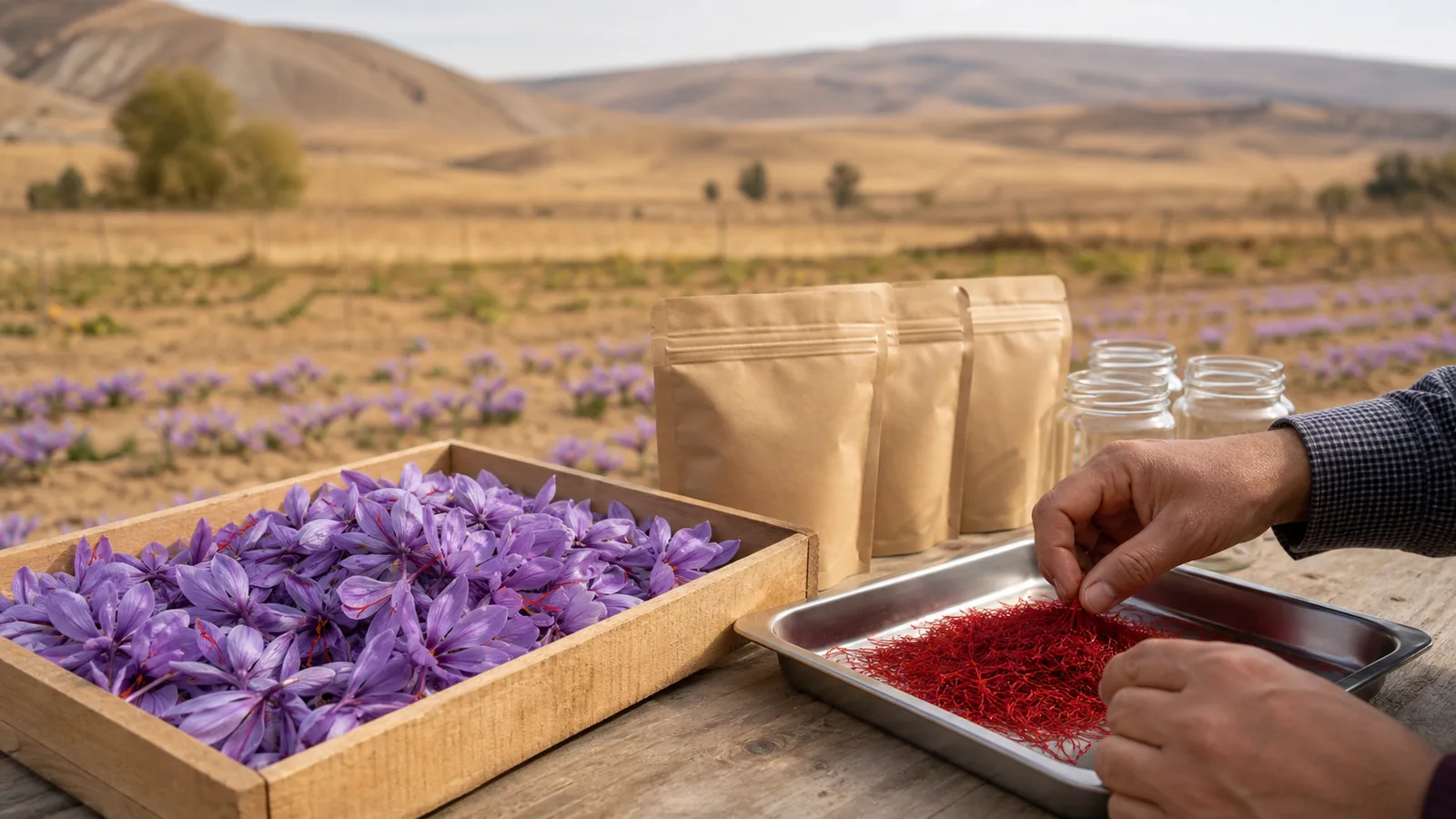
Komijan saffron was described as ranking third in Markazi Province in a historical local report that praised its quality but warned that weak packaging and branding were limiting its market.
The comments were attributed to Gholamreza Meyva, then governor of Komijan. The stored report does not state whether the third-place ranking referred to cultivated area, production or another measure, so the title’s rank should be read as a dated claim rather than a current verified league table.
What the report said about Komijan saffron
Meyva linked the character of local saffron to Komijan’s soil and temperature. He said the resulting crop had high quality and could command a stronger price than the general market average reported at the time.
The figures in the account were 7,000 tomans per gram as an average national price and 11,000 tomans per gram for Komijan saffron. These are historical price statements, not present-day retail guidance; saffron prices change with date, grade, harvest and market conditions.
Wild and cultivated medicinal plants
The governor placed saffron within Komijan’s wider medicinal-plant economy. He distinguished between plants that grew naturally and were gathered from the landscape, and crops that residents deliberately cultivated in fields.
Khakshir, often identified in English as flixweed, was one example from the first group. Meyva said it had grown particularly strongly around Milajerd that year—enough to be harvested with a combine.
He also referred to sage growing on the plains and thyme in mountainous areas, where people collected it. Saffron belonged to the cultivated group, and he described its development on farms as a positive change.
Other crops in Komijan
Mint fields, lemongrass and other medicinal plants were also part of the local picture. Meyva said these products had a good market.
At the same time, he drew attention to difficulties selling other agricultural output, including mushrooms and greenhouse crops. His broader concern was not simply whether Komijan could grow a good product, but whether that product could reach the market in a form that buyers recognized and valued.
The missing packaging link
The report’s central commercial problem was the lack of suitable packaging industries. Meyva said Komijan saffron had not developed a recognized brand despite its quality.
Selling an unpackaged crop made it harder to retain value in the city. In his account, the opportunity was being lost when products left without distinctive presentation or a local identity.
Packaging by itself does not prove quality, but it can protect a finished spice, communicate who produced it and allow buyers to distinguish one origin from another. That was the gap Meyva was pointing to: production existed, while the local route from crop to recognizable market product remained weak.
Why branding mattered to the governor’s argument
The historical price comparison suggested that Komijan saffron already had a quality reputation among some buyers. Without a recognizable Komijan brand, however, that reputation was difficult to carry into a wider market.
Meyva’s argument therefore joined three parts of the same chain: suitable local growing conditions, a crop that could achieve a premium price, and the absence of packaging capacity needed to preserve more of that value locally.
Key details preserved from the report
- Provincial position: the title described Komijan saffron as third in Markazi Province, but did not identify the ranking metric.
- Named official: the statements were attributed to Governor Gholamreza Meyva.
- Historical prices: 7,000 tomans per gram nationally and 11,000 tomans per gram for Komijan were the figures quoted at the time.
- Local plants: the account mentioned khakshir around Milajerd, sage on the plains, thyme in mountain areas, and cultivated saffron, mint and lemongrass.
- Market obstacle: inadequate packaging and weak branding were said to reduce the economic opportunity for Komijan producers.
A historical ranking, not a current market claim
The report offers a useful snapshot of how Komijan’s saffron potential was being discussed: good growing conditions and a price premium on one side, limited packaging and brand recognition on the other.
Current rank, production and prices would require newer official data. Until those are available, the provincial third-place claim and both toman figures should remain clearly tied to the historical account.

![Exporting Saffron to Turkey + Price Guide [Complete 0 to 100]](https://img.rowhanisaffron.com/20260827003933/saffron-export-turkey-quality-inspection.webp)



