


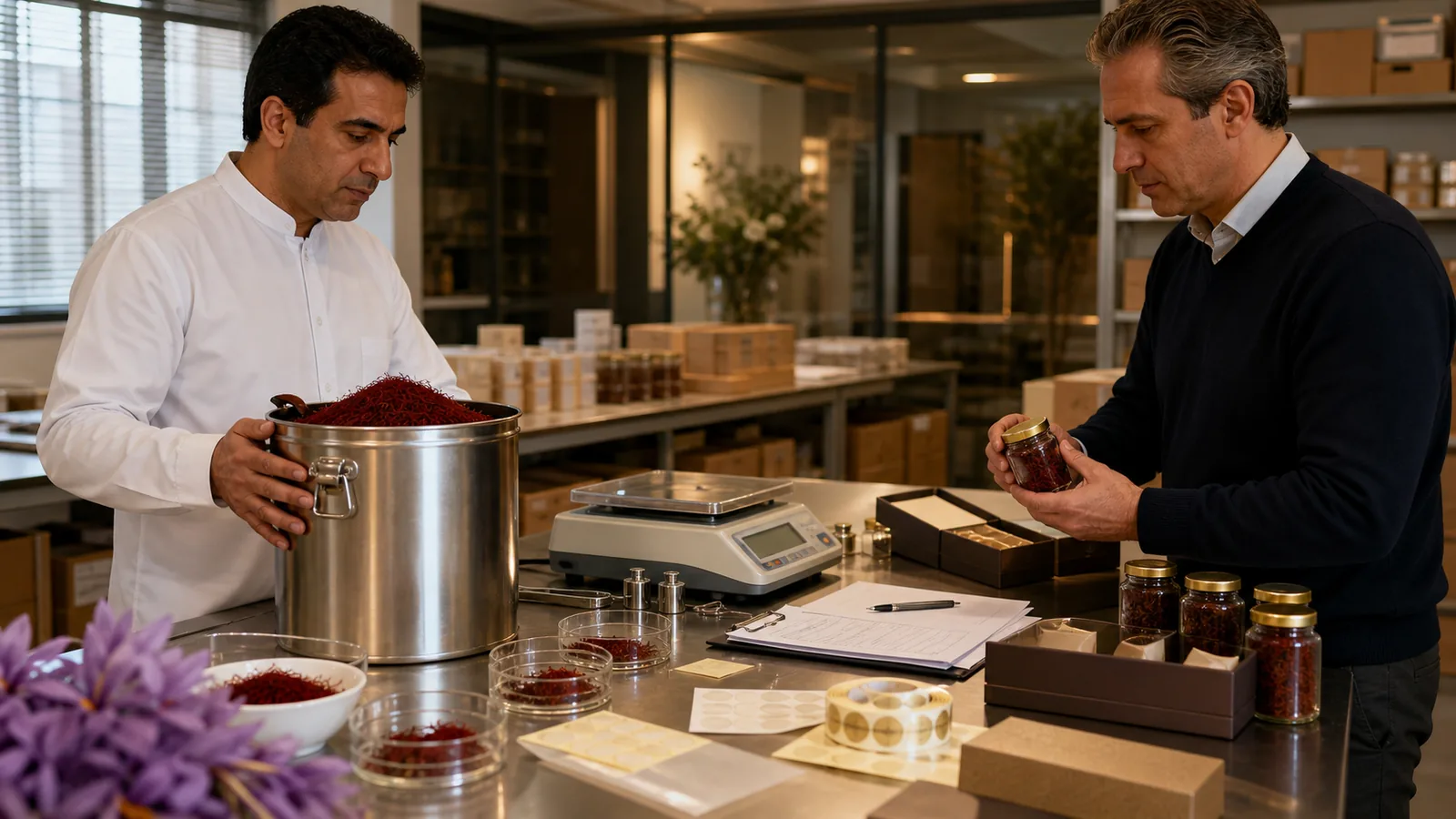
Iran was described as the world’s leading saffron producer while Spain was described as its biggest exporter in this 2016 ISNA report. The apparent contradiction came from two different measures: where saffron was grown and which country sold or re-exported it to foreign buyers. Spain could import Iranian saffron, package or market it through established European channels, then appear prominently in export statistics without growing anything close to Iran’s volume.
The headline must be read as a period claim, not a permanent ranking. Export leadership changes with the year, trade value or weight used, national reporting and whether re-exports are counted. The original article nevertheless captures an enduring issue for Iranian saffron: producing most of the raw spice does not guarantee retaining most of the value added after testing, branding, packaging and distribution.
The 2016 production claim for Iran
The report said Iran produced more than 250 tonnes of saffron a year and exported to 46 countries. It valued that production at more than 625 billion tomans. The old English version incorrectly changed the currency to “USD 625 billion,” a figure that is incompatible with the rest of the report.
ISNA also quoted a share above 95% of world saffron production. Global-share estimates vary by year and by source, but the statement reflects Iran’s dominant position in the period covered. Most of the country’s crop came from Razavi Khorasan and South Khorasan, where the article placed about 75,000 hectares under saffron.
Why Spain could export more than it produced
Manouchehri, identified as secretary of Iran’s National Saffron Council, said Spain was both the largest importer of Iranian saffron and the largest exporter in the world. He argued that Iran sold saffron at about USD 2,000 per kilogram, while Spanish businesses could package and sell it under their own brands for USD 4,000–5,000 per kilogram in international markets.
Those were reported prices from that period, not a current wholesale comparison. They also do not show that every Spanish exporter simply doubled its money. Imported lots may be tested, blended by grade, packed in small retail units, certified, insured, marketed and held in stock. Each step adds cost as well as potential value.
The strategic point remains sound: a country can lead production while another leads customer access. Importers with recognised brands, compliant packaging, local distribution and established retailer relationships can capture a larger share of the final selling price.
Iran’s first-quarter export surge
The article reported a 323% increase in Iranian saffron exports during the first three months of the year, reaching about USD 70 million. Spain accounted for more than USD 10 million and was presented as Iran’s largest export market. China, the United Arab Emirates, Italy, Saudi Arabia and India followed among the main destinations named.
The source does not provide the comparison period, customs table, export weight or exchange method behind the 323% figure. It should be treated as a historical ISNA statistic rather than applied to a different quarter. A change in value can reflect volume, grade, currency and price, so it is not automatically the same as a 323% rise in the amount of saffron shipped.
Production was expected to pass 250 tonnes
From roughly 75,000 hectares in the two Khorasan provinces, the previous harvest was reported at more than 240 tonnes. With planted area expanding in response to international demand, production for the following crop was forecast to exceed 250 tonnes.
That projection belongs to the article’s 2016 context. It is not a current acreage or harvest estimate. Comparing it with modern data requires the same crop year, geography and definition of dried saffron; mixing calendar-year exports with crop-year production can create a false surplus or shortage.
How many flowers are needed for 250 tonnes?
The source correctly emphasised the enormous labour behind dried saffron but corrupted the scale. It said farmers had to separate the stigmas from around 170,000 flowers to obtain one kilogram. It then claimed that 25 million tonnes of flowers were needed for 250 tonnes of saffron, which cannot be right.
Using the article’s own 170,000-flower estimate, 250 tonnes of dried saffron would require about 42.5 billion flowers. FAO material gives a commonly cited range of roughly 120,000–150,000 flowers per kilogram, which would imply 30–37.5 billion flowers. The exact number changes with flower and stigma size, moisture and final style, but either calculation shows why the harvest is so labour-intensive.
Fresh flower weight is a different measure. Research indexed by FAO’s AGRIS database reports about 68 kilograms of flowers for one kilogram of dried spice in one study. On that basis, 250 tonnes of dried saffron would correspond to roughly 17,000 tonnes of fresh flowers, not 25 million tonnes.
Harvest timing protects quality and value
Saffron flowers arrive in a short season and must be collected promptly. The red stigmas then need to be separated in hygienic conditions and dried with enough control to protect colour, aroma and safety. Delays between field, separation and drying can lower quality even when the crop was excellent at picking.
The deputy chairman of the South Khorasan association of saffron producers and exporters warned that rural labour shortages meant some flowers were not collected in time. He said harvested flowers might then travel kilometres to urban or peri-urban workers for separation. The article claimed that poor handling and movement could waste as much as one-third of the product in some cases.
That one-third figure was an attributed industry estimate, not a measured national loss rate. It still points to practical controls: nearby collection points, clean covered transport, traceable lots, trained workers and drying capacity sized for the harvest peak.
Yield per hectare was reported to be falling
Ali Hosseini told ISNA that average saffron yield had fallen by about one kilogram per hectare over two decades—from approximately 5 kilograms to 4 kilograms. He argued that grower education and agricultural extension were necessary to restore productivity.
A national average cannot predict a particular farm. Corm size and density, stand age, soil, irrigation timing, nutrition, disease and harvest management all influence yield. Expanding planted area without improving these factors can raise total output while leaving farmers with weak performance per hectare.
This is another reason value-chain investment matters. More acreage is less useful if flowers cannot be picked and processed promptly, or if inconsistent batches lose their premium in testing and export.
The warning about Iranian saffron corms
The article also raised concern about Iranian saffron corms leaving the country for neighbouring producers. Afghanistan was identified as a recipient that had made progress in saffron cultivation. The report argued that even a smaller competitor should not be ignored and described healthy Iranian corm stocks as an agricultural asset.
Movement of planting material is not only a competition issue. Corms can carry soil and plant-health risks, so legitimate cross-border trade should meet origin, phytosanitary and variety-identification requirements. “Smuggling” is a legal allegation and should not be inferred merely because another country grows saffron.
Production leadership and export leadership measure different things
Production statistics aim to record where the crop was grown. Merchandise trade statistics record the reporting country, destination, value and quantity of the product crossing a border. They may not reveal the agricultural origin of every gram after re-export, blending or repackaging.
Saffron is recorded under HS code 091020 in the Harmonized System. A current comparison should use the same year and code for all reporters, check whether the figures are value or net weight, and review missing or delayed national submissions. The United Nations Comtrade database notes that official data arrive as national authorities make them available, with no fixed posting schedule.
That is why “biggest exporter” needs a year and a metric. A country may rank highly by value because it sells small branded packs at a high unit price, while another leads by tonnes. A re-export hub may also report substantial exports without being a major grower.
How Iran can retain more of saffron’s final value
The answer is not to dismiss every importer or distributor. Those businesses provide access to customers and perform compliance, logistics and retail work. The opportunity for Iranian producers is to perform more high-value work before the product leaves the country and to keep origin information attached to the lot.
That means consistent harvesting and drying, representative laboratory testing, traceability, truthful grading, destination-compliant labels and packaging that protects the spice. It also means contracts and brands that allow the buyer to recognise Iranian origin rather than treating saffron as anonymous bulk material.
FAO’s current work with Iran on the saffron value chain emphasises production practice, post-harvest management, safety, traceability, modern marketing and quality integrity. Those are the practical links between being the largest producer and earning a stronger position in export markets.
Reading the Iran–Spain comparison accurately
The 2016 article is best understood as a value-chain warning. Iran produced the overwhelming share reported at the time; Spain had strong importing, packaging, branding and distribution channels. The producer and exporter labels were not mutually exclusive, and they did not mean the saffron changed agricultural origin when it was repacked.
Its historical numbers should stay historical: more than 250 tonnes, 625 billion tomans, 46 destinations, a reported share above 95%, USD 2,000 versus USD 4,000–5,000 per kilogram, and a first-quarter export value near USD 70 million. The impossible dollar and flower-tonnage translations have been corrected rather than repeated.
For any present-day claim about the largest saffron producer or exporter, specify the year, data source, trade code, metric and treatment of re-exports. Without those details, a simple ranking hides the part that matters most: where the saffron was grown, who made it market-ready and where the final value was retained.

![Exporting Saffron to Turkey + Price Guide [Complete 0 to 100]](https://img.rowhanisaffron.com/20260827003933/saffron-export-turkey-quality-inspection.webp)



