


Iran is the world’s largest saffron producer and accounts for over 90% of global saffron production, according to the UN Food and Agriculture Organization. That extraordinary production share gives the country deep influence over supply, but it does not mean Iran automatically receives 90% of the final value generated across the global saffron market.
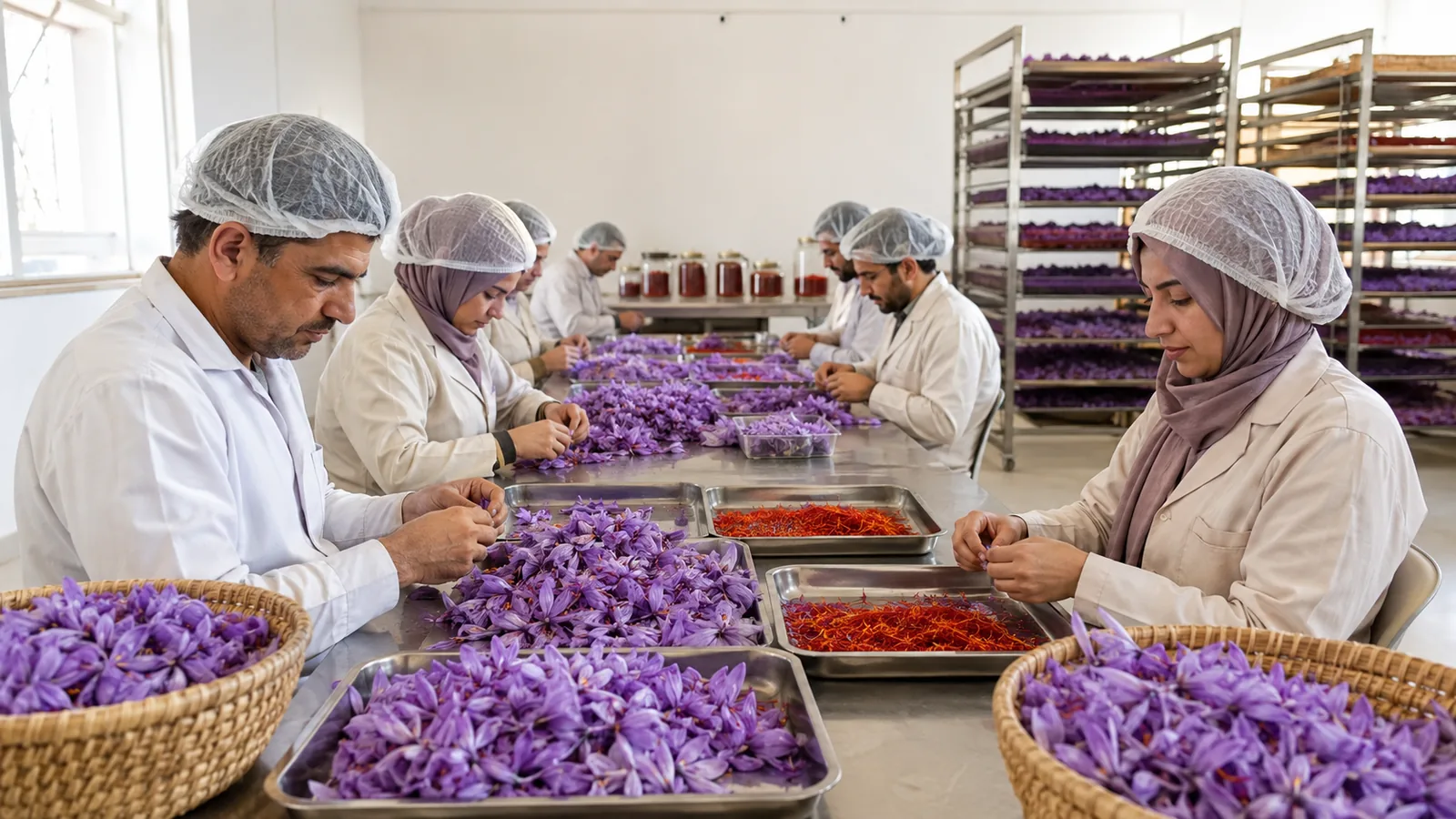
What percentage of the world’s saffron does Iran produce?
The clearest supported answer is more than 90%. The FAO’s profile of Iran’s Qanat-based saffron system describes the country as the largest producer and says it has over 90% of worldwide saffron production. The exact share can move from one harvest to another, so the percentage should be read as an authoritative estimate of production dominance rather than a permanent decimal.
Several similar searches lead to the same distinction: Iran’s percentage of global saffron production—and Iran’s share of global saffron production—are above 90%, but Iran’s share of global saffron revenue cannot be inferred from crop volume alone. Wholesale trade, testing, sorting, packaging, branding, distribution, retail margins, and saffron-containing products represent different stages of value. Our closer look at Iranian saffron’s production share and market value explains why those measures should not be combined.
How much saffron does Iran produce?
The archived report behind this page attributed an estimate of 122,000 hectares under saffron and approximately 400 tonnes of annual output to the head of the Medicinal Plants Office at Iran’s Ministry of Agriculture. Those figures retain useful historical context, but the copied report does not identify the official, the agricultural year, or a statistical release. They should not be used as a current land-area or harvest forecast without a dated source.
The same account said production exceeded 500 tonnes in 2019, fell by 50% to 250 tonnes the following year, and then rose by 30% in its unnamed “current year” to 350 tonnes. There is an arithmetic problem: a 30% rise from 250 tonnes would be 325 tonnes, while 350 tonnes would represent a 40% rise. Because the periods and measurement method are absent, the responsible approach is to preserve the sequence as claims from the archived report while making the inconsistency visible.
Production figures can also describe different things. A forecast made before flowering, an estimate of dried output, a quantity entering formal purchasing channels, and an export total are not interchangeable. Weather, corm condition, field age, irrigation, labour availability, drying loss, domestic consumption, and inventory held from earlier harvests can all change the number observed at each stage.
Khorasan Razavi’s role in Iranian saffron
The source article said around 80% of Iran’s saffron was cultivated and exported from Khorasan Razavi Province. Khorasan Razavi is unquestionably central to the industry, but the sentence combines cultivation and export into one percentage and gives no year. It should be treated as an historical estimate, not a current official share for both activities.
It is also unsafe to multiply that 80% by the FAO’s over-90% national estimate and present the result as Razavi Khorasan’s exact percentage of global production. The figures may come from different years and datasets, and provincial cultivation share is not necessarily the same as provincial export share. For searches about Razavi Khorasan saffron production percentage in Iran or globally, the sound answer is that the province is a leading centre, while an exact current percentage needs a dated provincial and national production table from the same harvest year.
Khorasan’s importance extends beyond hectares. The region contains experienced growers, seasonal labour networks, drying and trading knowledge, established markets, and firms accustomed to domestic and export requirements. Those capabilities help explain why changes in the province can affect the wider Iran saffron market.
Production dominance is not the same as trade dominance
Formal trade data offer another view. World Bank WITS records sourced from UN Comtrade report that Iran exported 324,979 kilograms of saffron worth about US$190.2 million in 2020. The equivalent 2022 record reports 215,879 kilograms worth about US$201.7 million under HS code 091020.
The comparison shows why volume, value, production, and exports must remain separate. The recorded export weight was lower in 2022 than in 2020, while the declared value was higher. Neither figure shows the final retail revenue or the portion returned to farmers. Customs data can also be revised and may differ from partner-country reporting, but dated records for one product code provide a more defensible checkpoint than an undated market statistic.
Iran’s dominance in the global saffron market is therefore strongest and clearest at the production stage. Extending that advantage into more of the final value chain depends on consistent quality, documented origin, lawful market access, reliable delivery, suitable packaging, and buyer trust.
Why production can fall sharply
The archived article connected the reported output decline with drought and reduced rainfall. Water stress can reduce performance, but a national year-to-year change should not be assigned to one cause without supporting data. The timing and adequacy of irrigation, temperature during key growth stages, corm health, salinity, disease, field age, labour and the area actually harvested may all contribute.
Saffron is drought-tolerant compared with many conventional crops, not drought-proof. It requires suitable moisture at important points in its cycle, and poor drainage can be as damaging as shortage. A resilient production plan therefore protects water quality and timing, monitors corm and soil condition, and avoids assuming that a historically strong region is immune to weather or management risk.
Why some saffron farmers report weak profits
The original account said many growers found saffron unprofitable despite a recovery in production. It named rising costs for water, fertiliser, machinery, and labour, and described brokers buying cheaply during harvest and selling later at a higher price. These pressures are plausible, but profitability varies by yield, field age, family and hired labour, input use, finance, grade, timing, buyer, and losses during processing.
It also gave a saffron price range of 25 to 41 million tomans, depending on quality. No date, weight unit, grade, or market level accompanies that range. It must not be read as today’s farm-gate, wholesale, retail, or per-kilogram price. In a high-inflation market, a toman figure without a date can become misleading quickly.
A useful farm calculation begins with saleable dried saffron rather than flowers harvested. It records all cash costs, values unpaid family labour, allocates corm and establishment costs across field years, includes drying and storage losses, and compares the net return under conservative and strong price scenarios. That shows whether an apparent high-value crop is actually paying the household for land, water, labour, and risk.
The Rural Cooperative Organization purchase account
The archived report described the Rural Cooperative Organization offering a guaranteed saffron purchase programme. According to that account, it accepted only qualifying high-quality saffron, paid an initial 10%, and held the balance pending quality assessment. Some farmers were reported to have waited as long as 50 days, while purchase prices sometimes differed from offers made by brokers.
The report then said quality evaluations were planned for “next week” and that 1,500 billion tomans would be needed to complete payments to producers, but neither the organization nor the government budget could allocate the amount at that time. Those details clearly describe a particular episode. Without an event date and programme documents, they are not evidence of a current guaranteed purchase, payment schedule, budget shortfall, or eligibility rule.
The episode still contains a useful policy lesson. A purchase programme can support growers only if grade rules are published before delivery, sampling and appeals are fair, payment timing is known, finance is secured, and the net price can be compared transparently with private offers. A high announced price loses much of its value if most of the money arrives too late for the farmer’s obligations.
Quality should be measurable, not simply described as “high”
When a cooperative, exporter, or buyer pays by quality, the parties need a common specification. The Codex standard for saffron covers whole threads, cut filaments and powder, with requirements related to quality, contaminants, hygiene and labelling. A particular market or contract may require additional tests, but the standard helps replace vague claims with defined criteria.
The result must follow the lot. A certificate that cannot be connected to the container, harvest, processor, and seal does little to protect either side. Lot identification, representative sampling, documented drying and storage, and an agreed method for resolving a disputed result are as important as the number printed on the report.
How brokers can add value—or weaken farmer bargaining
An intermediary is not automatically harmful. Aggregation, grading, financing, storage, finding buyers, carrying inventory risk, and arranging transport are real services. Problems arise when price formation is opaque, a cash-constrained grower has no alternative, quality deductions are unexplained, or the farmer cannot see how the final lot was valued.
Better information can improve the negotiation without pretending every grower should become an exporter. Cooperatives and market services can publish comparable grades, net weights, fees, payment dates, and recent transaction ranges. Buyers can issue written specifications before harvest. Farmers can compare the certain value of prompt payment with the costs and risks of storage or a later sale.
What would make Iran’s saffron position more sustainable?
Production leadership will be more durable when several parts of the system improve together:
- Farm resilience: protect corm health, water timing, drainage, soil condition, and skilled harvest labour.
- Transparent quality: use defined grades, representative samples, traceable laboratory results, and a fair appeals process.
- Prompt, financed purchasing: announce terms only when the buyer can meet the promised payment schedule.
- Traceable processing: keep lot identity intact through separation, drying, storage, packing, and dispatch.
- Reliable export routes: price customs, currency, testing, logistics, sanctions, tariffs, and destination rules before signing the sale.
- Market development: serve bulk, private-label, food-service, and consumer buyers with the format and evidence each one needs.
Our guide to barriers in saffron exports examines the customs, currency, finance, traceability, and market-access side of that work.
A careful reading of Iran saffron market statistics
The most defensible headline remains strong: Iran produces more than 90% of the world’s saffron, and Khorasan Razavi is a leading centre of that production. The original 122,000-hectare, 400-tonne, 80%, 2019–following-year–current-year sequence, 25-to-41-million-toman range, 10% initial payment, 50-day wait, and 1,500-billion-toman shortfall preserve the concerns of a historical report. They do not share a verifiable current date.
Readers, buyers, and policymakers should ask the same questions of every new number: what period does it cover, is it production or trade, is it weight or value, what geography and grade does it represent, and where is the source table? Answering those questions protects the reputation of the Iran saffron market far better than repeating a dramatic figure after its context has disappeared.

![Exporting Saffron to Turkey + Price Guide [Complete 0 to 100]](https://img.rowhanisaffron.com/20260827003933/saffron-export-turkey-quality-inspection.webp)



