


Buying Iranian saffron in Europe starts with origin and batch traceability, not the country where the final jar was packed. A reliable supplier should be able to identify the saffron as Crocus sativus, name the country of harvest, provide a lot or batch number, explain the grade or test method, and show who is legally responsible for the food in the European market.
Iranian and Afghan saffron are both genuine agricultural products. Some saffron may cross borders for packing or re-export, but it is inaccurate to assume that saffron labelled from Afghanistan is simply Iranian saffron under another name. Buyers need evidence for the individual batch.
What “Iranian saffron” should mean
Origin refers to where the saffron flowers were grown and harvested. Packing location, exporter address and seller location answer different questions. A product can be harvested in Iran, packed in another country and sold by a company established in Europe.
The label and supporting documents should make those roles clear. European Commission guidance on food origin labelling says origin or provenance must be given when omitting it could mislead the consumer. It also addresses cases in which the stated origin of a food differs from the origin of its primary ingredient.
Is Afghan saffron actually Iranian?
Afghanistan has its own saffron farms and origin-linked production. The UN Food and Agriculture Organization describes Herat-Bastan saffron as saffron grown in identified districts of Herat Province, with characteristics linked to the local environment and production practices.
Cross-border trade and re-export can complicate a supply chain, and food fraud is possible in any high-value spice. Neither fact allows a buyer to infer origin from appearance or a seller’s nationality. Ask for traceability records rather than relying on a general story about Iran, Afghanistan or a European packing address.
The historical report behind this page
The original 2013 article quoted an Iranian industry representative who argued that export duties encouraged saffron to leave Iran informally and be re-exported through Afghanistan. That was a policy claim from a particular period, not proof about every Afghan-labelled product then or now. Tax incentives and import rules change, so current purchases should be judged from current documentation.
How to evaluate Iranian saffron suppliers
Before comparing price, request a specification for the exact batch. A professional supplier should be able to answer:
- Where was the saffron harvested, and when?
- Is it whole stigma, cut filament or powder?
- What is the batch or lot number?
- Which laboratory tested it, on what date and by which method?
- How were colouring strength, aroma, bitterness, moisture and foreign matter assessed?
- What food-safety and contaminant checks apply to the batch?
- Who is the EU food business operator or importer of record?
- How was the product protected from humidity, heat and light in transit?
A generic certificate with no matching lot number is weak evidence. So is a test report issued long before the harvest or one that describes a different product form.
What ISO 3632 can—and cannot—tell you
ISO 3632-1:2025 specifies requirements for dried saffron made from the pistils of Crocus sativus. It applies to filaments, cut filaments and powder. The related test methods are used to assess characteristics connected with colour, aroma, bitterness and purity.
An ISO-referenced result can make two batches easier to compare, provided the sample and report are genuine. It does not prove geographic origin on its own, guarantee that every container matches the sample, or replace contaminant testing and supply-chain records.
Why whole threads are easier to inspect
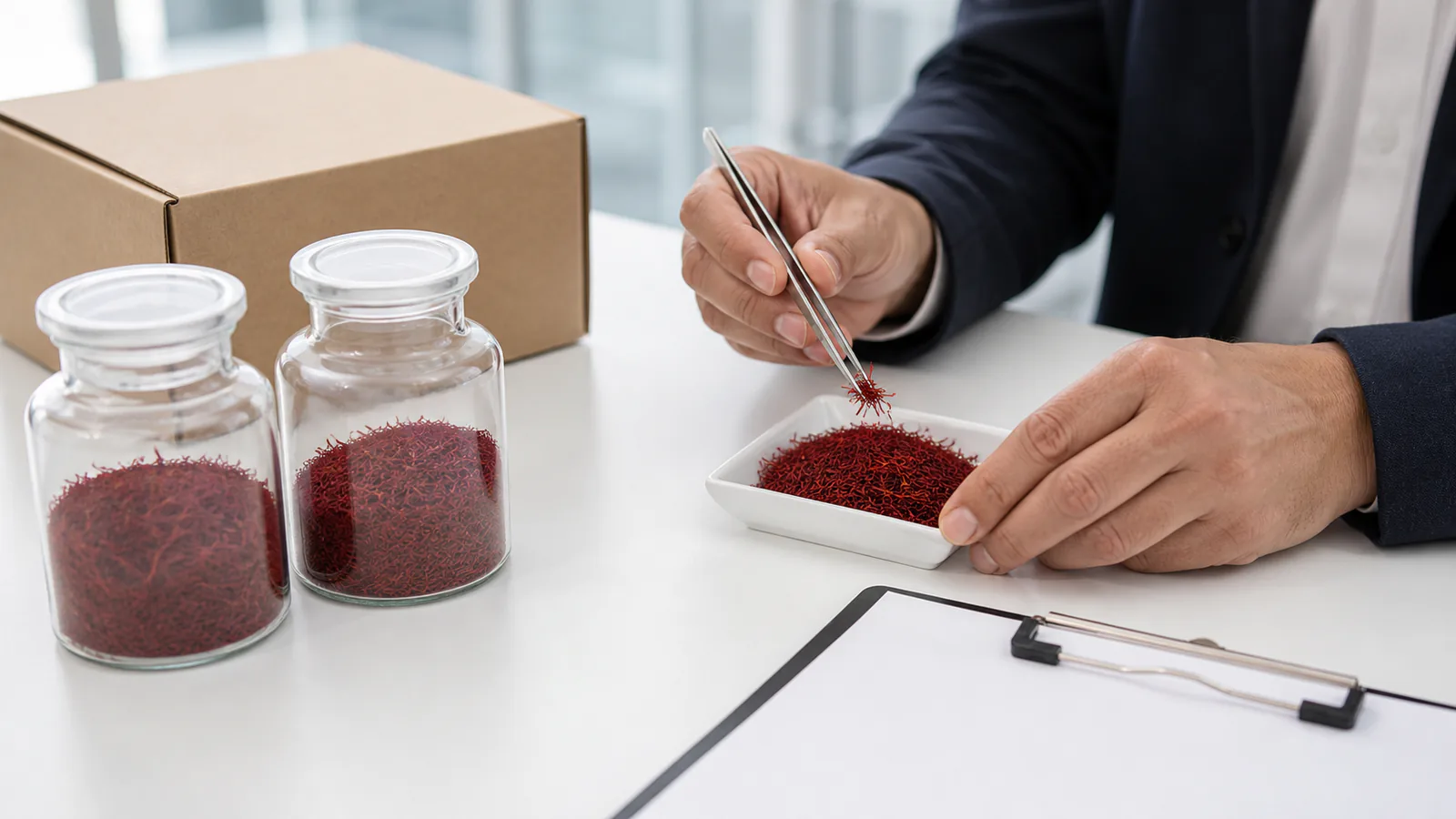
Whole red stigmas let a buyer examine shape, colour distribution and visible foreign material. Powder removes many visual clues and is easier to blend with other material. Powder is not automatically fraudulent, but it calls for stronger supplier controls and analytical verification.
Good saffron threads are dry rather than damp or oily, have a clean characteristic aroma, and release colour gradually in water. A very low price, instant artificial-looking colour or unexplained uniform fragments are reasons to investigate—not stand-alone laboratory tests.
Importing saffron from Iran into Europe
Commercial import is different from ordering a small retail jar. The importer must establish the correct commodity classification, customs treatment, food-business responsibilities, traceability, labelling and applicable contaminant or pesticide limits in the destination country.
Rules can differ by country and change over time. Before shipping, verify current requirements with the relevant customs and food-safety authorities or a qualified broker. Do not rely on a supplier’s old invoice or a blog post as legal clearance.
Documents commonly needed for due diligence
- commercial invoice and packing list;
- batch specification and certificate of analysis;
- country-of-harvest and traceability documentation;
- food-safety or hygiene documentation appropriate to the operator;
- transport and storage records where relevant;
- compliant consumer or business-to-business label information.
The exact legal set depends on the route, product, volume and destination. Documents should agree with one another on product form, weight, lot and origin.
How to compare price without buying the wrong product
Compare like with like: the same product form, grade or analytical range, harvest period, packaging, delivery terms and testing scope. A price per gram for a retail jar cannot be compared directly with a wholesale quote that excludes freight, duty, testing and local taxes.
Start with a representative sample, but accept a bulk delivery only against the agreed batch specification. Record the lot received and retain a sample. If the business needs consistent colour or flavour, define an acceptance range rather than relying on labels such as “premium” or “superior.”
A practical buying checklist
- Confirm the grower or country of harvest and the packer separately.
- Match the certificate of analysis to the offered lot.
- Check the current ISO reference and requested test method.
- Verify EU operator, label and import responsibilities before payment.
- Inspect a sample and define written acceptance criteria.
- Keep origin, batch, shipping and test records together.
Iranian saffron has a long production tradition, but provenance is strongest when it is documented rather than assumed. The same standard should be applied fairly to saffron from Afghanistan, Spain, Greece or any other producing region.

![Exporting Saffron to Turkey + Price Guide [Complete 0 to 100]](https://img.rowhanisaffron.com/20260827003933/saffron-export-turkey-quality-inspection.webp)



