


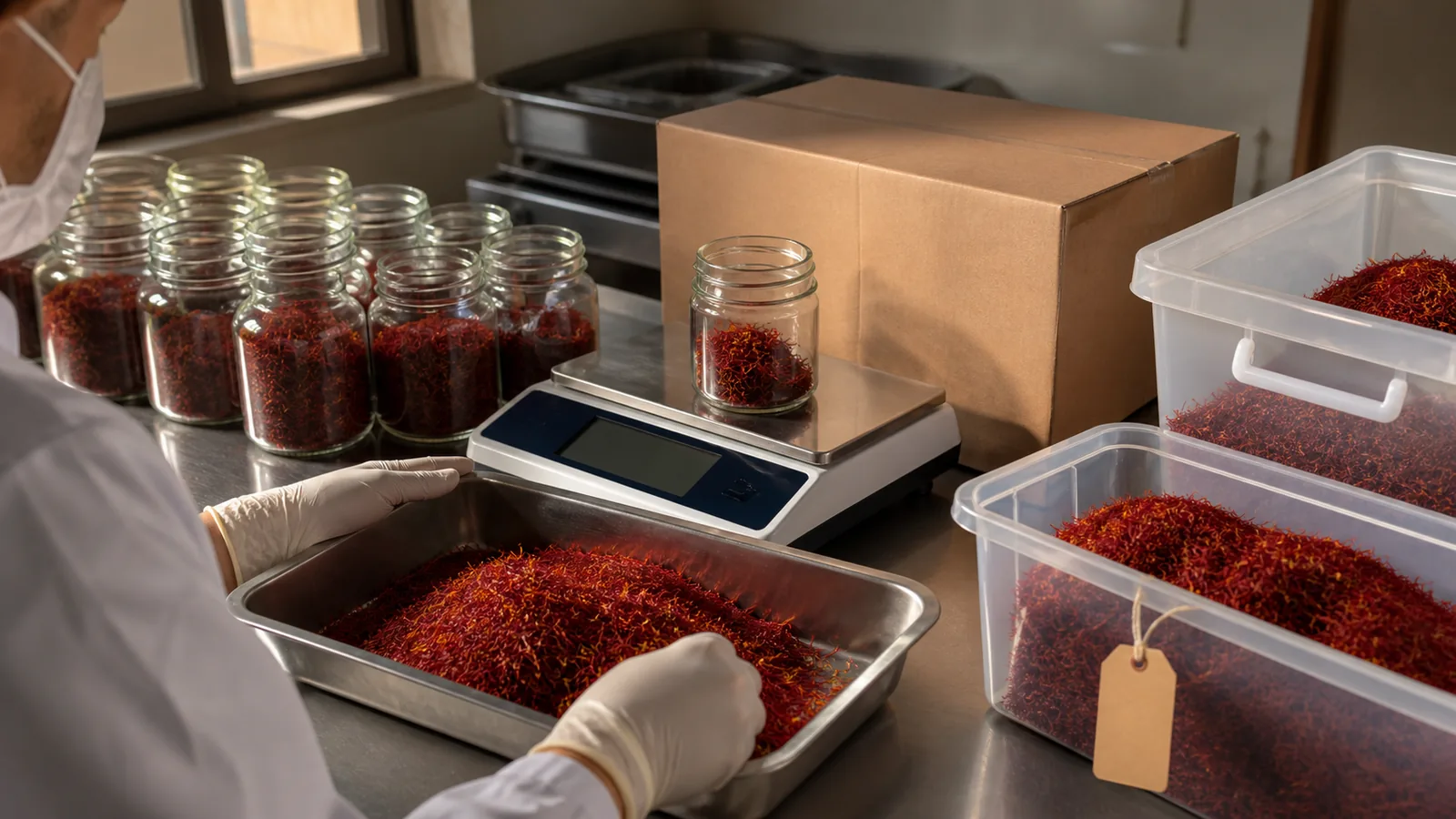
Iranian saffron exports rose in the four-month customs period covered by this historical report, yet the average export price fell to about $1,350 per kilogram. The reason was not that every grade of saffron suddenly had the same “lowest price.” The shipment mix shifted heavily towards larger packs and bulk categories, which carried a lower declared value per kilogram than small retail packs.
A separate five-month dataset from a later reporting year showed a different movement: bulk and 10–30-gram export prices rose to about $1,431 and $1,480 per kilogram. The two reports should not be added together or treated as consecutive months of one season. Their totals, package definitions, exchange-rate conversions, and comparison years differ.
What the four-month export figures showed
During the first four months of the year covered by the destination article, Iran exported 58 tonnes and 214 kilograms of saffron in various packages to 50 countries. The declared value was $78,580,656. Compared with the same period a year earlier, export weight increased by 25.30 percent and value by 22.91 percent.
Dividing the declared value by the shipped weight gives an average close to $1,350 per kilogram, matching the figure in the report. That average was 8.16 percent below the previous year’s approximately $1,470. In other words, total export revenue grew because substantially more saffron moved, even though the average value attached to each kilogram fell.
These are historical customs figures, not today’s price list. “This year” and “last year” refer to the original reporting period, and the dollar and toman amounts should not be carried forward without the exact customs period and exchange-rate basis.
Why higher volume produced a lower average price
The four-month report attributed the price decline to shipment mix. Packs above 30 grams accounted for about 39,839 kilograms, or roughly 68 percent of the total. Another 18,350 kilograms—about 31 percent—was recorded in an unground or non-powdered saffron category. Together, those lines represented more than 99 percent of the reported trade, leaving less than 1 percent for packs below 10 grams and packs of 10–30 grams.
Package size and product form are not the same thing, so those customs categories need care. A pack above 30 grams can still contain whole threads, and “unground” describes the form of the saffron rather than the consumer size of its container. The source used both kinds of classification. They explain the broad market pattern, but they should not be collapsed into one perfectly exclusive packaging table without the underlying customs codes.
Small packs carried a much higher value per kilogram
The report converted declared values into the tomans used at the time. Saffron in packs below 10 grams was valued at about 13.668 million tomans per kilogram. Packs above 30 grams were around 4.1 million tomans per kilogram, while the unground/non-powdered line was about 4.905 million. The overall average was reported as roughly 4.381 million tomans per kilogram.
The gap illustrates why export tonnage and export value tell different stories. Retail-ready small packs can reflect packaging, branding, compliance, distribution, and a closer position to the final customer. Larger shipments may be repacked or processed after export, leaving more of that downstream value with another business or country.
It does not follow that every larger package is low quality or that bulk export is inherently wrong. Bulk supply serves industrial and wholesale buyers and can move large volumes efficiently. The commercial question is whether exporters receive an appropriate return for the grade, testing, traceability, consistency, and services they provide.
The five-month report came from a different year
A later source covered the first five months of another year. It reported more than $60 million in total saffron exports: over $27.5 million in 10–30-gram packages and more than $33 million in packages above 30 grams.
Small-package exports were said to have fallen by more than 28 percent compared with that report’s previous-year period. Larger-package sales nearly doubled by weight and more than doubled in value. The stated average prices rose to $1,480 per kilogram for the smaller retail-pack line and $1,431 for bulk.
The source described the bulk increase as just under $200 per kilogram year on year. It also gave a local-currency value of about 3.87 million tomans per kilogram, around 400,000 tomans higher than the preceding year. That conversion is inseparable from the exchange-rate convention used in the original statistics and should be read only as a historical comparison.
Why the four- and five-month totals look inconsistent
At first glance, more than $60 million over five months appears incompatible with $78.58 million over four months. The explanation is that the reports do not describe the same year. The four-month article was stored earlier, while the five-month article was published later and compared its own period with a different previous year.
The correct conclusion is not that customs lost a month of exports. It is that market conditions changed between reporting years. Each dataset can show its own shift in volume, package mix, and average value, but the two should not be joined into a single five-month series.
Where the four-month shipments went
The destination report said Iranian saffron reached 50 countries. Its named markets included Spain, Australia, South Africa, Afghanistan, Germany, the United Arab Emirates, the United Kingdom, the United States, Italy, Bahrain, Belgium, Bangladesh, Pakistan, Taiwan, Turkey, the Czech Republic, South Korea, China, Japan, Singapore, Sweden, Switzerland, Iraq, Oman, France, the Philippines, Qatar, Canada, Kuwait, Lebanon, Malaysia, Nepal, Norway, New Zealand, the Netherlands, Hong Kong, and Greece.
That list demonstrates geographic reach, but it does not show how much each market bought or whether shipments were consumed there, processed, or re-exported. Spain and the UAE, for example, can function as trade and distribution hubs as well as end markets. Country count alone is therefore not a measure of value captured by Iranian producers and exporters.
Fars supplied saffron to Asian and European markets
A provincial report adds the production side of the export story. It recorded 580 hectares of saffron in Fars, concentrated around Estahban, Khorrambid, Abadeh, and nearby areas. Traditional planting was described as running from early to mid-September, with harvest from mid-November to the end of November.
The preceding season’s output was 2,800 kilograms from those 580 hectares, an implied average of about 4.8 kilograms per hectare. This is a calculation from the reported total and area, not a separate yield claim.
The source said Fars saffron moved through Persian Gulf export channels to China, Japan, South Korea, Germany, France, and Spain. That provincial route fits the national destination list: local production entered a wider network serving both Asian buyers and European saffron markets.
What the data says—and what it does not
The four-month figures show export volume growing faster than value, pushing the average price down. The five-month figures from another year show larger packages gaining share while declared per-kilogram values rose. The Fars report shows one province contributing 2.8 tonnes to that wider trade network.
None of the datasets proves that one package format is always more profitable. Customs value is not the same as a grower’s farm-gate price, an exporter’s margin, or the final retail price. Costs for raw saffron, grading, laboratory testing, packaging, finance, freight, insurance, compliance, distribution, and unsold stock all sit between those numbers.
The destination’s original warning that Afghanistan or China would replace Iran was an industry concern, not an outcome established by the cited statistics. A stronger lesson is that production advantage alone does not secure downstream value. Consistent grading, traceability, credible testing, market-specific packaging, reliable delivery, and direct buyer relationships determine how much of the final price remains with Iranian growers and exporters.
Reading “red gold at the lowest price” accurately
The phrase captures a real tension in the older four-month data: Iran shipped more saffron but received less per kilogram on average because lower-priced categories dominated. It should not be read as a universal or current market price.
For any present-day decision, the useful comparison is the same-period customs data for the same product code, grade, form, pack size, destination, and currency basis. For this historical record, the defensible figures are 58.214 tonnes and $78.58 million over four months, followed by a separate later five-month report of more than $60 million with a different package mix and higher stated unit values.

![Exporting Saffron to Turkey + Price Guide [Complete 0 to 100]](https://img.rowhanisaffron.com/20260827003933/saffron-export-turkey-quality-inspection.webp)



