


Increase in Saffron Production in Iran by 50% in Zarandiyeh was a 2019 local report about a young saffron sector. It recorded about 67,000 square metres of cultivation, an estimated yield of 3 kg/ha and roughly 20 kilograms of harvested saffron. The headline’s 50% increase is not accompanied by a previous-year production figure, so it remains a reported change rather than one that can be independently recalculated.
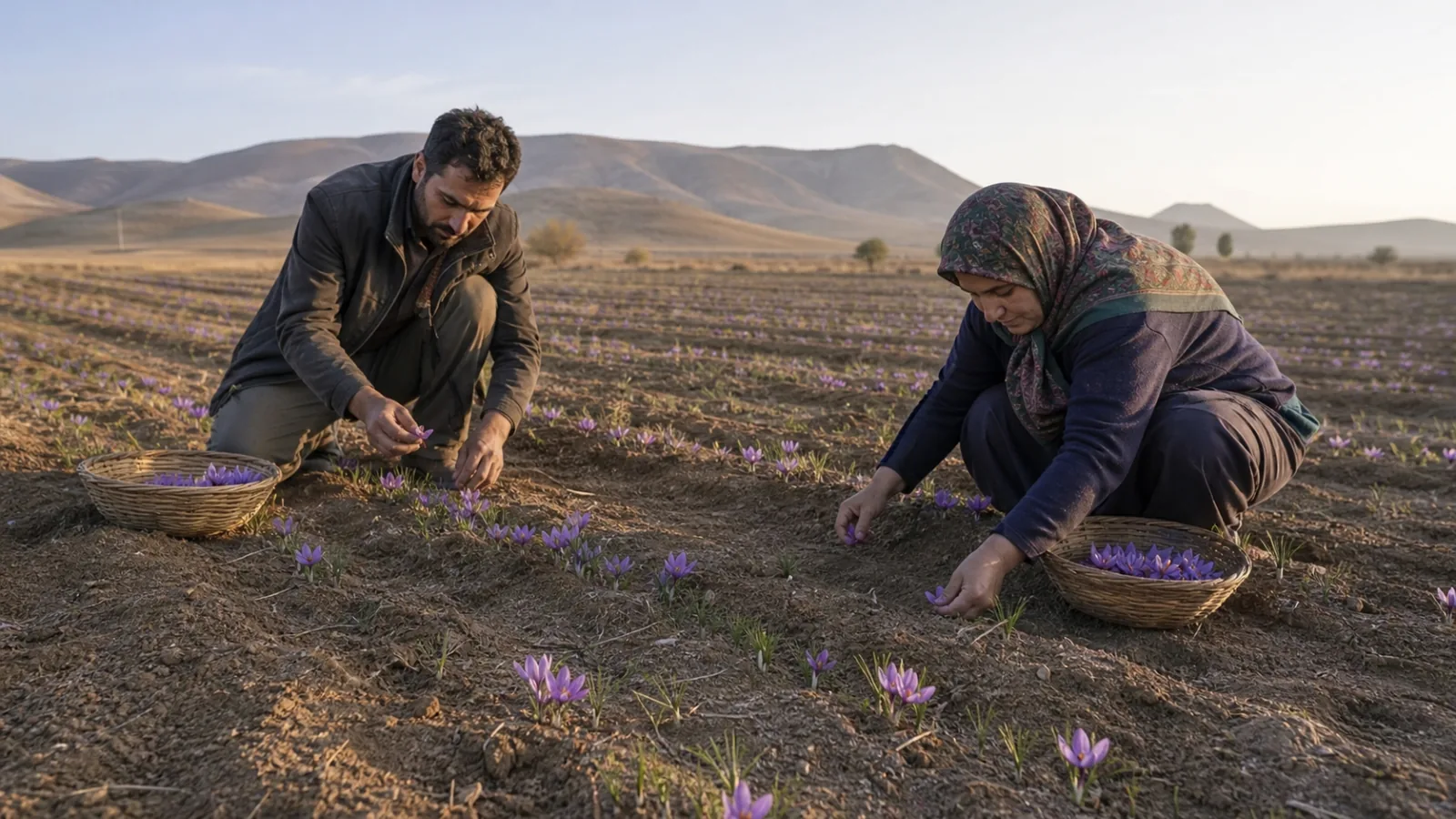
The 2019 Zarandiyeh saffron figures
The report quoted Ahmad Gharibbeiglou, director of the Agricultural Jihad organisation in Zarandiyeh. His name appeared in several damaged English forms, including Qarabiglu and Qarab-e-Baglou; the account refers to the same official.
He said about 67,000 square metres of agricultural land had been planted with saffron. That is approximately 6.7 hectares. Because many of the fields were young, he put the average yield at about three kilograms per hectare.
The arithmetic is consistent: 6.7 hectares multiplied by 3 kg/ha gives approximately 20.1 kilograms. The article reported about 20 kilograms of “pure saffron” harvested that year. Here, the phrase is best read as the dried saffron product, not as proof of a laboratory purity result.
More than 18 farms in the county were said to have allocated land to saffron and to have created employment.
What the 50% increase does and does not establish
A 50% production increase requires a starting value and an ending value measured on the same basis. The article supplies neither the previous harvest nor a current total explicitly tied to the percentage.
If the reported 20 kilograms represented a 50% rise, the implied earlier figure would be about 13.3 kilograms. That is only reverse arithmetic. It is not a value published in the source and should not be presented as Zarandiyeh’s confirmed previous harvest.
The report also expected more land to be assigned to saffron during the current year. That was a local forecast at the time, not evidence of later area or output.
Average saffron yield in Iran, in kilograms per hectare
A search for average saffron yield Iran kg per hectare can produce figures from fields at very different stages. Zarandiyeh’s 3 kg/ha estimate was explicitly connected to the young age of its farms. It should not be turned into a permanent county average or a national benchmark.
Useful yield reporting states the hectares actually harvested, dry saffron weight, field age, crop year, corm density and product form. A newly established field may flower differently from a mature stand, while an ageing or crowded field may decline.
Our saffron production statistics guide explains why planted area, productive area, forecast output and final dry yield should not be mixed.
Why farmers were interested in saffron
Gharibbeiglou attributed the expansion to greater farmer awareness, extension work by Agricultural Jihad specialists and saffron’s comparatively modest water requirements. Zarandiyeh faced limited water resources, so local planners were looking at crop choices that could combine water constraints with farm income.
Saffron can fit some dry-region systems, but it does not need zero water. Establishment, autumn growth and later leaf development depend on moisture. Drainage, irrigation timing, soil and local weather all affect the field.
A crop-pattern decision should compare irrigation volume, pumping costs, labour, establishment expense and saleable yield against the specific crop being replaced. “Low water” is a starting question, not a complete business case.
The 50-million-toman income estimate
The report said experts estimated an average net income of 50 million tomans per hectare. It did not give the saffron price, yield, corm cost, labour cost or accounting period used in that calculation.
For that reason, the amount belongs to the economics of the report’s period. It is not a current income promise. A farm budget should use expected saleable kilograms multiplied by the price the grower can realistically receive, then subtract corms, land preparation, irrigation, weeding, flower picking, stigma separation, drying, testing, packing and finance.
Labour deserves special attention. The value per kilogram is high partly because thousands of flowers must be collected and processed promptly. A farmer may have a suitable field yet lack enough people during the short harvest window.
How saffron fits the farming calendar
Gharibbeiglou said saffron planting and harvesting did not conflict heavily with other agricultural operations in timing. The crop’s autumn flowering can complement some local schedules, but the fit has to be checked for each farm.
Flower collection and stigma separation are not flexible jobs. If they overlap with another urgent crop, livestock work or limited household labour, the apparent calendar advantage can disappear. Development plans should map labour by week, not only by season.
Quality and export readiness are different claims
The report described Zarandiyeh saffron as highly desirable and suitable for export. Origin and appearance alone do not establish export readiness. The finished lot needs consistent handling, traceability, an agreed specification and compliance with the intended market.
ISO 21983:2019 covers harvesting, flower transport, stigma separation, drying and storage before packing. ISO 3632-1:2025 specifies requirements for dried saffron in filament, cut-filament and powder forms.
Growers should keep lots identifiable by field and harvest period. That lets a buyer’s test result improve the next crop instead of becoming an isolated certificate with no route back to the farm.
How to measure whether saffron remains a successful alternative
The report called saffron a successful economic alternative for Zarandiyeh’s crop pattern. A later assessment would need more than an area increase. It should track productive hectares, dry yield by field age, irrigation, labour hours, tested lot quality, farmer selling price and net return.
The 2019 numbers form a useful baseline: about 6.7 hectares, 3 kg/ha, 20 kilograms and more than 18 participating farms. They support each other. The headline’s 50% increase and 50-million-toman income estimate need additional underlying data before either can be treated as a verified performance measure.

![Exporting Saffron to Turkey + Price Guide [Complete 0 to 100]](https://img.rowhanisaffron.com/20260827003933/saffron-export-turkey-quality-inspection.webp)



