


In the past saffron was cultivated in Lorestan, according to a historical account given by Rasool Darvishian of the province’s Agricultural and Natural Resources Research Center. He said cultivation later stopped for reasons that were not established, prompting local adaptation trials before farmers began growing the crop again.
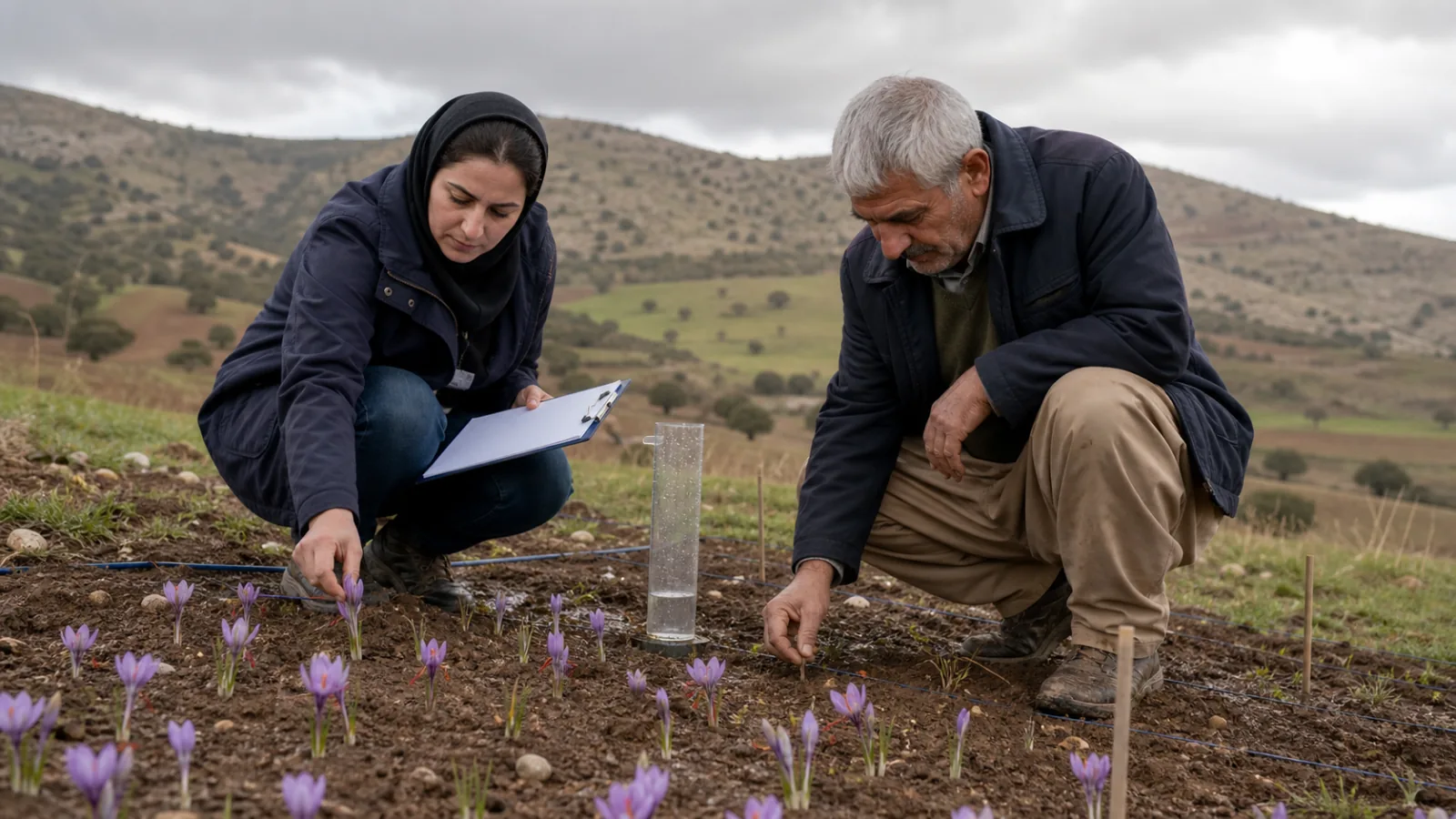
The account is useful as a record of that programme, but it leaves important gaps: it does not identify the historical sources, trial sites, plot sizes or measured yield and quality results. Its dates, botanical wording and financial example also need careful interpretation.
What the Lorestan research programme reported
Darvishian said the provincial research centre began saffron research and adaptation projects in the Iranian year 1375, approximately 1996–97 in the Gregorian calendar. He described the trial results as satisfactory for performance and quality and said cultivation then moved into farmers’ fields.
The report also referred to work in the Iranian year 1389, approximately 2010–11, on rainfed saffron in lower-elevation areas. It said the method appeared possible in Lorestan and that yield and quality did not differ when sufficient autumn rainfall occurred.
That last condition is decisive. “Rainfed” does not mean rainfall amount and timing are unimportant, and a result from one season or site cannot be extended to every field in the province.
The botanical name needed correction
The original translated text called saffron “Crocus officinalis,” referred to “Crocusus,” and described six genera and more than 1,500 species in its family. Those statements combine transcription and classification errors.
The accepted name for cultivated saffron is Crocus sativus L., in the iris family, Iridaceae. Kew’s Plants of the World Online record for Crocus sativus lists Crocus officinalis as a synonym, not a separate accepted crop species. “Crocusus” is not the genus name; the genus is Crocus.
Many Crocus species are valued as ornamental flowers, and wild crocuses can resemble the cultivated plant. That does not make every crocus a source of culinary saffron. Commercial saffron comes from the dried red stigmas of Crocus sativus, so identification matters before corms are planted or plant material is sold.
What makes a Lorestan field suitable
A successful adaptation trial asks more than whether flowers appeared. Site selection should consider drainage, soil texture and salinity, winter cold, summer dormancy, autumn temperature, rainfall distribution, access to supplementary water and the health and density of planted corms.
Results should be recorded over several seasons because saffron is a perennial crop and its output changes as daughter corms multiply and the stand ages. Useful measurements include:
- flower count and dry stigma yield per measured area;
- the date and amount of rainfall and irrigation;
- corm survival, multiplication and disease losses;
- drying conditions and final moisture;
- colouring strength, aroma and bitterness measured from representative lots;
- labour, planting material and post-harvest costs.
Without that record, “satisfactory” remains an expert’s summary rather than a result another farmer can reproduce.
Rainfed saffron remains rainfall-dependent
Lorestan’s historical trial was reported to perform comparably when autumn rainfall arrived. That is narrower than saying saffron can always be grown without irrigation.
A more recent semi-arid Iranian study of rainfed saffron and pre-flowering irrigation found large differences between low- and higher-rainfall seasons and reported a substantial yield penalty when pre-flowering irrigation was omitted. Its site and planting treatments are not a substitute for Lorestan trials, but they reinforce the need to measure rainfall rather than assume it.
For a farmer, the practical question is whether usable soil moisture is present at the stages that drive flowering and later corm growth. A contingency source of water may still be necessary in a dry autumn, even where post-flowering growth normally relies on rainfall.
How to read the seven-year income example
Darvishian’s account said revenue rises gradually across a seven-year cycle and used 50 kilograms of dry saffron at 5 million tomans per kilogram as an illustration. The multiplication gives 250 million tomans in gross sales over the period.
The translated text does not clearly state the land area behind the 50-kilogram total. It therefore cannot be treated as a per-hectare forecast. The quoted saffron price is also historical, not a current market value.
The report estimated cultivation costs at 20% of income. Applying that percentage to the example would leave 200 million tomans before any unlisted expense, tax, finance cost or loss, but this is only arithmetic based on the report’s assumptions. A current budget needs today’s corm, labour, water, drying, packaging, testing and sales costs, plus yield by year rather than a seven-year total alone.
From adaptation trial to a dependable farm plan
The Lorestan programme’s most useful message is that local testing came before wider farm adoption. A grower considering the same route should begin with a manageable plot, keep one comparison area, record water and labour, test dry saffron and review results across more than one weather year.
Our guide to saffron cultivation explains the corm, soil, planting and harvest choices that should be adapted to local conditions.
The claim that saffron had an earlier history in Lorestan remains attributed to Darvishian because the underlying historical references were not included in the article. What the report documents more clearly is the province’s later research effort: adaptation work from about 1996–97, farm adoption after favourable trials and a conditional experiment with rainfed cultivation around 2010–11.

![Exporting Saffron to Turkey + Price Guide [Complete 0 to 100]](https://img.rowhanisaffron.com/20260827003933/saffron-export-turkey-quality-inspection.webp)



