


Harvesting saffron from 3 hectares of agricultural land in ShahinDezh was presented as the beginning of a local diversification project, not as a completed production result. The historical report said three hectares were due to be cultivated and projected an average yield of 3 kilograms per hectare. It also proposed local packaging as a way to turn a small crop into longer-lasting work.
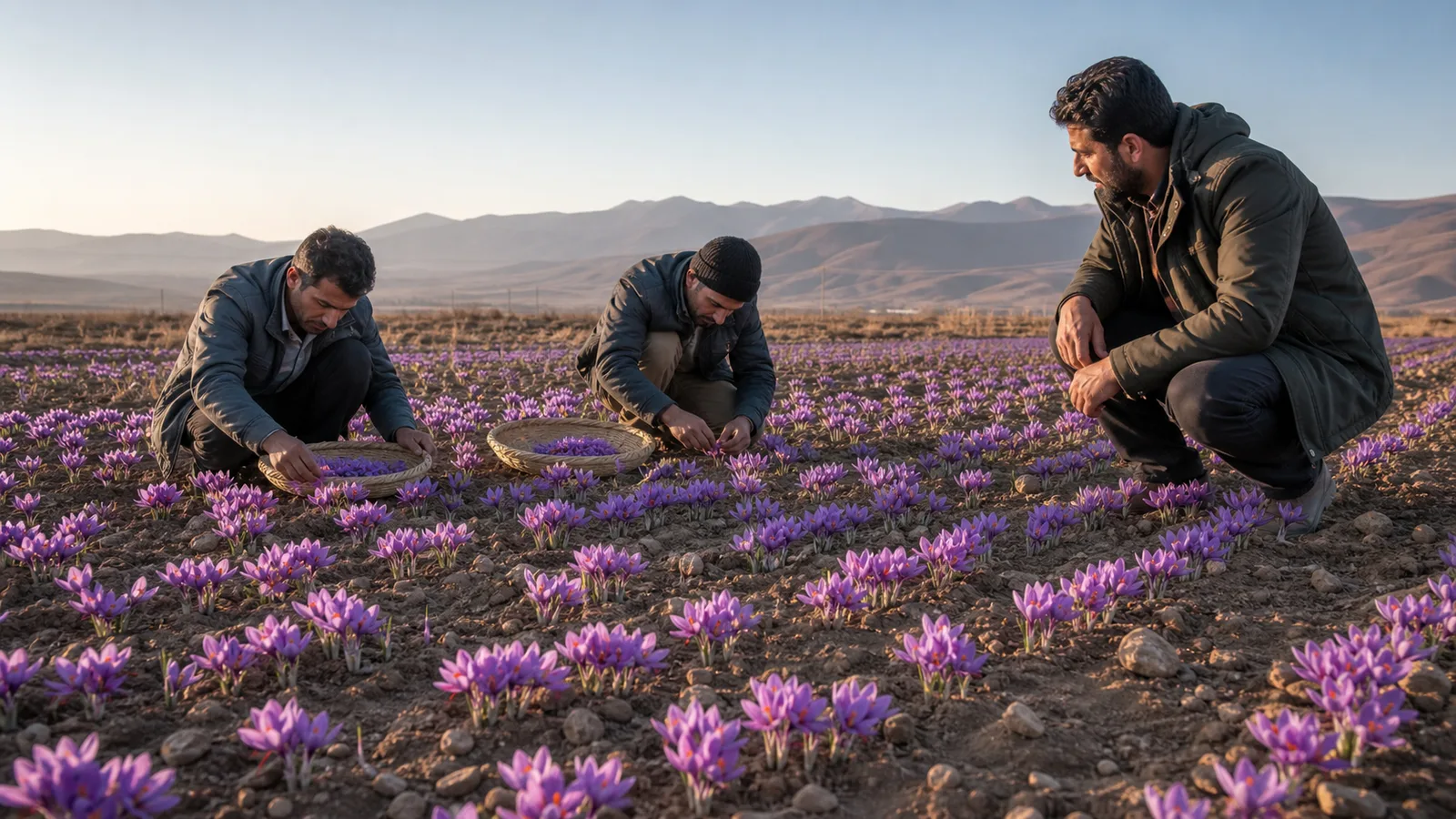
What was announced in Shahin Dezh
Saeed Khodaei, identified in the original article as the director of Shahin Dezh Agricultural Jihad, said saffron cultivation had begun in the county. The translated statement referred to “Shahin Farah lands,” wording that may reflect an imperfect transliteration. It is retained here as part of the source record rather than replaced with an unverified locality.
The central figure was three hectares of land. The report paired that area with an expected average yield of 3 kilograms of dried saffron per hectare. Simple arithmetic gives a possible total of about 9 kilograms if all three hectares were harvested and achieved the projection. That is not the same as a recorded harvest: the old article did not publish measured dry weight, grade or the area that actually flowered.
Expected yield is not harvested yield
A per-hectare target is useful for planning, but it can move considerably from one season to the next. Saffron yield is influenced by corm size and health, planting density, field age, soil condition, temperature, irrigation timing, disease pressure, flower-picking speed and losses during stigma separation and drying.
The original 3-kilogram figure should therefore remain attached to its historical context. It did not guarantee that every ShahinDezh field would produce that amount, and it does not establish a current county average. A later assessment would need the harvested hectares and the final dry saffron weight from each field.
Why a three-hectare project can still matter
Three hectares is modest beside Iran’s established saffron regions, yet a small introduction can answer practical questions before growers expand. It can show whether local autumn temperatures trigger flowering reliably, whether soils drain well, how much labour is available during the short harvest and whether the crop can be dried to a consistent standard.
This pilot-scale view is safer than assuming that a high-value spice automatically creates a high-profit farm. Saffron uses little land, but harvest and stigma separation are labour-intensive. Corm purchase, irrigation, weed control, drying equipment, packaging and rejected material all belong in the cost calculation.
What support from the agriculture office would need to cover
Khodaei said the Shahin Dezh agriculture office was ready to support cultivation. For that support to improve results, it would need to extend beyond distributing planting material. Useful work includes:
- testing soil texture, salinity, nutrients and drainage before planting;
- selecting sound, appropriately sized corms and documenting their source;
- planning irrigation around local weather and field conditions;
- monitoring corm rot, rodents, weeds and flower density;
- training pickers and stigma separators before the flowering rush; and
- measuring dry yield and quality consistently after harvest.
These records would let growers compare seasons and decide whether expansion is justified. Without them, an expected yield can become a promotional number rather than a management tool.
Why packaging was part of the plan
The report proposed packaging units as a route to production and employment in the region. That idea has merit only when processing protects the spice. Freshly separated stigmas require hygienic handling and controlled drying. The dried product then needs protection from moisture, strong light, contamination and misleading mixing.
Packaging alone does not add value if the saffron inside is poorly dried or cannot be traced. A sensible small-scale unit would document the grower, harvest date, lot, dry weight and quality checks, use food-contact materials and avoid claims that are not supported by the product or the law of the destination market.
What the old health-claim list does—and does not—show
The brief source ended with a sweeping list: it called saffron relaxing and antispasmodic, described it as a memory enhancer and appetite aid, said it reduces blood pressure, and claimed it prevents heart disease and cancer. The article supplied no study, population, dose, preparation or safety information for those statements.
Those phrases are preserved here so the meaning that previously appeared on the page is not silently lost, but they are not presented as established outcomes. A local cultivation announcement cannot show that saffron prevents cancer or heart disease, and ordinary culinary use should not be offered as treatment for high blood pressure, memory problems or any other medical condition.
Saffron compounds are studied in laboratories and clinical trials, but a research finding is not permission to generalise across diseases, doses and people. Readers with symptoms or prescribed treatment should use medical care rather than replacing it with saffron. This is especially important for concentrated products, which are different from the small amount used to flavour food.
How the original claims should be tested
If Shahin Dezh wants to judge the project on evidence, the next report should publish the planted and harvested areas separately, measured dry yield, flowering dates, corm survival, water use, labour days, quality grade and farm-gate price. Costs should be reported alongside revenue.
The packaging proposal also needs its own measures: the number of operating days, lots processed, quality failures, saleable weight and whether growers received a better net return after fees. Employment should distinguish temporary harvest work from permanent processing or sales positions.
A careful reading of the three-hectare milestone
The ShahinDezh announcement matters as a record of a new local planting and an intention to support farmers. It does not prove that 9 kilograms were harvested, that a packaging unit opened or that cultivation remained at three hectares. It also does not validate the medical claims attached to the story.
Its strongest practical idea is the link between field production and responsible post-harvest work. If local records eventually show healthy fields, repeatable dry yield, sound quality and a viable market, then a three-hectare trial can become a useful foundation. Until those data exist, the figures should remain what they were: a historical area and yield expectation.
Sources
The three-hectare area, 3-kilogram-per-hectare expectation, official’s name, support proposal, packaging idea and health-claim list come from the historical statement preserved in the original post. Agronomic context was checked against the Iranian Agricultural News Agency’s review of saffron elevation, temperature and nutrition. The distinction between research and proven cancer prevention follows the US National Cancer Institute’s cancer-prevention overview.

![Exporting Saffron to Turkey + Price Guide [Complete 0 to 100]](https://img.rowhanisaffron.com/20260827003933/saffron-export-turkey-quality-inspection.webp)



