


Harvesting 40 kg of saffron in Nahavand Iran was the result reported from seven bearing hectares in a historical season. Hossein Kheradmand, then head of Agriculture Jihad in Nahavand, put the rounded average at 6 kilograms of dried saffron per hectare.
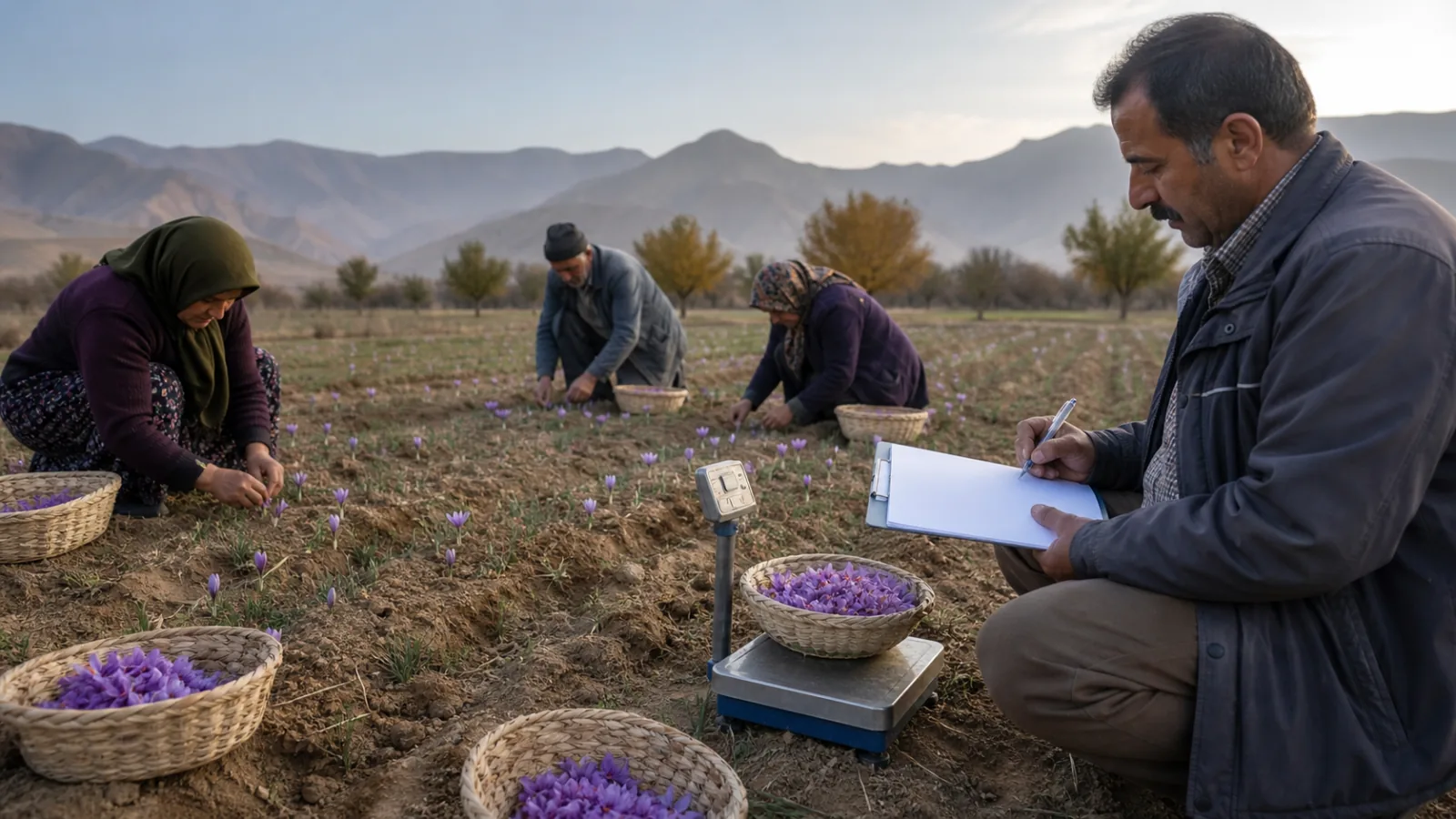
The figures are reasonably consistent: 40 kilograms divided by 7 hectares is about 5.7 kilograms per hectare. The article records what the local official announced at the time; it is not a current Nahavand production report.
How much saffron land was reported in Nahavand?
Kheradmand said more than 26 growers or operators were involved in saffron cultivation and harvest. He placed the total area in Nahavand and its villages at about 11 hectares, of which roughly 7 hectares were bearing and producing a crop.
That distinction explains why the 40-kilogram total should be divided by 7 rather than 11 hectares. Newly planted land may be counted as cultivated before it contributes a normal harvest, and older stands may also fall out of production.
A complete area record would separate planted, irrigated, flowering and harvested hectares. “Under cultivation” alone does not show how much land contributed to the season’s dry weight.
The 40-kilogram harvest arithmetic
The historical statement described 40 kilograms collected from the seven fertile hectares in November. At 5.7 kilograms per bearing hectare, rounding to a “relative yield” of 6 kilograms is understandable.
Yield still varies from field to field. Stand age, corm density and health, autumn temperature, irrigation timing, soil drainage, flower-picking speed and drying losses can all change the amount of saleable dry saffron.
To verify the county total, each lot would need a field identifier, harvest date, final dry weight and moisture-controlled storage record. Fresh flower weight cannot be added directly to dried stigma weight.
Planting and harvest calendar
Kheradmand described Nahavand as suitable for planting saffron corms from the beginning of summer. He placed the flowering and harvest period from late October through November and into early December.
Those are regional planning windows rather than fixed dates. Flowering shifts with temperature, moisture, planting date, elevation and corm condition. A grower needs a picking and stigma-separation team ready before the first buds appear, not only on the forecast peak date.
Our practical guide to saffron cultivation covers the field preparation, corm, irrigation and harvest decisions behind that calendar.
What the reported price would imply
The translated statement gave a minimum value of 10 million and 390 thousand tomans per kilogram. Read as 10.39 million tomans/kg, multiplying it by 40 kilograms gives a gross crop value of about 415.6 million tomans.
That calculation does not prove the price every grower received. The report does not identify the grade, transaction date, buyer, payment terms or whether the figure was farm-gate, retail or a forecast. It also says nothing about corm, water, labour, drying, packaging or sales costs.
The amount is historical and should never be used as a current saffron price.
Where the crop was sold
Kheradmand said Nahavand ranked second within Hamadan province for saffron production and cultivated area. He described local sales to travellers and tourists, with distribution to neighbouring cities as another route.
Small direct sales can retain local identity, but the label still needs the producer or packer, net weight, lot identification, storage instructions and any legally required information. A traveller buying a souvenir pack should receive the same traceability as any other customer.
The employment claim needs a denominator and timeframe
The official attributed two permanent jobs to each hectare of saffron. Applied mechanically to 11 cultivated hectares, that would mean 22 permanent jobs; applied to 7 bearing hectares, it would mean 14. The article does not say which area basis was intended.
Saffron also creates a sharp seasonal labour peak for picking flowers and separating stigmas. Counting a few weeks of work as a full permanent job would overstate the result. A reliable employment measure should report full-time-equivalent hours, seasonal workers, family labour, paid roles and the period covered.
How Nahavand compared with the provincial forecast
The same report said 156 hectares in Hamadan province were under saffron and forecast more than 400 kilograms from those farms. Four hundred kilograms divided by 156 hectares is about 2.6 kilograms per hectare—well below Nahavand’s rounded 6-kilogram figure.
That difference is not necessarily a contradiction. The provincial area may have included young or non-bearing fields, and “more than 400” is an open-ended forecast rather than a final measured total. The source does not provide enough detail to make a valid productivity ranking.
Nahavand’s reported second-place position and the provincial forecast should both remain attributed until dated official area and dry-weight records are available.
One planting can flower for several years
The final translated line referred to “one-year cultivation and 7-year-old flowering.” In context, this means a one-time establishment that can produce flowers across a cycle of roughly seven years—not planting a new crop every year.
That does not mean output stays level for seven years. Daughter corms multiply, crowding increases and disease or declining corm size can reduce performance. The timing of lifting and replanting should follow field measurements rather than the calendar alone.
The report also listed relatively low water demand, high crop value and suitable land among saffron’s advantages in Hamadan. Each is conditional: water use must be measured, value depends on saleable grade and price, and land still needs appropriate drainage, soil and climate.
What would confirm the result today?
A current update should publish planted and bearing hectares separately, the number of active growers, total verified dry weight, yield distribution, lot-test results, water use, realised prices and labour hours. It should also state whether provincial numbers are forecasts or final outcomes.
The historical 40-kilogram figure remains useful when its boundaries stay intact. It describes seven bearing hectares in one reported season, not all 11 cultivated hectares, not every year and not a guaranteed yield for a new Nahavand field.

![Exporting Saffron to Turkey + Price Guide [Complete 0 to 100]](https://img.rowhanisaffron.com/20260827003933/saffron-export-turkey-quality-inspection.webp)



